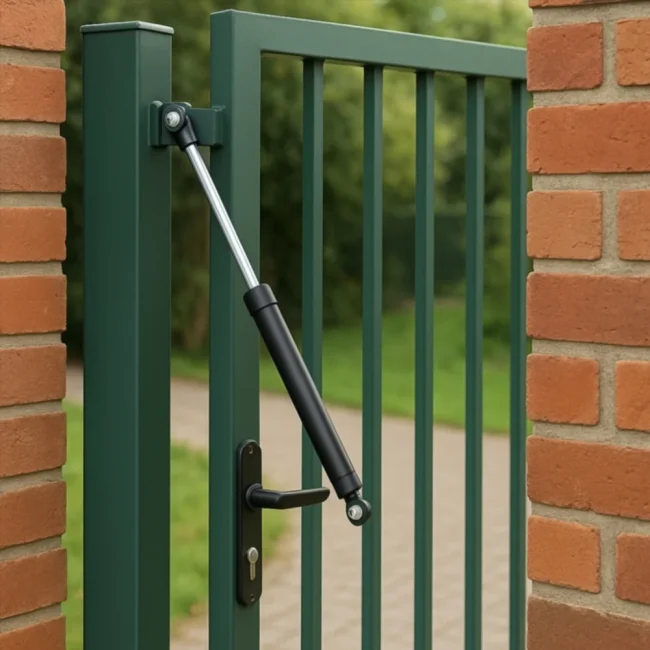
A gate damper is an essential hardware component, ensuring smooth closing, protection from sudden impacts, and extending the lifespan of the structure. It is especially important in situations where the gate is heavily used: in private homes, summer cottages, co-ops, and at the entrances to public and industrial areas. In this article, we'll explore in detail what a gate damper is, the different types available, how to choose, install, and maintain one, and also discuss common mistakes to avoid.
- What is a shock absorber and why is it needed?
- Where are shock absorbers used?
- Types of shock absorbers for gates
- Gas shock absorbers
- Hydraulic closers (hydraulic shock absorbers)
- Spring shock absorbers
- How to choose a shock absorber for a gate?
- Weight of the sash
- Frequency of use
- terms of Use
- Speed control
- Installation method
- Installing a shock absorber yourself
- Preparation:
- Installation process:
- Maintenance and care
- Common installation errors
- Popular manufacturers
- Alternatives and additional solutions
- Conclusion
What is a shock absorber and why is it needed?
A gate damper is a device designed to dampen vibrations caused by the gate's movement when opening or closing. It most often takes the form of a cylinder with a piston inside, filled with oil or air. Depending on the design, it can be gas-powered, hydraulic, or mechanical.
The main functions of the shock absorber:
- Ensures smooth closing of the gate without slamming.
- Prevents premature wear of hinges and lock.
- Reduces noise levels during operation.
- Increases safety by eliminating the possibility of injury when the door slams shut.
- Improves performance in windy conditions.
Where are shock absorbers used?
Shock absorbers are used in various types of gates:
- Private plots and summer cottages.Provides silence and comfort during use.
- Apartment buildings.They reduce noise in entrances and extend the life of metal doors.
- Production facilities and warehouses.Improves personnel safety.
- Fencing with access control.They work in conjunction with door closers and electromagnetic locks.
Types of shock absorbers for gates
There are several types of devices, differing in design and operating principle. Let's look at the main ones:
Gas shock absorbers
They contain compressed gas (usually nitrogen), ensuring smooth and controlled operation. They are often used in the automotive and furniture industries, but are also used for gates, especially lightweight ones.
Pros:
- Compactness.
- Quiet operation.
- Easy to install.
Cons:
- Limited resource.
- Sensitivity to temperature changes.
Hydraulic closers (hydraulic shock absorbers)
They use a viscous fluid inside the cylinder. They are characterized by high reliability and precise adjustment.
Pros:
- Durability.
- Smooth and adjustable closure.
- Suitable for heavy sashes.
Cons:
- Higher cost.
- Difficulty in installation and adjustment.
Spring shock absorbers
The simplest mechanisms rely on spring compression. They are the least efficient in terms of smoothness, but are inexpensive and durable.
Pros:
- Affordable price.
- Easy to install.
Cons:
- There is no smooth closing - the gate may "slam".
- High probability of wear and tear over time.
How to choose a shock absorber for a gate?
When choosing a shock absorber, there are several factors to consider:
Weight of the sash
Heavy metal gates require powerful hydraulic systems. Lightweight wooden or aluminum gates can be supported by gas or spring shock absorbers.
Frequency of use
If the gate is opened dozens of times a day (for example, at a store or warehouse), choose durable professional models.
terms of Use
For outdoor use, devices with protection against moisture and dust, and resistance to frost and temperature changes are suitable.
Speed control
The adjustable screw is a huge advantage. It allows you to customize the closing speed to your needs.
Installation method
Some models can be mounted using universal brackets without drilling metal. This is convenient if you don't want to damage the structure.
Installing a shock absorber yourself
Many models come with mounting hardware and instructions. However, when installing them yourself, it's important to follow these basic steps:
Preparation:
- Check the complete set: shock absorber, brackets, screws, instructions.
- Determine the installation side (internal or external).
- Prepare the tools: screwdriver, tape measure, level, drill.
Installation process:
- Determine the attachment points.The upper part of the device is attached to the gate, the lower part to the support (post or wall).
- Mark the holes.Use a level for horizontal placement.
- Drill holes.If metal, use a metal drill bit.
- Install the brackets.Fix it securely with screws.
- Secure the shock absorber.Make sure that movement is not obstructed.
- Adjust the closing speed (if adjustable).
Important: The device should operate without jamming or making any unusual noise. If the sash closes too quickly, reduce the pressure or change the mounting point.
Maintenance and care
Shock absorbers do not require complex maintenance, but periodic inspection will extend their service life:
- Inspect the fasteners- there should be no play.
- Check for leaks- if there is an oil leak, the shock absorber loses its effectiveness.
- Lubricate moving parts- Apply a drop of machine oil once a year.
- Corrosion protection— especially relevant for external gates. The coating must be anti-corrosive.
Common installation errors
- Incorrect choice of model.A shock absorber that is too weak will not cope with the load, while one that is too powerful will create unnecessary resistance.
- Incorrect installation angle.The shock absorber must operate in a straight plane, without distortion.
- Ignoring weather conditions.A device without protection will quickly fail in frost or rain.
- Lack of adjustment.If the popping sounds are constant, it is better to change to an adjustable model.
Popular manufacturers
You can find both domestic and foreign brands on the market:
- Dorma— are known for their reliable door and gate closers.
- Geze- German quality with good adjustment.
- Apecs, CISA, Palladium— produce affordable solutions.
- Locinox— professional systems for external wickets and gates.
Alternatives and additional solutions
- Hinges with a closer.Integrated mechanism into the loop itself.
- Electromagnetic closer.Can work in conjunction with access control systems.
- Magnets-fixers.They hold the gate in an open or closed position, complementing the shock absorber.
Conclusion
A gate damper isn't just a convenience; it's an essential element of safety, durability, and comfort. By choosing the right type and installing it correctly, you'll eliminate slamming sounds, extend the life of your hinges and lock, and protect others from injury. Investing in a quality damper pays off not only in reliability but also in peace of mind in your daily life.