A stable power supply is a fundamental component of comfort and safety in the home. However, in reality, voltage in the grid doesn't always meet regulatory standards. Fluctuations, surges, and sags gradually damage household appliances and electronics. Many people only consider buying a voltage stabilizer for their home after expensive appliances break down, although signs of problems usually appear long before that.
Let's take a closer look at how to recognize the need to install a stabilizer and what signals you should pay attention to.
- Voltage standards and real conditions
- The main signs of unstable voltage
- Flickering light
- Frequent equipment breakdowns
- Spontaneous shutdown of devices
- Slow operation of electrical appliances
- Equipment overheating
- Triggering of circuit breakers and fuses
- In which houses is the problem most common?
- Private houses and cottages
- Old housing stock
- New areas with active development
- Why are power surges dangerous?
- Accelerated wear and tear of equipment
- Complete failure
- Fire hazard
- When a stabilizer is really necessary
- How to check network status
- Measuring with a multimeter
- Using a voltage monitoring relay
- Observing the behavior of equipment
- Why it is important not to delay the decision
- Results
Voltage standards and real conditions
The standard voltage in a household network is 220–230 V. Deviations of approximately ±10% are considered acceptable. This means the normal range is from 198 to 253 V. Anything outside these limits will affect the operation of the equipment.
In practice, much more serious deviations are encountered in private homes and even apartments:
- drop to 150–170 V;
- surges above 260–280 V;
- sharp short-term impulses.
Such conditions create increased stress on electrical appliances and accelerate their wear.
The main signs of unstable voltage
Flickering light
If the lamps start to dim periodically or, conversely, shine brighter than usual, this is one of the first signs. This is especially noticeable when turning on powerful appliances such as a kettle, water heater, or washing machine.
Constant flickering indicates that the voltage is “wandering” in the network.
Frequent equipment breakdowns
Regular failure:
- power supplies,
- televisions,
- refrigerators,
- washing machines,
may not be related to the quality of the equipment itself, but to an unstable power supply.
Modern electronics with microprocessors and sensitive components are especially vulnerable.
Spontaneous shutdown of devices
Some devices have built-in protection. They shut down if voltage fluctuates significantly:
- heating boilers,
- gas water heaters with automatic control,
- computers,
- air conditioners.
If such outages occur for no apparent reason, the problem often lies in the network.
Slow operation of electrical appliances
At low voltage the equipment works worse:
- the kettle takes longer to boil water;
- the microwave heats up slowly;
- pumps lose performance;
- Refrigerator compressors are overloaded.
This is not only inconvenient, but also dangerous for the equipment.
Equipment overheating
If your devices start to get hotter than usual, it could be due to an unstable power supply. This is especially true for:
- electric motors,
- compressors,
- transformers.
Long-term operation in such conditions reduces the service life of the equipment.
Triggering of circuit breakers and fuses
Intermittent tripping of circuit breakers may indicate power surges. While this is most often associated with overload, an unstable power grid can also cause such situations.
In which houses is the problem most common?
Uneven stress isn't a characteristic of all objects. Some categories pose a higher risk.
Private houses and cottages
- distance from the substation;
- worn-out power lines;
- high network load in the evening.
In rural areas, fluctuations are common.
Old housing stock
In houses with outdated electrical wiring the following may occur:
- voltage sags;
- overheating of cables;
- unstable load distribution.
New areas with active development
When infrastructure fails to keep up with the growth of consumption, the following arise:
- overloads;
- temporary voltage drops;
- uneven phase distribution.
Why are power surges dangerous?
Accelerated wear and tear of equipment
Even if devices don't break down immediately, their lifespan is reduced. This applies to:
- refrigerators,
- washing machines,
- televisions,
- computers.
Complete failure
A strong surge can instantly damage electronics. Particularly sensitive are:
- control boards;
- power supplies;
- microcircuits.
Fire hazard
In case of critical deviations, overheating of wiring and equipment is possible, which increases the risk of fire.
When a stabilizer is really necessary
There are situations in which installation becomes practically mandatory:
- voltage regularly exceeds normal limits;
- equipment often breaks down for no apparent reason;
- the lighting is unstable;
- there is sensitive equipment (boilers, servers, smart home systems);
- The house is located in an area with unstable power supply.
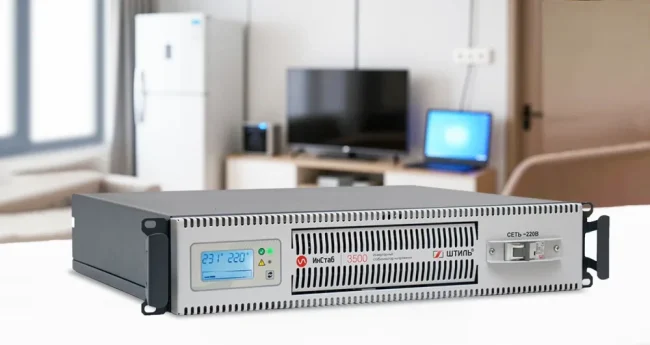
In such conditions, a 220V voltage stabilizer for the home becomes not just an additional device, but an element of protection for the entire electrical system.
How to check network status
Before making a decision, it is useful to conduct a simple diagnosis.
Measuring with a multimeter
Taking measurements at different times of the day will help you see the real picture:
- in the morning,
- during the day,
- in the evening (peak load).
Using a voltage monitoring relay
These devices record minimum and maximum values, showing how much the voltage changes.
Observing the behavior of equipment
Even without instruments, one can draw conclusions based on indirect signs:
- changes in light brightness;
- unstable operation of devices;
- frequent reboots.
Why it is important not to delay the decision
Ignoring the problem leads to accumulation of consequences:
- gradual failure of equipment;
- increase in repair costs;
- risk of emergency situations.
The cost of a stabilizer is often significantly lower than the amount that would have to be spent on replacing damaged equipment.
Results
You can tell your home needs a voltage stabilizer by a number of obvious signs: unstable lighting, malfunctioning appliances, frequent breakdowns, and overheating. This problem is especially acute for single-family homes, older buildings, and areas with overloaded grids.
Timely installation of the stabilizer allows you to:
- protect household appliances;
- extend the service life of equipment;
- ensure safe and stable operation of the entire electrical system.
Paying close attention to the signals your electrical grid sends can help you avoid significant costs and maintain comfort in your home.