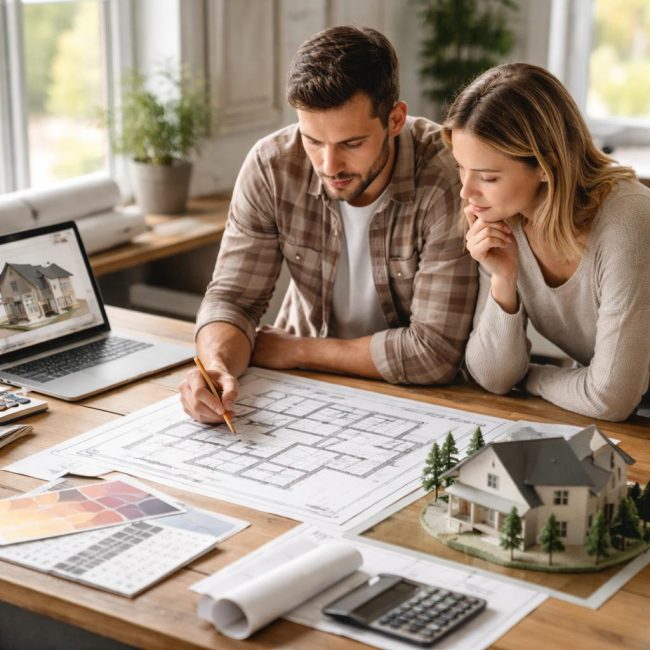
Choosing a private home design rarely begins with drawings, but rather with an idea of what the living space should look like. Some focus on the number of rooms, others on the number of floors, or the appearance of the façade. However, it's more convenient to immediately look at actual layouts and solutions to understand how certain parameters impact everyday comfort. When studying foam block house designs from developers like [unclear text], you can see how the spaces are distributed, where utility rooms are located, and how zoning is organized.
Next comes the fine-tuning process: the home must match not only your desires, but also the site conditions, your family's lifestyle, and your future plans. Below is a detailed breakdown of what you should really pay attention to.
- Family composition and living arrangements
- House area: how much is really needed?
- Number of storeys: one or two
- One-story house
- Two-story house
- Layout: spatial logic is more important than area
- The site and its features
- Facade and architectural style
- Engineering solutions and technical premises
- Budget and actual cost of implementation
- Project flexibility and the possibility of changes
- Common mistakes when choosing a project
- Result
Family composition and living arrangements
The first thing to consider when choosing a project is not the area or the number of floors, but real life scenarios.
It is important to answer several questions:
- how many people will live in the house permanently;
- Are you planning to add to your family?
- will there be overnight guests?
- Do you need a separate office or workshop?
- Is an isolated space required for elderly family members?
If the family is small (2-3 people), a compact house of up to 100-120 square meters is often sufficient. However, if you have children or plan to expand the family, it's best to allow for some extra space right away.
Typical mistake — focus only on current needs. A house is built to last for decades, and remodeling later is more expensive than choosing the right design from the start.
House area: how much is really needed?
Area is one of the key parameters, but it must be justified.
Approximate logic:
- up to 100 sq. m – a compact house for 2–3 people;
- 120–150 sq. m is a comfortable option for a family with children;
- 150–200 sq. m – spacious housing with plenty of space;
- More than 200 sq. m. - already a project with additional areas (guest rooms, office, dressing rooms, utility rooms).
It's important to consider not only the net square footage but also its distribution. Sometimes a 140-square-meter house can be more convenient than a 180-square-meter one, thanks to a well-thought-out layout.
Number of storeys: one or two
The choice between a one-story and a two-story house is one of the most controversial issues.
One-story house
Pros:
- ease of movement without stairs;
- safety for children and the elderly;
- easier to operate.
Cons:
- takes up more space on the site;
- requires a larger foundation and roof area.
Two-story house
Pros:
- saving of site space;
- clearer zoning (bedrooms upstairs, living room downstairs);
- compactness of development.
Cons:
- presence of stairs;
- more complex design and operation.
If the plot is small, a two-story house is often chosen. If space allows, a single-story house is often more convenient for everyday living.
Layout: spatial logic is more important than area
A well-designed layout makes a home comfortable, regardless of its size.
What to look for:
- division into day and night zones;
- the presence of a vestibule (important for the climate);
- the location of the kitchen and its connection with the living room;
- number of bathrooms (minimum one per floor);
- the presence of a storage room or dressing room;
- separate technical room.
It is especially important that:
- bedrooms were removed from noisy areas;
- the bathrooms were located next to the bedrooms;
- the kitchen had convenient access to the entrance (for bringing in food).
The site and its features
Even the ideal design may not be suitable if the characteristics of the site are not taken into account.
Key factors:
- size and shape of the site;
- relief (slope, elevation changes);
- soil type;
- groundwater level;
- location according to the cardinal points.
For example:
- on a narrow plot it is better to choose an elongated house;
- on a site with a slope - a project with a base or foundation adaptation;
- The orientation of windows affects illumination and energy consumption.
The project should always be adapted to the specific site, and not vice versa.
Facade and architectural style
The appearance of a house is not only aesthetics, but also practicality.
Popular options:
- classic style;
- modern minimalism;
- terraced houses;
- projects with an attic.
When choosing a facade, it is important to consider:
- climate;
- durability of materials;
- complexity of maintenance.
For example, complex architectural forms may look impressive, but require more construction and maintenance costs.
Engineering solutions and technical premises
This aspect is often underestimated at the project selection stage.
It is important to plan in advance:
- boiler room or utility room;
- storage space (pantry, wardrobe);
- communications wiring;
- ventilation.
The absence of such zones leads to the fact that equipment and household items begin to “eat up” living space.
Budget and actual cost of implementation
The project must meet not only the wishes, but also the budget.
The cost is influenced by:
- house area;
- complexity of architecture;
- foundation type;
- finishing;
- engineering systems.
It is important to take into account that:
- a simple house shape is cheaper to build;
- increasing the area directly increases costs;
- Complex roofs and facades significantly increase the cost of the project.
The smart approach is to choose a project that can be implemented without compromising quality.
Project flexibility and the possibility of changes
It rarely happens that the finished project completely meets expectations.
Good project:
- allows for adaptation to the site;
- allows you to change internal partitions;
- can be modified for specific tasks.
It is important that the changes do not violate the structural logic of the building.
Common mistakes when choosing a project
Some typical miscalculations:
- choosing a house “for growth” without real need;
- ignoring the site's features;
- focusing only on appearance;
- lack of technical facilities;
- underestimation of the budget.
These errors lead either to cost overruns or to operational inconvenience.
Result
Choosing a foam block house design isn't about looking for a "pretty picture," but rather a well-thought-out decision that takes into account your lifestyle, family composition, and the site's features. It's important to consider not only the area and appearance, but also the layout, engineering solutions, and actual construction conditions.
The more accurately the project meets your initial needs, the fewer adjustments, costs, and compromises there will be during construction and subsequent occupancy.