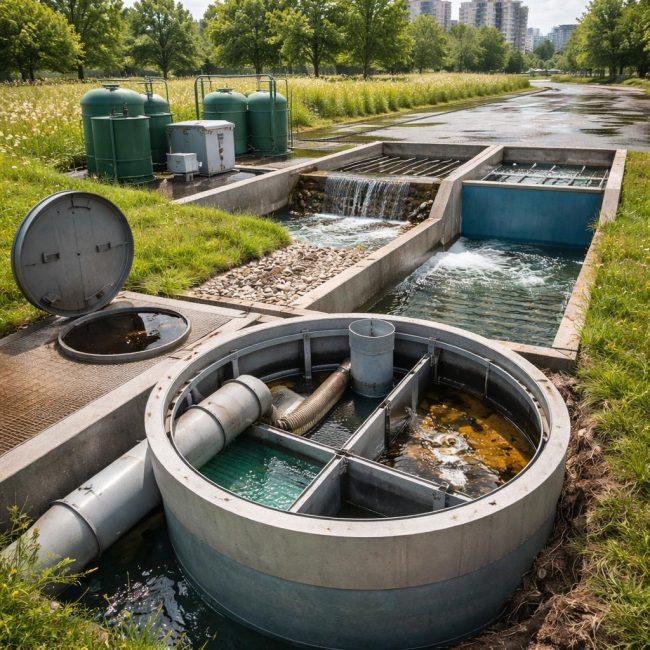
Rainwater and meltwater drainage systems play a vital role in the functioning of urban and industrial infrastructure. Rainfall on roads, parking lots, building roofs, and industrial sites collects contaminants such as sand, petroleum products, rubber particles, heavy metals, and household waste. If this water directly enters the soil or natural water bodies, it can cause serious environmental pollution. This is why stormwater treatment plants—specialized engineering systems designed to treat surface runoff before discharging it into water bodies or soil—are used.
These systems are used in cities, industrial plants, gas stations, warehouses, parking lots, logistics centers, and any areas where significant volumes of rain or melt water are generated.
- What are stormwater treatment plants?
- How a storm drain works
- Surface water collection
- Transportation of wastewater
- Wastewater treatment
- Construction of stormwater treatment facilities
- Sand trap
- Oil separator
- Sorption filter
- Features of choosing stormwater treatment facilities for specific tasks
- Catchment area
- Type of coverage
- Environmental requirements
- Installation conditions
- Operation and maintenance of systems
- The importance of stormwater treatment plants for ecology
What are stormwater treatment plants?
Stormwater treatment plants are engineering installations that purify surface wastewater from mechanical impurities, petroleum products, and other pollutants. The primary objective of these systems is to reduce pollutant concentrations to levels established by environmental standards.
Surface runoff differs from domestic and sanitary sewage. It is generated not inside buildings, but in open areas, so the composition of the pollutants is specific. Most often, it contains:
- sand and fine gravel;
- soil particles;
- fuel and oil residues;
- wear products of automobile tires;
- organic impurities;
- heavy metals.
Without preliminary treatment, these substances enter water bodies and degrade the ecosystem. This is why modern engineering solutions require the mandatory installation of stormwater treatment systems.
How a storm drain works
A storm sewer is a system for collecting and transporting rainwater. It consists of a network of channels, pipes, inlets, and manholes that transport the water to treatment facilities.
The operating principle of such a system can be conditionally divided into several stages.
Surface water collection
In the first stage, rainwater and meltwater are collected from the surface of the area. Special elements are used for this:
- rain gutters;
- linear drainage channels;
- water collection wells.
They are placed in areas with the greatest accumulation of water: along roads, near sidewalks, in parking lots and industrial sites.
Transportation of wastewater
After collection, the water is sent through pipelines to the treatment system. The pipes are laid at an angle, allowing the water to flow by gravity.
At this stage, additional elements can be included in the system - sand traps, which trap large mechanical particles and prevent clogging of pipes.
Wastewater treatment
The main stage of the system's operation is water purification. This is where specialized units are used to separate solid particles, petroleum products, and other impurities.
After purification, water can:
- dumped into natural water bodies;
- be directed into the drainage system;
- be used for technical purposes.
The efficiency of purification depends on the design of the equipment and the number of filtration stages.
Construction of stormwater treatment facilities
Modern purification systems consist of several modules operating in sequence. Each module performs its own function and removes a specific type of contaminant.
Sand trap
This is the first element of the system. Its purpose is to separate heavy mechanical particles such as sand, fine gravel, and soil.
The operating principle is based on gravitational sedimentation: when the flow velocity decreases, heavy particles settle to the bottom of the chamber.
Sand traps prevent large contaminants from entering subsequent system elements, thereby increasing their service life.
Oil separator
The next stage of purification is designed to remove petroleum products – gasoline, diesel fuel, oils.
The operation is based on the difference in density: oil products are lighter than water, so they float to the surface, where they are retained by special partitions or coalescence modules.
Such devices are especially important for areas with heavy traffic.
Sorption filter
The final stage involves filtration through sorption materials. These are capable of absorbing residual contaminants, including small particles of petroleum products and dissolved substances.
Activated carbon, special polymer materials or mineral granules are often used as a sorbent.
After passing this stage, the water reaches standard quality indicators.
Comprehensive treatment produces environmentally safe wastewater. This is how modern stormwater treatment plants operate, effectively protecting natural water bodies from pollution.
Features of choosing stormwater treatment facilities for specific tasks
The selection of a treatment system is always individualized. A number of factors, related to both the site's characteristics and regulatory requirements, influence the choice of equipment.
Catchment area
The larger the area from which water is collected, the greater the volume of wastewater. Consequently, higher-performance equipment is required.
For large facilities such as shopping centers, warehouse complexes, and industrial sites, high-capacity systems are used.
Type of coverage
Different types of coatings produce different contaminant compositions. For example:
- asphalt roads produce high levels of petroleum products;
- soil areas contain a large amount of sand and clay;
- The roofs of buildings often produce relatively clean runoff.
The number of purification stages and the configuration of the equipment depend on this.
Environmental requirements
In some cases, higher purification quality requirements are imposed. This is especially true for facilities located near natural bodies of water, recreational areas, or drinking water sources.
In such situations, multi-stage filtration systems with additional sorption modules are used.
Installation conditions
Another important factor is installation conditions. Treatment facilities can be located:
- underground;
- partially buried;
- in ground execution.
Underground tanks are most often made of fiberglass or polyethylene, which ensures high tightness and corrosion resistance.
Operation and maintenance of systems
For effective operation of wastewater treatment plants, regular maintenance is required. Key activities include:
- removal of accumulated sand from sand traps;
- collection of oil products from oil separators;
- replacement or regeneration of sorption materials;
- checking the tightness of tanks and pipelines.
The frequency of maintenance depends on the intensity of operation of the facility and the volume of incoming wastewater.
Timely maintenance helps maintain high cleaning efficiency and significantly extends the service life of the equipment.
The importance of stormwater treatment plants for ecology
The use of modern surface water treatment systems is of great environmental importance. They prevent pollutants from entering rivers, lakes, and soil, thereby preserving natural ecosystems.
In addition, such systems help to comply with environmental legislation and avoid fines for environmental pollution.
As cities grow and transportation infrastructure expands, the importance of stormwater treatment plants continues to grow. They are becoming an integral part of utility systems, ensuring the safe and environmentally responsible management of surface runoff.