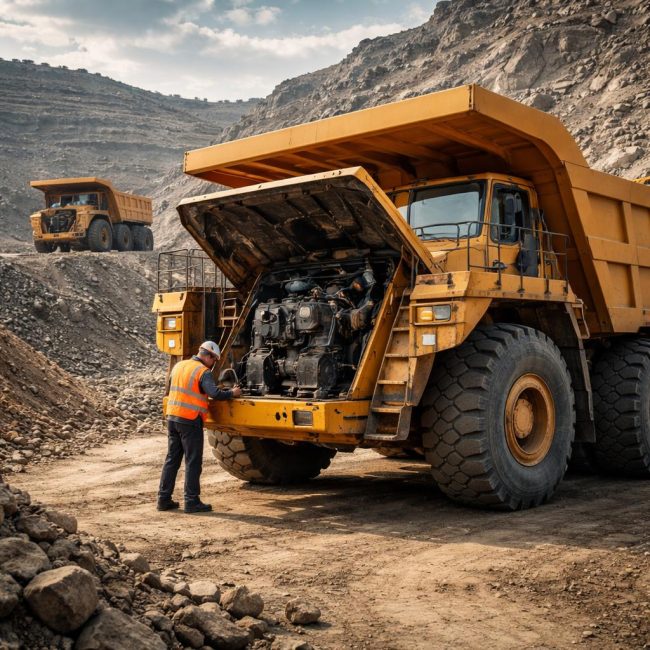
A mining dump truck is a specialized vehicle designed for continuous operation under heavy loads, on unprepared roads, and in intensive conditions. Unlike conventional dump trucks, these vehicles are designed from the ground up for mining: the frame is reinforced, the service life of components is increased, and a different chassis and body geometry is used.
When choosing, it's important to consider not only the nominal specifications but also the actual working environment. Even machines with the same lifting capacity can exhibit different efficiency depending on the design, layout, and balance of components. In the medium-sized mining machine segment, models with lifting capacities of approximately 60–100 tons are often considered, such as LGMG quarry dump truck, with a classic rigid frame and direct specialization for quarry transportation.
- Classification and compliance with tasks
- Up to 60–70 tons
- 70–120 tons
- Over 120 tons
- Frame and chassis design
- Important points:
- Engine and traction
- Main parameters:
- Transmission and power transmission
- Mechanical
- Hydromechanical
- Electromechanical
- Body: shape and wear
- Main types:
- What to look for:
- Suspension and load on nodes
- Used:
- Cross-country ability and stability
- Brake systems
- Important:
- Maintenance and service life
- Rated by:
- Exploitation Economy
- Main articles:
- Result
Classification and compliance with tasks
Quarry dump trucks are selected not based on the principle of "the bigger the better," but rather based on a specific mining technology.
Up to 60–70 tons
- used in limited spaces
- suitable for short hauls
- work with small and medium-class excavators
70–120 tons
- the most versatile segment
- optimal in terms of performance and cost ratio
- are used in most quarries
Over 120 tons
- require a wide technological road
- effective for large volumes and long routes
The main criterion is coordination with the loading equipment. If an excavator uses 6-8 buckets instead of 3-4, productivity drops sharply.
Frame and chassis design
The foundation of any quarry truck is the frame. It experiences constant impact and torsional loads.
Important points:
- box or reinforced welded construction
- calculation for overload
- resistance to fatigue cracks
The chassis is usually built according to the following scheme:
- front steering axle
- rear drive axle (or tandem)
This ensures stability and even distribution of the load.
Engine and traction
In quarry equipment, it is not the maximum speed that is important, but the traction force.
Main parameters:
- power: 400–800+ hp
- high torque at low revs
- resistance to overheating
The engine is running:
- in constant load mode
- with frequent acceleration-braking cycles
- at low speeds
Therefore, stability and resource are more important than peak performance.
Transmission and power transmission
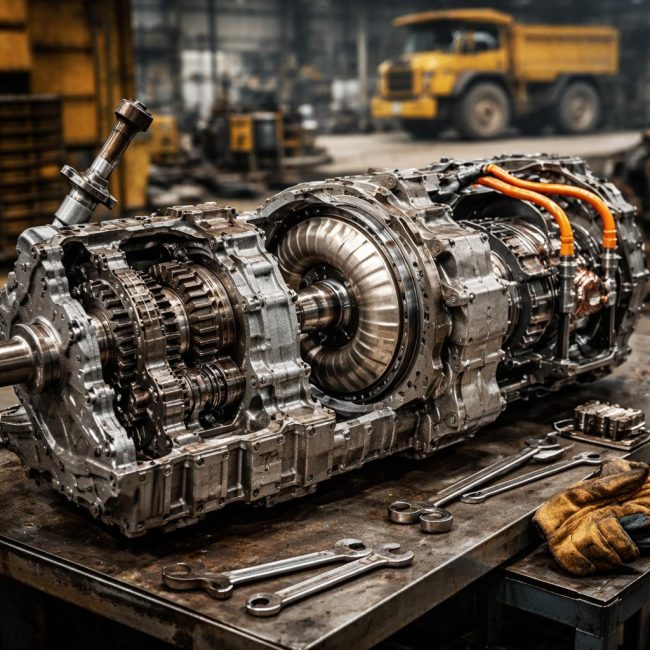
The type of transmission directly affects the car's performance.
Mechanical
- reliable
- easier to repair
- requires experience from the operator
Hydromechanical
- smooths out loads
- reduces wear
- increases work comfort
Electromechanical
- used on heavy dump trucks
- works better on long climbs
For most medium-sized quarries, hydromechanics is used as a compromise between reliability and convenience.
Body: shape and wear
The body determines not only the volume, but also the service life of the car.
Main types:
- rock - reinforced, for dense rocks
- volumetric - for light materials
What to look for:
- metal thickness
- presence of reinforcements
- bottom shape
V-shaped bodies:
- unload better
- reduce sticking
Flat:
- convenient for general-purpose work
Suspension and load on nodes
Quarry dump trucks experience extreme loads when driving over uneven surfaces.
Used:
- hydropneumatic suspension
- rear axle balancers
This:
- reduces shock loads
- increases the lifespan of the frame
- reduces operator fatigue
Cross-country ability and stability
Work is in progress:
- on loose soil
- on slopes
- fully loaded
Key factors:
- clearance
- track width
- weight distribution
The load on the rear axle can reach tens of tons, so the correct choice of tires and pressure is critical.
Brake systems
Safety in the quarry is a separate issue.
Important:
- service brakes
- engine brake
- retarder
Retarder:
- relieves the load from the main system
- prevents overheating on descents
Maintenance and service life
A quarry dump truck must operate with minimal downtime.
Rated by:
- access to units
- frequency of maintenance
- cost of spare parts
When working in a quarry, it's not just how long a machine can operate without breakdowns that matters, but also how quickly it can be returned to service. Downtime is unacceptable, so attention is paid to accessibility, simplicity of design, and the ability to repair it on-site. These factors are equally important for any equipment—including when it comes to Chinese dump truck LGMG, where they immediately see how convenient it is to service the car and how much time it takes to perform typical work.
Exploitation Economy
The price of the car is only part of the costs.
Main articles:
- fuel
- service
- tires
- repair
Sometimes a simpler design is more advantageous than a more complex one if it:
- easier to repair
- requires less specialized service
Result
Selecting a quarry truck is an engineering challenge, not a catalog search. A combination of factors is crucial:
- compliance with excavator
- working conditions
- machine design
- node resource
Proper selection ensures stable operation without overload, reduces equipment wear and tear, and allows for high production rates to be maintained without unnecessary costs.