It's difficult to navigate the vast array of options on the construction market, so before purchasing, it's important to thoroughly understand the volume of rolled pipes and how they're used in practice. You can use the online calculator below to convert without any theoretical knowledge.
- Online calculator for converting inches to millimeters and vice versa
- An example of how to enter data into a calculator
- How to convert inches to metric units
- Translation tables
- Correspondence between two notation systems
- Precise definitions - formula for calculation
- What is inch volume?
- Conformity between metric and inch parameters
- Inch expression of size
Online calculator for converting inches to millimeters and vice versa
ENTER THE SIZE IN INCHES
Pipe diameters in inches and millimeters are very important. Many people have faced the challenge of replacing or installing a pipeline and finding the right materials for the job.
An example of how to enter data into a calculator
When writing a size in inches, separate the whole number from the fractional part (if any) with a space: for example, 10 1/4 or 20 4/8; otherwise, you'll get 10 1/4 and 20 4/8. Fractional numbers in millimeters are entered with a period, not a comma (25.4, not 25.4).
Enter the calculation data in the following order: left-click in the corresponding parameter window to reveal a blinking cursor; enter your numbers. Fractional parts of inches are entered without a sign.
 1 inch = 25.4 millimeters (mm). Due to its clarity, the inch is currently often used to measure the diameters of water and gas pipes and threads. Many components also have dimensions that are multiples of inches. In addition to whole inches, measurements are taken in fourths (1/4), eighths (1/8), sixteenths (1/16), thirty-seconds (1/32) of an inch, etc. A 1-inch steel pipe has a nominal internal diameter of 25.5 mm, and an external diameter with threads of 33.25 mm. These discrepancies are due to the fact that pipe sizes in the metric system are measured by the nominal bore Dn, while in the inch system they are measured by the external diameter D.
If you have any questions about using the online calculator, you can always ask in the comments. We also strongly recommend reading the instructions (located below the calculator).
How to convert inches to metric units
Converting pipe volumes from inches to metric is done using specialized tables. Here's an example of such a table: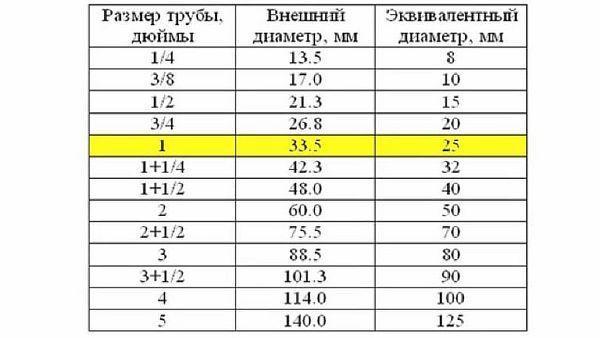 To convert the metric diameter of a pipe range, round up. When making this conversion, remember that according to international standards, one inch is equal to 2.54 cm.
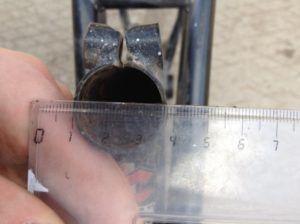
With this data, the conversion can be done using the simplest calculator. Now that the cross-section of the rolled tubular product has been calculated, its volume must be accurately calculated.
In practice, when converting steel dimensions, it's important to remember that the inch measurements won't equate to the mm measurements. This is because the internal volume is specified when marking.
The unit of measurement then becomes the nominal bore, designated as an integer. For these reasons, values must be rounded to convert them. This conversion is difficult for an inexperienced technician.
Therefore, if you need to convert these values, it's best to seek professional help or perform the conversion using a special table. Professionals will help you convert the required values and select the right products and other components for your pipeline.
Translation tables
In the construction of pipelines for various purposes, various pipe materials are used: steel, copper, brass, plastic, and others. All these products have different classifications and measurement units.
The overall dimensions of all tubular products are determined by the following indicators:
- Дн – external Ø.
- Дв – internal Ø.
- h – wall thickness.
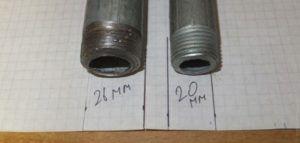 Previously, only steel pipelines were used, and a special system for determining dimensions was created for them. For example, the diameter of a half-inch pipe, converted to mm, is 12.7These are its internal dimensions. This figure takes into account not only the dimensions of the half-inch tubular blank but also its throughput capacity.
The outside circumference of a half-inch blank is 2.1 cm. Therefore, the word "pipe" is always added next to the half-inch thread in the table. Knowing the exact dimensions of a half-inch or any other type of pipe allows you to quickly and accurately select the required volumes.
This is clearly shown in the table:
| Dimensions (in inches) | 1/2 | 3/4 | 7/8 | 1 | 1.5 | 2 |
| Internal Ø (in metric) | 12.7 | 19 | 22.2 | 25.4 | 38.1 | 50.8 |
| Thread diameter (mm) | 20.4-20.7
| 25.9-26.2
| 29.9-30.0
| 32.7 – 33.0 | 45.8 – 46.2 | 57.9 – 58.3 |
Nowadays, it is customary to indicate these dimensions as shown in the following table:
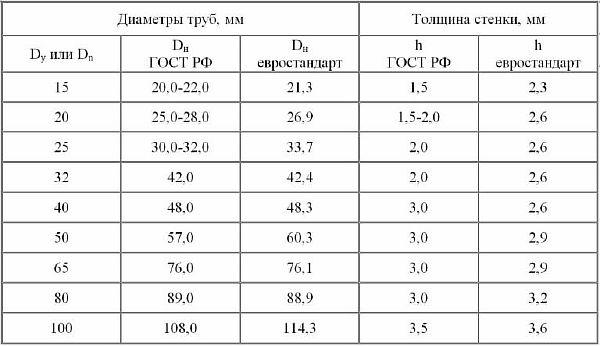
First table of diameters (its symbolic designation is Ø, which will be further designated in the article) pipes shows the values in millimeters, and the second table uses inches (international designation - inch or in, will be further designated in the article). An inexperienced technician might wonder why this is so? And what designations are considered correct?
The reason is that the metric system is used worldwide. This system is based on two units: conventional and nominal volume. These concepts are approached differently, but ultimately they represent external volume. These quantities are inherently dimensionless, but they are sometimes expressed in millimeters.
By analyzing the table data, one can compare products from domestic manufacturers and their foreign-made counterparts.
Interesting! The discrepancy in measurement arose simultaneously with the introduction of copper systems in Europe in the second half of the 20th century. In Russia at that time, metal gauge standards were defined in mm, not inches, a measurement system that remains widely used today.
Correspondence between two notation systems
Steel pipes are widely used in water and gas systems. Their dimensions are expressed as whole numbers or fractions thereof. For example, the diameter of a 1-inch pipe in mm is 33.5, while the diameter of a 2-inch pipe in mm is 67.
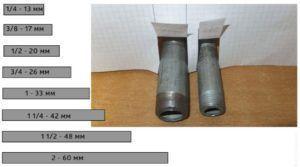 This, of course, doesn't correspond to the stated 25.4 and 50 mm. When installing rebar with inch designations on 1- and 2-inch products, there are no difficulties, but replacing with plastic and copper products requires taking into account the discrepancy in the designations.
Why complicate things so much? The fact is that the internal diameter is crucial for fluid flow. For this reason, this is the specific dimension used for 1-inch, 2-inch, and all other types of pipe materials. The most accurate dimensions are considered to be those based on nominal bore.
The nominal bore of 1-inch, 2-inch, and other pipe sizes is equal to the clearance dimensions. To indicate the metric size of 1-inch, 2-inch, and any other pipe, it is recommended to use tables.
Precise definitions - formula for calculation
This knowledge is needed to calculate the volume of transported medium. This is crucial for heating systems. For example, when installing a heating system, the cross-sectional dimensions of the pipe must be determined and calculated to ensure uniform heating throughout the entire home.
The formula can help you accurately determine the cross-section of each pipe in units such as inches:
D = sqrt ((314 * Q) / (V * DT))
In it:
- D – internal volume of the rolled pipe;
- Q is the heat flow, which is measured in kW;
- V denotes the speed of the heat carrier, it is determined in m/s;
- DT is the difference in temperature readings at the input and output of the network;
- sqrt – square root.
Despite the availability of formulas, tables help determine Ø more quickly. This saves a significant amount of time.
What is inch volume?
Deciphering pipe diameters given in inches is simple. They are often measured in these units. One such unit equals 3.35 cm. As already noted, the interpretation of this value varies, due to the fact that the range is measured not by external volume, but by internal volume. For example, the internal dimension of an inch-sized pipe blank can vary from 2.55 to 2.71 cm. This value varies depending on the wall thickness.
A 1-inch pipe has an outside diameter of 25.4 mm, while a 2-inch pipe is 50 mm in metric measurement. So where do the numbers 33.249 and 66.498 come from in the technical specifications for cylindrical pipe threads?
These threads on 1- and 2-inch products are made on the outer volume. Therefore, the ratio of the thread diameter to the inner volume is relative. Based on this, the dimensions of 1- and 2-inch rolled tubing are calculated by adding 25, 4, or 50 to the two wall thicknesses of the tubular product.
Before decoding, it's important to remember that product measurements should be taken from the inside, not the outside. Why is this necessary? By connecting sections of pipe made of different materials and taking measurements only from the outside, you can get an incorrect result, which will lead to errors, as the entire product range has different wall dimensions.
Also, when performing the decoding, one must not forget that the standards of different manufacturing companies are different; they all focus on their own indicators.
If you find it difficult to decipher the data yourself, you should seek professional help. They will be able to effectively assist you in choosing the right products.
Conformity between metric and inch parameters
All tubular products are manufactured according to a specific standard, and the pressure rating is a fixed value. Therefore, it is essential to accurately understand the correspondence between the diameter of all pipes shown in inches and mm. Ignoring this correspondence will prevent you from selecting the correct tubular product range.
When selecting a specific size, use the table information as a guide, and when substituting, use the closest approximation. There is no exact correspondence between the two different measurement systems, so piping components are often equated in practice.
How this correspondence is applied in everyday life can be found in the table below:
| Metric quantity | Size in inches |
| 15 | ½ |
| 20 | ¾ |
| 25 | 1 |
| 50 | 2 |
| 80 | 3 |
| 100 | 4 |
| 150 | 6 |
Using this information, you can accurately determine the correspondence between two types of dimensional measurements, and select parts for work that exactly match each other.
Inch expression of size
These values are written as a whole number, followed by a double dash, for example, 3". Similarly, pipe diameter dimensions expressed in inches are written as a fraction, for example, ½.
If we consider these dimensions using specific examples of Du correspondences, they will look as follows:
- The diameter of a standard 12 inch pipe is 300.
- The diameter of a 3-inch pipe product is 80.
- 8 inch diameter of standard rolled pipe is equal to 200.
- The diameter of a standard rolled pipe, 32, when converted to inches is shown as 1 ¼.
- The diameter of a 40 mm rolled pipe in inches is written as 1 ½.
- The Ø of a standard 15 inch pipe is expressed as ½.
- The Ø of a standard 4-inch product, translated into metric, is equal to 100.
- The Ø of a 3/4 inch pipe in metric translation is equal to 20.
- The Ø of a standard 1/2 inch tubing in metric translation shows the number 15.
Pipe diameters in inches and millimeters are commonly used. Knowing these dimensions can help avoid significant difficulties when connecting pipeline components. Special tables help find the required dimensions of connecting parts and ensure proper fitting.