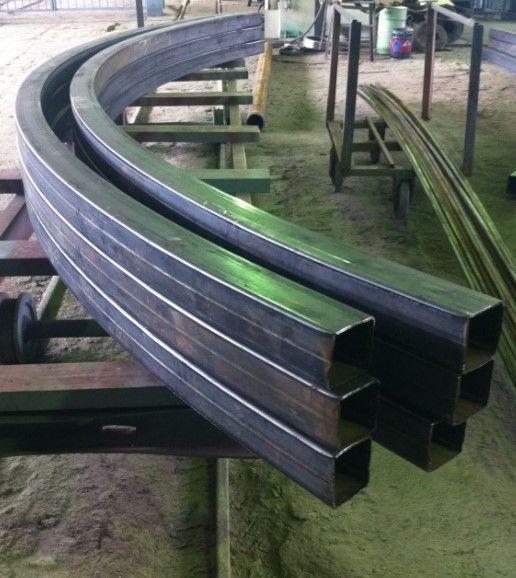
Nowadays, in the production of metal structures, pipe bending along the radius is used as an alternative to welding and threaded connections.
It is produced using special tools. If the cross-section of the material is small, manual pipe benders are used.. When the diameter of the products is significant, machines are used.
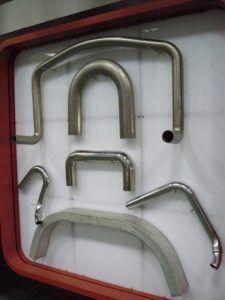
Most often, there is a need to bend round and shaped pipes.
- Theoretical foundations of the bending process
- Behavior of circular, square and rectangular sections, types of failure
- How to calculate the minimum allowable radius
- Methods of bending pipes by radius
- Bending in dies using pressing
- Pipe bending machine equipment
- Compression processing
- Rotary-extraction bending
- Conclusion
- Watch the video
Theoretical foundations of the bending process
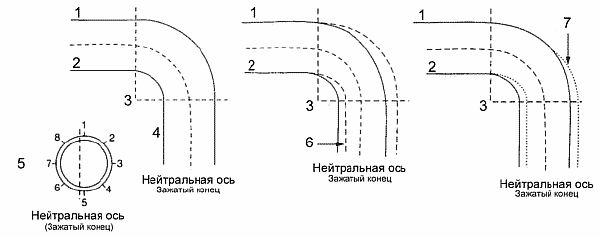
Due to the stresses arising during bending:
- the pipe wall is stretched along the outside by the applied force;
- compressed on the inside;
- a neutral axis is also formed, on which the state of the material does not change.
Behavior of circular, square and rectangular sections, types of failure
 The thickness of the pipe walls on the outer part of the bend becomes smaller due to the fact that the resulting stresses create a tensile moment:
- The thinned outer wall tends to bend toward the pipe's centerline. This causes its cross-section to become deformed.
- When the tensile strength of the product is exceeded, it breaks along the outer bending plane.
The thickness of the pipe walls on the inside of the bend increases due to the onset of compressive stress. When the compressive strength of the product is exceeded, it loses local rigidity. This leads to the formation of deep folds on the inside of the bent pipe.
How do square and rectangular profiles behave?
- Their tubular walls are subject to compressive and tensile stress, both on the outer and inner planes of bending, to the maximum.
- The material has an increased tendency to deformation, making it difficult for the craftsman to control it.
- The profile material on the inside of the bend tends to expand vertically. It also flows horizontally along the end face of the product. These stresses push the vertically aligned pipe walls into place. This causes the square cross-section to deform, taking on a trapezoidal shape.
- Rectangular and square cross-sections poorly transmit clamping forces between the bending and clamping jaws.
- The profile tends to slide along the shoe at the beginning of the bend. This can cause friction, leading to equipment wear.
Behavior of a material with a circular cross-section when it is bent:
- The material deforms less in areas of highest stress. The areas of maximum compression/stretching are located tangent to the centerline of the cross-section.
- The round shape allows the metal to flow evenly in all directions during bending. This allows the artisan to more easily control the material's deformation processes.
- Due to the round cross-section, the pipe transmits forces well between the bending and clamping jaws.
- When bending round pipes along a radius, they practically do not slip in the tool.
How to calculate the minimum allowable radius
The minimum bending radius of a pipe at which a critical degree of deformation occurs is determined by the ratio:
Rmin=20∙S
In it:
- Rmin means the minimum possible bending radius of the product;
- S denotes the thickness of the pipeline (in mm).
Therefore, the radius along the middle pipe axis is: R=Rmin+0.5∙Dn. Here, Dn denotes the nominal diameter of the round rod.
A prerequisite for correctly calculating the minimum bending radius is the need to take into account the ratio:
Kt=S:D
Here:
- Kt means the coefficient of thinness of products;
- D indicates the outside diameter of the pipes.
Therefore, the universal formula for calculating the minimum allowable bending radius is:
R=20∙Kt∙D+0.5∙Dn.
When the given radius is greater than the value obtained from the formula above, then the cold pipe bending methodIf it is less than the calculated value, the material should be preheated. Otherwise, its walls will deform during bending.
It is necessary to take into account the case when the thin-wall parameter is 0.03<Kt< 0.2
- Then the minimum allowable bending radius of a hollow rod, without using a special tool, should be: R ≥9.25∙((0.2-Kt)∙0.5).
- When the minimum bending radius is less than the calculated value, then the use of a mandrel is mandatory.
The correction of the bending radius of pipes after removing the load, taking into account springback (straightening inertia), is calculated using the formula:
Ri=0.5∙Ki∙Do.
Here:
- Do means the cross-section of the mandrel;
- Ki is the coefficient of elastic deformation for a specific material (according to the reference book).
So:
- For an approximate calculation of elastic deformation for a steel or copper pipe with a bore of up to 4 cm, a coefficient of 1.02 is adopted.
- For analogs with an internal diameter greater than 4 cm, this figure will be equal to 1.014.
To know the exact angle at which the material should be bent, taking into account the radius of gyration of the pipe, the following formula is used:
∆=∆c∙(1+1:Ki)
Here:
- ∆c is the angle of rotation of the median axis;
- Ki is the spring coefficient according to the reference book.
When the required radius is 2-3 times greater than the cross-section of the hollow rod, a spring coefficient of 40-60 is taken.
Watch the video
Methods of bending pipes by radius
There are several methods for bending pipes to a radius.
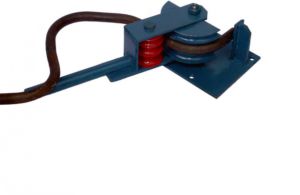 Using manual pipe benders. Hand tools are used for single-piece production of bent pipes. The material can be heated or worked cold. The tools consist of a mandrel equipped with a moving roller that bends the material. They operate by compressing the rod. The radius of gyration of the round or square pipe is taken into account before use.
You can work directly on the construction site using mobile devices of various designs.
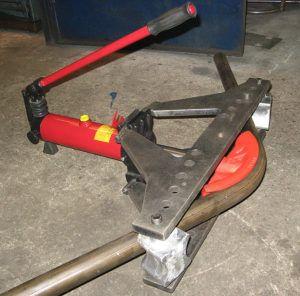 The simplest lever-type devices. Their long arms allow the material to be bent using human force. Lever-type devices allow bending pipes at angles of up to 180 degrees, provided the material is flexible (stainless steel, copper, aluminum) and has a diameter of up to 20 mm.
Crossbow pipe benders have a more complex design. They place the pipe on two supports that rotate around their axis. The bending module, coupled with a moving rod, applies pressure to the section of the rod located between the supports.
In crossbow devices, it is possible to bend hollow rods with a cross-section of up to 10 cm at angles of up to 90 degrees.
The rods that press on the workpiece can be:
- screw mechanical;
- hydraulic, equipped with manual drive;
- hydraulic, equipped with an electric motor.
Electric devices are the most productive. They bend workpieces using removable modules with varying radii. The workpiece is bent to the desired angle using a rotating mandrel. If the construction site lacks power, the device can be powered by a battery.
With the help of such a tool, it is possible to bend workpieces at an angle of up to 180 degrees.
Bending in dies using pressing
Bending blanks up to 70 centimeters long can be accomplished using stamping. In this case, hydraulic or mechanical presses are used. This method allows for the production of structural elements with complex shapes.
Pressing blanks is the most expensive bending method. However, it also offers the highest productivity. This method allows for the production of a wide range of products.
Pipe bending machine equipment
Bending pipes on an industrial scale is carried out using machines.
Roll bending. The most common type of bending machine is the rolling machine. Three-roller machines, designed for bending long workpieces, are most commonly used. They can also be used to produce spiral tubular products.
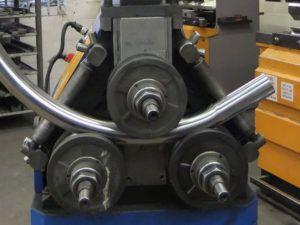
The workpiece moves through rollers, the position of which determines its bending radius. Simultaneously, it is compressed on both sides by a deformation cylinder. It is positioned between the rollers to allow the workpiece to be bent while suspended. The rollers act as support during metalworking.
Compression processing
Machines that bend small-radius workpieces using compression bending are often used in production. These machines process workpieces of both small and large cross-sections. The process involves localized heating of the workpieces and simultaneous axial pressure.
The machine consists of:
- a frame with a heater located on it;
- support roller;
- a pair of clamps, the first of which is a bending rotary clamp, the second is an upsetting clamp.
The device is capable of bending elements at an angle of 180º. It clamps workpieces with a constant force, regardless of their cross-section and the magnitude of the axial force generated at the epicenter of deformation during bending. The equipment can process square and rectangular profiles.
Rotary-extraction bending
Rotary pipe drawing is performed on machines with electric or hydraulic supports for moving the pressing rollers. The latter are used to achieve the desired configuration and thickness of the produced element.
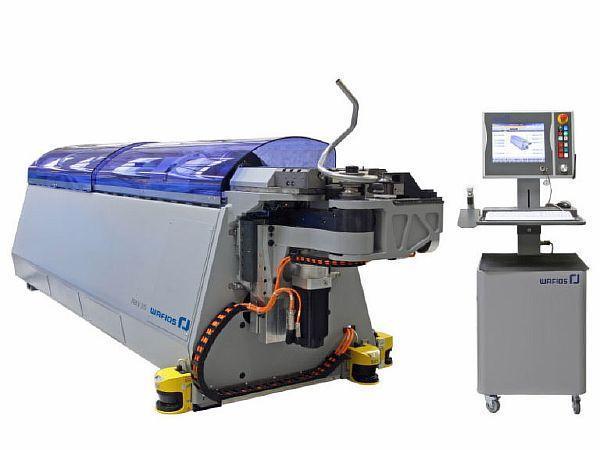
Rotational drawing produces parts from hollow rotating rods deformed by rollers on a moving mandrel. Currently, CNC rotary drawing machines are used in most cases. Their software takes into account the material's resistance to deformation. The relevant GOST standards are used in manufacturing.
Conclusion
In small volumes, pipe bending can be done using hand tools. On an industrial scale, this is done using specialized machines. Before beginning, it is necessary to calculate the minimum allowable bending radius.