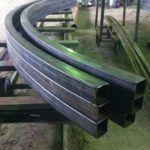
 Profiled tubing is becoming an increasingly popular building material. It is used to construct structural elements such as floors, load-bearing frames, and beams. This widespread use is primarily due to the ease of construction, operation, and maintenance of the structures, as well as the light weight of the products themselves.
However, it is important to remember that the profile pipe must have increased bending strength, and how to calculate it will be discussed later in the article.
We suggest you take advantage of it An online calculator for calculating the bending strength of beams of various cross-sections made from pipes.
Features and properties of profile products
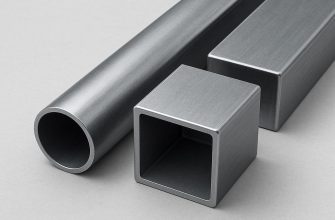
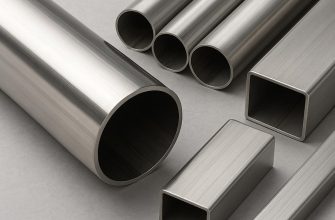
Profile pipes are pipes with a cross-section other than circular. The most common options are rectangular and square. As mentioned earlier, the particular popularity of this type is due to one of its key advantages: the lightweight construction.
Moreover, their unique shape significantly simplifies fastening both to each other and to other surfaces. This type of building product, according to GOST standards, is manufactured from a wide range of metals and alloys. However, the most commonly used are profiled steel pipes made of carbon and low-alloy steel.
Every metal has an important natural property—its resistance point. This can be either minimal or maximal. The latter, for example, is the cause of deformation in erected structures, leading to bending and, consequently, fracture.
When bending, it's important to evaluate characteristics such as the size, cross-section, type of product, its density, as well as the material's rigidity and flexibility. Knowing all these general properties of the metal helps us understand how the structure will perform during use.
It's important to remember that when you bend a product, the internal parts of the structure are compressed, their density increases, and they themselves decrease in size. The outer layer, accordingly, becomes longer, less dense, but more stretchable.
Moreover, the central sections retain their original characteristics even after the process is completed. Therefore, it should always be remembered that in During the bending process, tension will inevitably arise even in areas located as far as possible from the neutral zoneThe maximum pressure will be in those layers that are very close to this neutral axis.
Allowable bending radii based on material strength
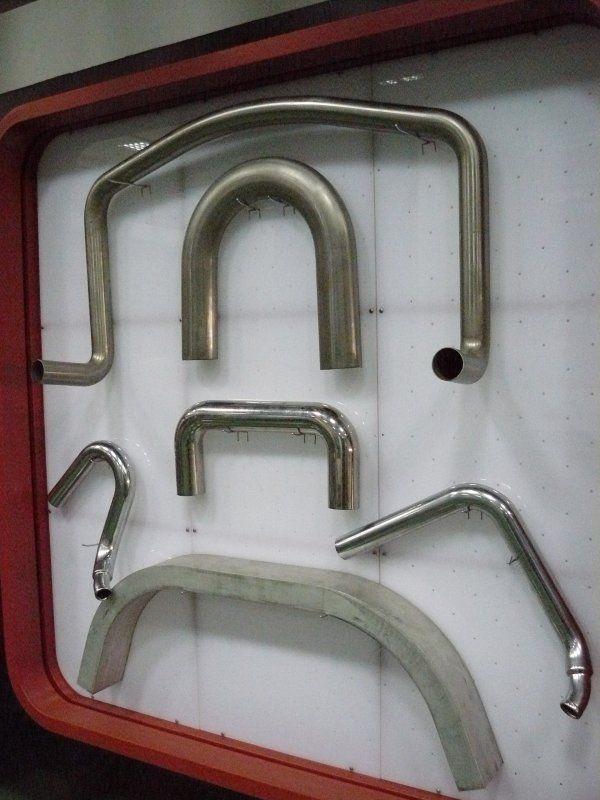
GOST standards regulate in great detail both the properties and characteristics of elements, as well as their transformation procedures. This includes the minimum bending radius of a profile pipe. It is determined based on the bending conditions. When bending with sand packed into the pipe or by heating, the outside diameter should be at least 3.5DN.
If the master has the ability to apply specialized equipment (for example, a pipe bending machine), which allows the necessary operations to be carried out without heating or other additional actions, then in this case the diameter should be at least 4DN.
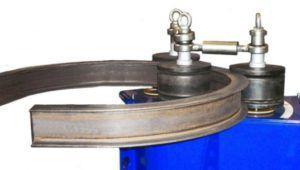 If you want to make a bend that is quite steep, for example to make a bent sewer branch or pipeline, then in this case the diameter should be at least 1DN, since the bending will be done by other methods, mainly using high temperatures.
Of course, the values stipulated by state standards can be slightly reduced, but in this case, the pipe's bending strength must be calculated very carefully. If the bending method allows for a certain reduction in wall thickness by 15% of the original, deviations from the GOST standard are possible, and the bending itself can be performed below the specified values, which will not significantly affect the subsequent strength.
Formulas and tables used
To successfully calculate a pipe's deflection without unexpected complications, you need to determine the length of the part. This value is calculated using a simple formula:
L = 0.0175 × r × α + I
In this expression, the main indicators are represented by the following letter expressions:
- r – bending radius of the profile pipe (mm);
- α - corresponds to the angle you ultimately want to obtain;
- I – distance of 100/300 used when working with special equipment for holding the workpiece.
When calculating the deflection of a pipe, an important stage of the work is the calculation of the bending element.
Watch the video
When making an estimate, we must estimate the size of the section that needs to be bent. The formula for this is extremely simple and looks like this:
U = π × α / 180 (r + DH / 2)
Here the elements included in the formula can be represented as follows:
- π in this case is taken to be equal to 3.14;
- α – represents the bending angle, expressed in degrees;
- r – bending radius (mm);
- DH – outer diameter.
For the convenience of the master and for maximum safety during work, as well as during the operation of erected structures made of copper and brass, GOSTs contain the minimum values for the main characteristics used to calculate the bending strength of a profile pipe.
For your convenience, the main characteristics required to determine the bending strength of a profile pipe are presented in the table.
Table 1.
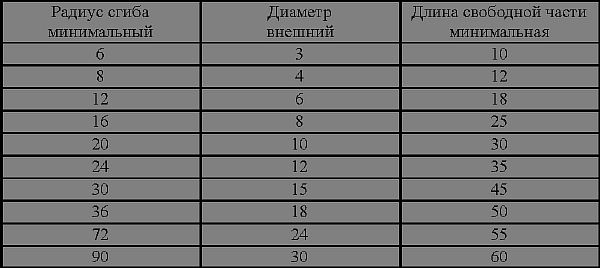
While the previous table primarily contained fixed values for copper and brass elements, the next one will cover data for steel elements. This table allows you to estimate the bending load of a profile pipe (GOST No. 3262/75).
Table 2.
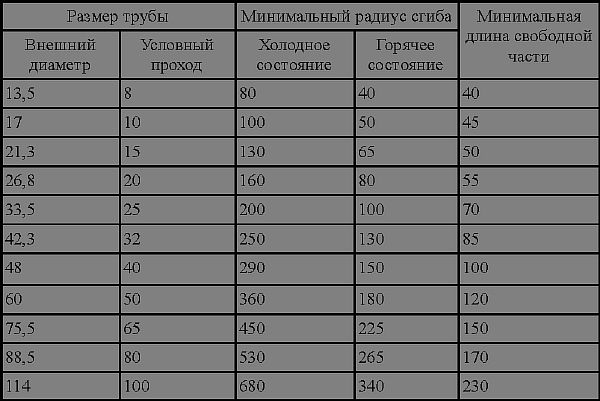
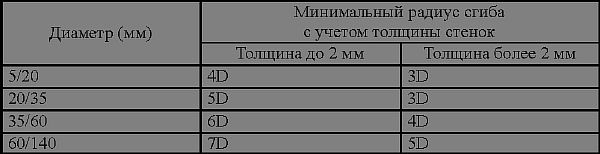
As mentioned earlier, wall thickness plays a key role in calculating the bending strength of a square pipe (as well as a round pipe). Therefore, the following table allows for both wall thickness and diameter to be considered in calculations.
Table 3.
Bending process technology
As has already been rightly noted, any deformation of a metal structure causes additional stress on the structure's walls. On the inner layer, this is due to an increase in the metal's density due to compression, while on the outer layer, the opposite is true: tension, which reduces the metal's density.
During bending, the cross-sectional shape changes as expected. This applies to round, rectangular, and square-shaped pipes. For the latter two, these changes are not very pronounced, which is not the case for round pipes.
This is how the ring profile becomes oval. It's noteworthy that the greatest change in shape can be observed directly at the bend, and the further away from it, the closer the cross-section will remain to its original shape.
Watch the video
However, it's important to accurately assess the force of impact and the degree of pipe deformation to avoid unnecessary fractures and distortions. For a part with a diameter of up to 20 mm, the degree of oval deformation should be no more than 15%.
As the profile increases, the value decreases further, reaching only 12.5%. Another important factor is the presence of folds (thin-walled products are particularly susceptible to this). This factor is especially important if the bending structure will serve as a pipeline.
The resulting folds reduce flow, increase resistance to fluid flow, and increase clogging. Therefore, when using a bendable pipe for these purposes, careful consideration must be given to the choice of wall thickness.
What load acts on profile pipes?
Calculating a pipe's bending strength boils down to simply determining the maximum stress at a given point in the structure. It's important to understand the material the profile is made of, as each material has its own stress rating.
To calculate correctly, you need to use the correct formula. In this case, Hooke's law applies, which states that the elastic force is directly proportional to the deformation. The calculation expression is as follows:
VOLTAGE = M / W , where:
- M is the value of the degree of bending along the axis along which the force acts;
- W is the bending resistance value taken along the same axis.
How can I tell if my calculations are correct?
As mentioned earlier, each metal or alloy has its own normal stress values. Determining these values is one of the main tasks you face when deciding to build a structure using profiles.
To be sure of the correctness of the results, you need to know several important rules and, of course, follow them.
- Perform all calculations accurately, carefully, and without rushing. At each stage, follow the relevant formulas, without trying to adjust the values to suit your own needs.
- Having calculated the bending strength of a profile pipe, care should be taken to ensure that the obtained values do not exceed the established maximum values.
- Take into account the material from which the profile is made, the thickness of the walls, in order to prevent its destruction or deformation, which will hinder the functioning of the structure in the future.
- Before performing calculations, it's necessary to draw a schematic of the future element. This technical drawing will allow for more accurate calculations, preventing errors associated with misunderstanding the structure's shape.
Watch the video
By following all necessary rules and safety precautions, even a non-professional can be confident that all pipe bending strength calculations will be accurate and the outcome will be successful. Constantly checking your calculations and monitoring every stage of the work is key to a successful outcome.