To fix a toilet cistern, in most cases, you need replace the membrane.
- To do this, we drain the water from the tank to prevent leakage.
- We unscrew the nut connecting the flush tank to the flush pipe.
- We loosen the siphon nut, which is located at the base of the tank.
- We disconnect the siphon from the water drain lever and take it out.
- After this, we replace the membrane and assemble the drain tank in the reverse order.
What should I do if my cistern is leaking? A malfunctioning toilet may be caused by damage to one of its components. In most cases, malfunction is caused by a faulty siphon, fittings, shut-off mechanism, rubber bulb, or gasket.
Sometimes a toilet leaks due to physical damage to the tank or bowl of the plumbing fixture.
Such malfunctions can cause a lot of trouble for apartment residents, so it is recommended not to delay repairs.
You can perform the repair procedure yourself. In this article, we'll cover in detail the causes of this malfunction and how to fix them.
- Why the cistern is leaking - the main reasons
- Necessary tools and materials
- How to fix a leaking toilet cistern
- Leaks due to overflow
- Leaks at the junction of the cistern and toilet bowl
- Leak due to defective hoses
- It's leaking from the rubber bulb.
- The plumbing is leaking due to a tilted float.
- It's leaking because of the siphon.
- Leaks in the tightness of joints
- The problem is in the shut-off valve
- It leaks due to cracks
- What to do if your toilet cistern starts leaking
- Preventive measures
Why the cistern is leaking - the main reasons
If you're wondering why your toilet cistern is leaking, the problem has already occurred. Now it's time to figure out the cause. The most common cause is a simple overflow, which causes excess liquid to flush. There are several key factors that most often lead to malfunction:
- Deterioration of the elastic properties of the rubber gasket. Over time, this material wears out, causing the water flow to become unsealed and the plumbing to leak. A deformed part allows water to pass through easily;
- The rubber gasket hasn't lost its elasticity or become deformed, but it doesn't fit snugly against the outlet located near the valve mechanism. Due to the loose seal, the toilet cistern is leaking.
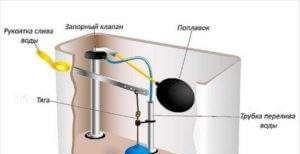
- The valve mechanism pin has been corroded or physically damaged. This component maintains the float in the correct position, but over time, the element wears out;
- A damaged valve body is another cause of leakage. However, cracks that cause a leaky toilet cistern only occur in plastic components. If brass components are installed, such problems will not arise, as brass components are known for their increased strength.
Other common reasons for a leaking toilet cistern include:
- Damage to bolts and other fasteners connecting the cistern and toilet bowl. Over time, metal parts often corrode, and plastic ones break;
- If your toilet cistern leaks when you flush, the bulb may be the cause, as it has become less elastic over time. After prolonged use, this part loses its original properties, causing it to lose its ability to take on the desired shape.
- The lever that locks the float into place may shift. This can occur due to prolonged use, causing the float to lose its seal. This can lead to liquid leaking into the float. Sometimes, low-quality components can also cause this type of malfunction, resulting in plumbing leaks.
- breakage of the siphon or tank hoses;
- Water may leak between the cistern and the toilet bowl due to a leak in the seal. This typically occurs when the rubber seal changes shape;
- the shut-off valve mechanism is damaged;
- cracks appeared.
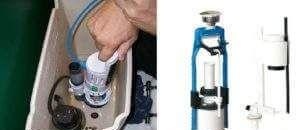
The main signs that the toilet cistern is leaking include:
- a frequent or constant sound of pouring liquid;
- the appearance of traces of limestone in places where liquid emerges;
- the surface of the bowl, which is located closer to the cistern, is constantly wet from the inside, even if the plumbing has not been used for a long time;
- water flows slowly when draining;
- water consumption increases;
- Condensation appears on the pipeline and drain tank.
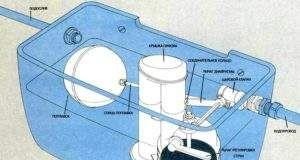
Even one of the above problems indicates that the toilet cistern is leaking. In this case, repairs are required. We recommend you familiarize yourself with toilet cistern device, common faults and their repair.
Necessary tools and materials
If your plumbing is leaking, shut off the water before attempting any repairs. Because the system is pressurized, the leak could flood the room during repairs. The following tools are required for repairs:
- a sealant suitable for plumbing fixtures;
- sandpaper;
- screwdriver;
- burlap, twine or tow;
- hammer;
- knife;
- pliers;
- If a component needs to be replaced, a working part of a certain type will be required.
Once the necessary tools have been collected, repair work can begin.
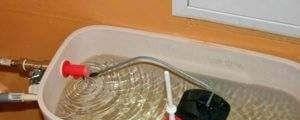
How to fix a leaking toilet cistern
Once the cause of the toilet leak has been identified, repair and restoration work can begin. It's worth noting that the solution varies slightly from case to case, and the procedure largely depends on the toilet's shape.
All the action algorithms listed below are given for the case when a classic-shaped tank is leaking.
Leaks due to overflow
What should you do if your toilet is leaking due to an overflow? First, you need to check which component is malfunctioning. You can determine this yourself by performing a simple test:
- Remove the toilet seat.
- Raise the float slightly and hold it.
- If the tank doesn't leak when raised a few centimeters, the float lever is faulty. Its position prevents the water from shutting off. To fix the problem, bend the lever slightly and lock it in a position that stops the water intake and the leak.
- If the toilet still leaks even after raising the float, carefully inspect the valve. The pin securing the part should not be deformed, nor should it show signs of corrosion or other damage. It's also recommended to check that the pin hasn't become dislodged. Normally, the pin is located inside the valve and stops the float lever. If this is the problem, it's often replaced with a larger-diameter copper wire.
- If the stud is undamaged, it's a good idea to inspect the hole where the component enters. Sometimes water leaks from the cistern into the bowl when the hole is deformed. In this case, a new valve mechanism must be installed.
- Check the gasket. To do this, gently but firmly press it against the valve. If the toilet no longer leaks, adjust the seal. If this is not possible, replace the gasket.
The above steps will help identify the cause of the problem and fix it in 80% of cases. However, if they don't help, you'll need to look for damage in other system components.
Leaks at the junction of the cistern and toilet bowl
The reason why water is leaking from under the toilet may be damage to the bolts, which secure the cistern to the toilet. This type of malfunction can occur with fasteners made of any material, whether plastic or metal. What should you do if your toilet cistern is leaking due to the bolted connections?
It is necessary to conduct a careful visual inspection of all components, which will require a complete disassembly of the flush tank (since in some cases the breakdown is not visible while the tank is assembled).
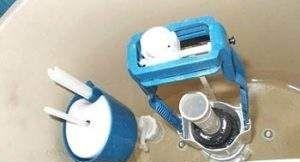 It's possible that only one part is damaged, so only that part will need to be replaced. However, in most cases, several components will need to be replaced, and it's advisable to purchase a complete set of plumbing parts.
Stages of analysis:
- Make sure the water supply is turned off.
- Drain all liquid from the tank.
- Remove the flexible wiring through which water enters the tank.
- Remove the fasteners. Sometimes, after prolonged use, the surface of the bolts becomes rusty; this corrosion can be removed with a hacksaw.
- Move the tank.
- The shelf located on the cuff is removed.
- The remaining liquid needs to be drained.
- All traces of corrosion found must be removed.
Reassembly is performed in reverse order. Replace the rubber gaskets and install new fasteners. It's important to avoid distorting the bolts when tightening. It's also important to remember to apply only moderate force when tightening, as too much pressure can damage the porcelain.
Leak due to defective hoses
The pipe connecting the water supply and the tank is quite durable. The weak point is considered to be the section where the flexible hose connects to the float system. A clear sign of failure is a leak at the hose connection.
Quite often, this type of malfunction is caused by loose fastener connections. This is easy to fix: simply tighten the nuts securely and tighten the fasteners. In some cases, it's also necessary to replace the gasket if it has lost its elasticity and is no longer performing its intended function.
However, it should be noted that when tightening plastic components, extreme caution is required. Careless tightening or excessive force will cause breakage. It's also best to avoid using metal tools in this case, as this can strip the threads.
If the toilet corrugated pipe is leaking, it will need to be replaced. Corrugated pipe is inexpensive, so if a homeowner discovers a leak, it should be replaced as soon as possible.
It's leaking from the rubber bulb.
A deformed bulb is a fairly common cause of water leaking from the toilet cistern into the bowl. This especially often occurs after many years of use, during which the rubber has lost its elasticity.
The solution to this problem is quite simple and is considered the least resource-intensive of all recovery methods.
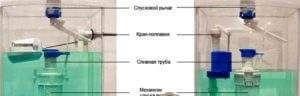
What should you do if your toilet cistern is leaking because the bulb is broken? Repairing an old, broken part is not recommended. It's best to buy a new one from a plumbing supply store.
When purchasing, it is recommended to choose the softest and most flexible pear, then this element will be able to function without problems for a long period.
The component is secured with a thread. To remove the element from the tank, turn the thread clockwise. During installation, the bulb is secured by turning it the other way.
If for some reason it is not possible to purchase a new spare part, it can be temporarily replaced with a small weight (a heavy nut can be used) that hangs on the rod.
The plumbing is leaking due to a tilted float.
A misaligned float lever can cause a malfunction. This can occur due to external influences or prolonged use of the plumbing fixture. What should you do if your toilet is leaking due to misalignment?
First, check the float. If there is no visible damage, it will need to be replaced. It's recommended to save money on this part and purchase a higher-quality one to prevent future leaks.

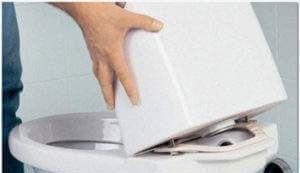
If a visual inspection reveals a small hole in a component, it can be repaired in the following ways:
- seal with polyethylene;
- Heat a small piece of plastic with a lighter and seal the hole tightly with the melted material.
However, it should be noted that such methods are only a temporary solution. Ultimately, you will still need to purchase a new component.
It's leaking because of the siphon.
The siphon membrane prevents water from leaking even when the drain is not running. Over time, this system component wears out and must be replaced.
To do this, it is recommended to purchase a new part that perfectly matches the size and shape of the plumbing model. If it is chosen incorrectly, the defect will not be corrected.
Algorithm for eliminating the problem:
- Instead of the tank lid, a crossbar is installed, connected to a float.
- The water is washed away.
- The nut that connects the pipe to the tank is unscrewed.
- The siphon nut is slightly unscrewed.
- The siphon is removed.
- Then the faulty membrane is removed and a new one is installed.
- The system is installed in reverse order.
Leaks in the tightness of joints
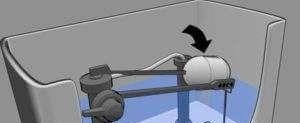 When the seal breaks, the connection becomes unsealed. What should you do if your toilet is leaking for this reason? You'll need to install a new gasket between the bowl and the cistern. Let's break it down:
- Remove any remaining liquid using a soft sponge.
- The drain nut located under the valve is slightly unscrewed.
- All fastening elements of the tank are removed and it is dismantled.
- The lock nut holding the drain is removed and then the drain is put away.
- A new rubber gasket is installed. This element prevents plumbing leaks, so it must be selected carefully. When selecting, it is recommended to know the appropriate dimensions and shape. If the wrong part is chosen (too large or too small), the plumbing fixture will continue to leak.
- The drain is secured with lock nuts.
- The tank is returned to its place and secured with screws.
The problem is in the shut-off valve
If your toilet is constantly leaking, there's a high risk of a faulty valve mechanism. Disassembling and repairing it isn't worth the effort, as in most cases, these steps won't produce the desired results. The best solution is to replace the flush assembly or the entire tank.
Instructions:
- Rinse off all liquid.
- Remove the top cover and remove any remaining moisture.
- Remove the mounting screws.
- Remove the tank.
- Remove the seal.
- Loosen the lock nuts securing the drain assembly.
- Remove the previous mechanism.
- Install a new valve.
- In reverse order, secure the drain, install the gasket and install the toilet tank.
It's advisable to buy a mechanism from the same brand as the flush tank. Ideally, it should be the exact same model as the one installed in the plumbing system before it started leaking. It's worth noting that when installing a new system, new nuts and gaskets are required.
It leaks due to cracks
Sometimes cracks and other physical damage can appear in plumbing fixtures. You can fix this problem yourself at home. The procedure requires only standard tools and a sealant designed for plumbing fixtures.
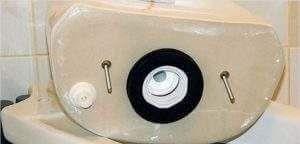
Instructions:
- Drain all the liquid.
- Carefully remove the tank.
- Dry it from the inside, removing residual moisture.
- Cover all cracks with sealant.
- Install the tank in place.
If the toilet is leaking from the bottom and the crack is found in the bowl itself, it can also be sealed with plumbing sealant. However, this solution is not permanent; the damaged component will definitely need to be replaced.
What to do if your toilet cistern starts leaking
In such a case, the first step is to check the condition of the switch. If the return spring mechanism malfunctions, the flush button may remain in the tank, causing the lid to remain permanently open.
How to fix a leaking toilet cistern with a push button:
- Remove the top panel.
- Remove the switch that is stuck.
- Replace the return spring.
- Center the mounting point, which is located directly under the hole in the lid.
- Assemble the system in reverse order.
Preventive measures
To prevent a leaky toilet cistern, whether with or without a flush button, you should regularly perform certain preventative measures and follow the operating instructions.
Prevention may include the following actions:
- minimize the likelihood of mechanical deformation of the toilet;
- minimize sudden temperature changes;
- clean the toilet bowl and cistern every six months;
- regularly check the condition of plumbing fittings, fittings and other parts to ensure they do not leak;
- avoid the formation of condensation.
Therefore, if your plumbing is leaking, you can easily repair it yourself without calling a plumber. First, you need to determine the cause of the leak.
It's important to remember that timely preventative maintenance will extend the lifespan of your plumbing and sewerage systems. If a problem is detected, it's recommended to address minor issues first before addressing major damage.
To prevent moisture from accumulating on cold surfaces, it is necessary to ensure proper ventilation in the room.
A leak may occur due to a worn out gasket, clogged valve, or damaged valve. Replace the gasket, valve, or clean out any accumulated debris.
To do this, you need to do the following: remove the drain device; remove the old gasket; clean the area where it was located from dirt; install a new gasket; check for leaks.
After discovering that my toilet cistern was leaking due to "just" a defective hose, I felt like a fool. I'd thought it was due to poor insulation (which is exactly what happened, but not where I thought). At least the silver lining is that, according to the article, I also learned about the manhole assembly.
Brilliant advice from theorists: if water constantly leaks, replace the unit or… the tank!!!! Because it's strange – what could possibly happen in the tank or with it? The cause is 100% the gasket, which is made entirely of soot, with no rubber – that's why it hardens after just a month, and everyone "curses" such "today's" production. And then there are the hacks who produce SUCH toilets – like the Vorotynsky production. We installed SUCH a toilet after a car repair: the poop doesn't flush because it's a "fan flush" – in a circle, and whatever's piled up straight stays there.
For a complete understanding there is a lack of visual materials and step-by-step instructions.