Cast iron sewer pipes have been used in construction and utility systems for over a hundred years, and their popularity remains strong even today, despite the advent of many modern materials. This is due to their combination of high strength, durability, and resistance to vibration and temperature fluctuations. To properly design, install, and maintain such pipelines, it is important to understand their design and materials science.
Below is a detailed analysis of all the elements of cast iron pipes, their manufacturing principles, and the features that affect their operation.
- The main purpose and characteristics of cast iron sewer pipes
- Cast iron grades used for sewer pipes
- Construction of a cast iron sewer pipe
- Pipe wall
- Inner surface
- Trumpet
- Straight smooth end
- Features of internal and external processing
- Internal processing
- External coating
- Production of cast iron sewer pipes
- Metal preparation
- Casting into molds
- Cooling and heat treatment
- Mechanical processing of ends
- Marking and testing
- Connectors and accessories
- Operational design features
- Resistance to vibration and noise
- Fire resistance
- Resistance to aggressive wastewater
- Minimal deformation
- Weaknesses of the design that you need to be aware of
- Conclusion
The main purpose and characteristics of cast iron sewer pipes
Cast iron sewer pipes are designed to drain domestic, storm, and industrial wastewater. They are typically used in systems:
- internal sewerage of buildings;
- external gravity networks;
- water drainage systems in industrial workshops;
- risers of apartment buildings.
Key performance benefits derived directly from the design:
- high mechanical strength — pipes can withstand heavy loads, including soil pressure;
- natural sound insulation due to the density and mass of the walls;
- resistance to chemically active environments;
- durability of more than 50–70 years, which is confirmed by operational practice.
All these properties are the result of the unique structure of cast iron and the specific features of pipe manufacturing.
Cast iron grades used for sewer pipes
Gray cast iron with lamellar graphite is used to produce traditional socket-type sewer pipes. Its structure ensures:
- low brittleness,
- good vibration resistance,
- shock absorption ability,
- corrosion resistance.
The main elements of cast iron:
- carbon 2.5–4% in the form of graphite plates - it reduces vibrations and improves casting properties;
- silicon 1–3% - helps to stabilize the graphite structure;
- small additions of sulfur, manganese and phosphorus.
It is due to this graphite structure that the pipe tolerates temperature changes well, does not deform, and has a long service life.
Construction of a cast iron sewer pipe
Although the design appears simple, each element has an important engineering role.
Pipe wall
The wall thickness varies from 4 to 8 mm and depends on:
- diameter (standard sizes 50, 100, 150 mm);
- pipe type (internal, external);
- operating conditions.
Wall functions:
- perception of mechanical loads;
- protection against hydraulic pressure;
- ensuring strength during installation;
- vibration reduction.
Inner surface
Classic cast iron pipes have an internal roughness, but modern products are equipped with:
- epoxy coating,
- bitumen or anti-corrosion treatment.
This reduces fouling and extends service life.
Trumpet
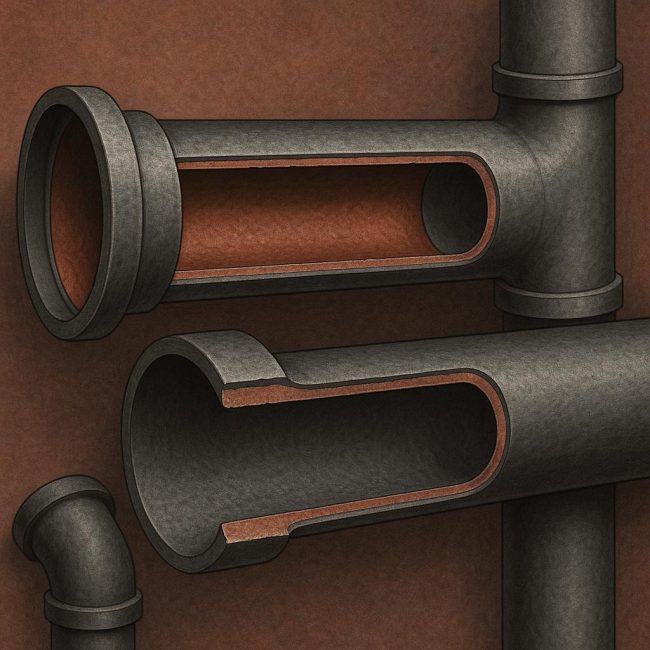
A socket is an expanded part of a pipe intended for connection with another pipe or fitting.
It provides:
- tightness;
- strength of fastening;
- the ability to compensate for minor deformations.
Compaction is carried out using tow, a cement-sand mixture or modern polyurethane compounds.
Straight smooth end
This element fits into the socket of the next pipe - a classic "plain end → socket" connection.
Its geometric accuracy determines the reliability of installation.
Features of internal and external processing
To ensure that cast iron lasts for decades, pipes are coated with protective compounds.
Internal processing
Applicable:
- epoxy compounds;
- acrylic resins;
- bituminous materials.
Coverage functions:
- reduction of runoff friction,
- corrosion protection,
- facilitating preventative care,
- reducing the risk of sediment build-up.
External coating
The outer coating protects against:
- humid environment,
- aggressive soil,
- temperature changes,
- mechanical damage.
In most cases, bituminous mastic is used - a proven, durable option.
Production of cast iron sewer pipes
The manufacturing process includes several mandatory stages.
Metal preparation
Cast iron is melted in cupolas or induction furnaces with controlled composition parameters.
Casting into molds
The pipes are produced using the centrifugal casting method:
- The rotating mold ensures uniform distribution of cast iron;
- the wall is obtained without voids;
- the metal structure is stabilized.
Cooling and heat treatment
Cooling shapes the microstructure of cast iron, affecting:
- strength,
- plastic,
- corrosion resistance.
Mechanical processing of ends
The smooth ends are aligned to ensure precise geometry of the connections.
Marking and testing
Standard types of control:
- wall thickness measurement;
- leak testing;
- impact and hydraulic testing;
- visual inspection of castings.
Connectors and accessories
Cast iron sewerage includes not only pipes, but also a whole range of shaped parts:
- 45° and 90° bends,
- tees and crosses,
- expansion joints,
- transitions,
- revisions.
All of them are also made of cast iron and have a socket design.
Operational design features
Resistance to vibration and noise
The massiveness and density of the walls dampen vibrations, making cast iron risers the “quietest”.
Fire resistance
Cast iron does not burn or emit toxic gases when heated, which is important for fire safety.
Resistance to aggressive wastewater
The cast iron structure is not affected by hot wastewater, oils, alkalis and acids in household concentrations.
Minimal deformation
Even with temperature fluctuations, the pipes retain their shape—this is critical for vertical risers.
Weaknesses of the design that you need to be aware of
Although cast iron is considered a durable material, it has design features that require attention:
- weight - complicates installation;
- brittleness when struck with a point - may crack from a strong local impact;
- corrosion in old systems in case of damage to the coating;
- overgrowth of the inner surface in untreated pipes of the old type.
These factors are taken into account during maintenance and repair.
Conclusion
The design and construction of cast iron sewer pipes is the result of a combination of engineering expertise, metallurgy, and proper material processing. Cast iron pipes offer high strength, stability, and durability, maintaining their position in construction due to their reliability.
Understanding their structure—from the composition of the cast iron to the design of the socket and processing methods—allows for the proper operation of old systems and the competent design of new ones.