Before purchasing sanitary ware, it's recommended to familiarize yourself with standard toilet sizes and determine which dimensions are suitable for your space. This typically depends on the type of sanitary ware and the size of the room. Wall-hung and floor-standing toilets have different designs and, accordingly, different toilet and cistern sizes.
The height of a toilet is the distance from the floor to the top of the toilet seat, not including the lid/seat. According to the 2018 interstate standard, the height of a floor-standing toilet should be 40 cm for adults and 33.5 cm for children. These standards were developed based on the average height and build of a person and are still relevant today.
Once the required dimensions have been determined, you can begin designing the toilet and arranging the plumbing fixtures in the bathroom. Experts recommend not selecting plumbing fixtures after drawing up the floor plan.
Rules for choosing toilet sizes
First, you need to determine the required width and length of the plumbing fixture. You'll need to take measurements and find out the following technical parameters:
- The width and length of the room. A distance of 30 cm from the toilet to other fixtures or walls, and 60 cm from the bowl to the wall in front, is considered optimal;
- width and shape of the sewer outlet (oblique, horizontal or vertical pipe outlet);
- the width and length of the sewer pipe (from the wall to the branch pipe), which determines the distance of the toilet from the wall;
- distance to the water supply.
If you are installing a system that requires installation (for example, a suspended product or one with a built-in cistern), then it's necessary to additionally consider the width, height, and other dimensions of the structure. Also, don't forget about the false wall and its finishing.

Once the width and length have been determined, the toilet's height should be determined. Generally, the height to the floor should be such that your feet can rest comfortably on it, rather than dangling. It's best to calculate the height based on the tallest person in the house.
Features of measurements
To ensure that your purchased plumbing fixtures can be installed without any problems, it is recommended to consider the following factors:
- If the sewer line is located near the walls (the standard option), rather than in the ceilings between floors, you should purchase options with an oblique outlet. Their installation is quite simple, regardless of the location of the sewer outlet;
- Based on the width and length of the sewer outlet pipe, it is necessary to select a connecting cuff;
- presence of a bidet;
- The flexible hose that connects the water supply and the cistern should be short, but not hanging in the air, otherwise the water will stagnate.
When purchasing a toilet, consider not only the dimensions and area of the bathroom or shower room, but also the shape, width, and height of the waste outlet. The distance from the wall to the toilet directly depends on the outlet.
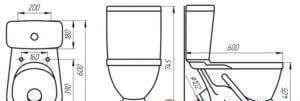
It's believed that the lower-mounted outlet requires the most effort to reinstall. In this case, a renovation will be necessary, which will affect the flooring and wall finishes.
Therefore, before purchasing plumbing fixtures, it is important to consider how much space the installed toilet will take up (for example, know the height of the toilet from the floor).
Types of toilets and their sizes
To begin, it's a good idea to understand the different types of cisterns. If the cistern isn't part of a monolithic structure with the toilet bowl, then it's recommended to learn the specifics of the different types. The following points should be noted:
- The volume of liquid in the tank. It is advisable to choose an option with a larger capacity;
- drain types: vertical (almost never used now, only found in older buildings), horizontal and oblique;
- Flush mechanism material: plastic or ceramic. It's better to buy the plastic version, as it's not susceptible to corrosion;
- Flush button. It's recommended to install a double flush button if possible. This allows you to control the volume of liquid flushed, thus saving on water consumption.
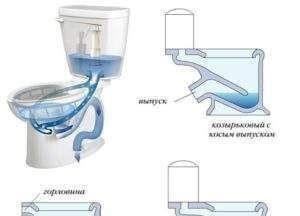
Based on the installation method, the following types of products are generally distinguished:
- Monoblock – has a monolithic construction. It can be used for long periods of time, but is often quite expensive, as such products are often designer pieces;
- Compact models feature a shelf behind the toilet bowl onto which the cistern is bolted. Standard sizes are typically small, so they are often installed in small bathrooms. However, during installation, it's important to ensure reliable waterproofing with a gasket and special sealant; otherwise, the cistern may begin to leak after a few years of use.
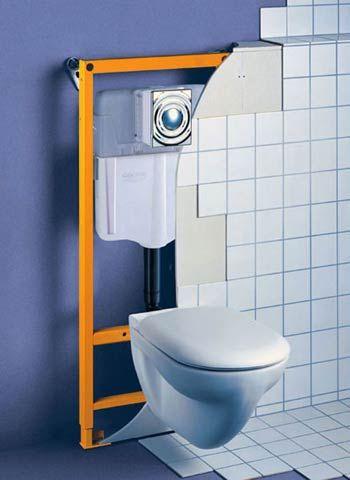
- Wall-hung or built-in fixtures with concealed plumbing. This option is becoming increasingly popular due to its attractive appearance and high reliability. Installation of this type of fixture is somewhat more complex than other options, as it requires installation of a frame to which the water tank and other components are attached.
Floor-standing models are the most common, as wall-hung models are often not possible in small bathrooms. They vary depending on the cistern shape and the design of the frame. For example, corner models don't require much space.
All sanitary fixtures are also classified by size: children's, small, medium, and extra-large. Larger toilets, if required, are usually made to order. Stores and other retail outlets typically only stock standard-sized products.
Corner
Corner standard fixtures are quite popular among owners of small bathrooms. They visually enlarge the space and also allow some plumbing fixtures to be hidden. Corner installation is possible thanks to the triangular cistern.
There are two types of these models: a monoblock design and a compact design. A monoblock design consists of a toilet bowl and a cistern. A compact model is typically installed separately. This design is wall-hung, with the cistern placed in a standard frame installation or behind a false wall.

Advantages:
- allow you to realize any design idea in the interior, thanks to a wide variety of products;
- Placing plumbing fixtures in the corner helps save space and accommodate all necessary items;
- Most models have an automatic safety system built in. If the cistern leaks, this will prevent flooding by directing the liquid into the overflow pipe.
Disadvantages include certain installation difficulties. The walls on which the plumbing is mounted must be strong, as standard-sized toilets are quite heavy.
When calculating the dimensions it is required take into account the width of the cornerStandard dimensions of a corner toilet: width from 35 to 38 cm, height from 38 to 42 cm, depth from 73 to 80 cm.
Suspended
Wall-hung toilets in standard sizes are currently gaining popularity. Their unique design allows only the toilet bowl to be visible to the user.
The cistern is completely hidden behind a false wall or positioned in a corresponding niche. This type of installation can increase the available space, but in reality, this doesn't happen because the ceiling or wall moves forward.

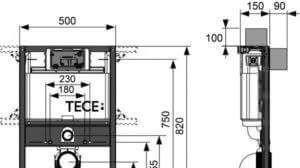
The cistern and other structural components are secured to a durable metal frame that can support up to 400 kg. Some models have an increased load-bearing capacity, supporting up to 800 kg. This is convenient when installing the structure on a non-load-bearing wall.
The advantages of a wall-hung toilet include easy cleaning, the ability to conceal plumbing, and a quiet cistern. Standard toilet bowl dimensions include a width of 34 to 37 cm, a height of 36 to 40.5 cm from the floor, and a length of 47 to 70 cm.
During the design stage, the width and height of the installation should be considered separately. Dimensions depend on its type and shape. Standard flush tanks are typically thin (around 90 mm) and wide (usually up to 50 cm).
Exclusive large types
In some cases, installing a system capable of supporting heavy weight is impossible. For example, if mounting on a load-bearing wall is not possible, or if another design option is unsuitable.
However, if you have larger family members, it's advisable to purchase a toilet specifically designed for this purpose. These models are not standard; they are larger in size and more durable, allowing them to withstand heavier loads.
Due to the increased width, height, and other dimensions of a toilet with a cistern, these models are quite difficult to find commercially. In most cases, they are custom-made by specialized companies. To do this, you need to provide the desired dimensions of the design elements to ensure a perfectly fitting product.

Most often, plumbing fixtures sold in standard stores have the following dimensions:
- width (42-46 cm);
- height of the toilet with cistern (60-68 cm);
- depth (up to 82 cm).
Built-in
Built-in toilets offer the same advantages as wall-hung toilets, and their dimensions are similar. All plumbing in built-in toilets is hidden behind the wall. However, unlike wall-hung toilets, these models can be installed on the floor. Built-in corner toilets and floor-standing toilets for children are also available.
Standard sizes of this type of toilet:
- width: 35 - 38 centimeters;
- height: 38 - 42.5 centimeters;
- depth: 48 - 57 centimeters.
When designing a built-in toilet, in addition to its dimensions, it's essential to consider the depth of the wall behind which the main plumbing fixtures will be located. In some cases, such plumbing fixtures are installed in a wall niche, and the standard plumbing fixtures are then concealed by trim panels.

Disadvantages include the need for a supporting wall or niche, as well as increased repair complexity. It's important not to make the closing panel completely blind.
If a leak occurs, a pipe breaks, or the system's integrity is damaged, the entire structure will need to be completely dismantled and reinstalled after repairs. However, despite the labor-intensive process, it is possible to install a standard cistern yourself.
Children's
Of all the varieties, the most original shapes are those designed for children. In most cases, they are created in the likeness of various animals, which requires unusual bowl sizes.
They differ from plumbing fixtures for adults in their reduced size, which makes it possible to install them even in small bathrooms.
Overall dimensions of this type of toilet:
- depth – 44-60 cm;
- width – 29-35 cm;
- The standard height of a toilet from the floor is 26-34 cm.
Typically, the dimensions of the toilet fixture are chosen to ensure complete comfort for the child. Sometimes, a slightly larger toilet is acceptable to ensure its long-term use.
Monoblock
One of the most popular types is the monoblock toilet. They differ from compact models in that the cistern and bowl are a single ceramic unit. There are no connecting parts between these elements.
 The main advantage is increased product reliability and long-term operationThis is achieved largely due to the absence of connecting mechanisms that can corrode or fail.
The main drawback is the high price, which is explained by certain manufacturing features. If a part of the internal mechanism breaks, the entire assembly will need to be replaced, as replacing just one element is virtually impossible.
If possible, experts recommend purchasing an additional internal mechanism kit when purchasing a toilet, as after 8-12 years, when the original fittings fail, finding a similar model will be quite difficult.
Standard sizes on the Russian market (according to GOST):
- width – 35-38 cm;
- standard toilet height: 38-78 cm;
- length – 68-71 cm.
Compact
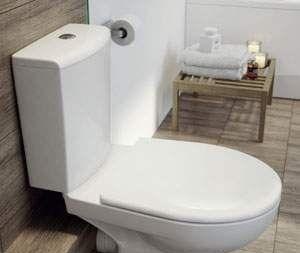 Typically, in most standard apartments with small bathrooms, a compact model is installed, as it doesn't require much space. A unique design feature is that the cistern is attached to the bowl, creating a separate component.
This type of installation is much easier to carry out, as there is no need to secure the toilet to the floor, the cistern to the wall, and then connect them using flexible pipes.
According to Russian law, all dimensions of various types of plumbing fixtures are regulated by the relevant GOST standards, resulting in differences in size between the Russian and international markets. Compact toilets are available in two variations: with a built-in shelf and a separate one.
Dimensions of a compact toilet with a built-in element:
- width – 37 cm;
- height – 61 cm;
- depth – 34 cm.
Dimensions of the toilet with cistern and separate shelf:
- width – 40 cm;
- standard toilet height is 46 cm;
- depth – 36 cm.
Standard
Standard models are suitable for a person of average build in all respects. If there are no special requirements (for example, if you don't need overly sturdy or oversized toilets) and there's plenty of space in the bathroom, these options are typically chosen.
The advantage is that there is no need to create a niche for installing the installation (as in suspended or built-in plumbing), as well as the affordable cost.
Like compact toilets, standard toilets vary in shelf mounting method. Options include those with a built-in (one-piece) shelf and those with a separate shelf. Standard sizes:
- depth – 61 cm (with a separate element 32-47 cm);
- height – 34 cm (36 cm);
- width – 31-37 cm (30-35.5 cm).
It's worth noting that before designing a bathroom, it's recommended to select a suitable plumbing model so that the dimensions (width, height, and length) are optimally suited to all residents of the space.
Then, based on the selected product, you need to consider its placement in the room. It's also important to remember that not all plumbing fixtures comply with Russian GOST standards, so it's advisable to confirm the dimensions with the seller before purchasing.
Installation recommendations
Experts generally recommend dimensions that suit most people: 38 x 48 x 37-40 cm. However, installation methods vary depending on the type of product. It's important to carefully read the instructions before beginning the installation process.
It's important to remember that standard dimensions (depth, height, and width) of products manufactured in different countries vary. Therefore, before purchasing, it's important to confirm the exact dimensions in advance to avoid any surprises when the plumbing fixtures arrive.
Installation is generally not difficult (See how to install a toilet on a tiled floor), even a novice home craftsman in construction can do it correctly.