Businesses and homes consume large quantities of water. These figures serve as more than just a concrete indicator of consumption.
They also help determine the pipe diameter. Many believe that calculating water flow based on pipe diameter and pressure is impossible, as these concepts are completely unrelated.
However, experience has shown that this is not the case. The capacity of a water supply network depends on many factors, and the first on this list are the diameter of the pipe and the pressure in the main line.
It's recommended to calculate the pipe's throughput capacity based on its diameter during the pipeline construction design phase. The resulting data determines key parameters not only for domestic but also industrial pipelines. This is what we'll discuss below.
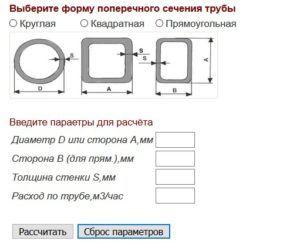
- Let's calculate the pipe's throughput using an online calculator
- What factors influence the flow of liquid through a pipeline?
- Calculations of the cross-section according to SNIP 2.04.01-85
- Formula for calculating by pressure and pipe diameter: q = π×d²/4 ×V
- Determination of pressure loss
- Video: How to calculate water consumption
- Answers to current questions
Let's calculate the pipe's throughput using an online calculator
To make the calculation correctly, it is necessary to pay attention to the following:
— 1 kgf/cm2 = 1 atmosphere;
— 10 meters of water column = 1 kgf/cm2 = 1 atm;
— 5 meters of water column = 0.5 kgf/cm2 and = 0.5 atm, etc.
— Fractional numbers are entered into the online calculator using a period (for example: 3.5, not 3.5)
What factors influence the flow of liquid through a pipeline?
The criteria that influence the indicator in question comprise a long list. Here are some of them.
- The internal diameter that the pipeline has.
- The flow rate, which depends on the pressure in the line.
- Material taken for the production of pipe assortment.
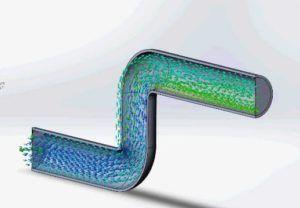
The water flow rate at the main outlet is determined by the pipe diameter, as this characteristic, along with other parameters, influences the system's capacity. When calculating the amount of liquid consumed, the wall thickness must also be taken into account, as it is determined based on the estimated internal pressure.
It could even be argued that the determination of "pipe geometry" isn't solely influenced by the length of the network. The cross-section, pressure, and other factors play a very important role.
Furthermore, some system parameters have an indirect, rather than direct, impact on flow rate. These include the viscosity and temperature of the pumped fluid.

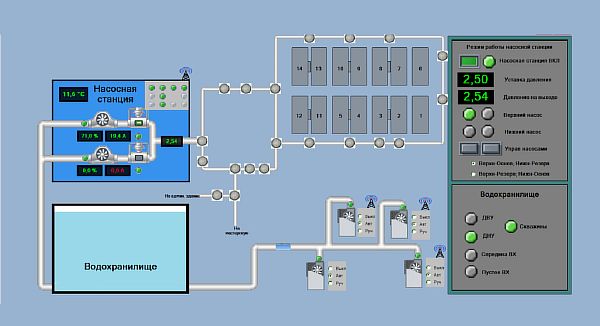
To summarize, determining the network's capacity allows us to accurately determine the optimal material for system construction and select the technology used for its assembly. Otherwise, the network will not function effectively and will require frequent emergency repairs.
Calculation of water consumption by diameter round pipe, depends on its sizeConsequently, a larger cross-section will move a significant amount of fluid over a given period of time. However, when calculating and taking the diameter into account, pressure must not be ignored.
If we look at this calculation using a specific example, it turns out that less fluid will flow through a meter-long pipe with a 1-cm opening in a given time period than through a main line several dozen meters high. This is understandable, as the highest water flow rate on a site will be greatest at maximum network pressure and at the highest water volumes.
Calculations of the cross-section according to SNIP 2.04.01-85
First of all, it's important to understand that calculating the diameter of a culvert is a complex engineering process. It requires specialized knowledge. However, when constructing a domestic culvert, the hydraulic calculation for the cross-section is often performed independently.
This type of design calculation of flow rate for a drainage structure can be performed in two ways. The first is using tabular data. However, when consulting tables, it is necessary to know not only the exact number of faucets but also the number of water collection containers (bathtubs, sinks), and other items.
Only with this information about the drainage system can one use the tables provided by SNIP 2.04.01-85. These tables are used to determine the volume of water based on the pipe circumference. Here's one such table:
According to SNiP (Building Code of Practice), the daily water consumption per person does not exceed 60 liters. This is assuming the home is not equipped with running water, but in a well-appointed home, this amount increases to 200 liters.
While these volumetric data showing consumption are certainly interesting as information, a pipeline specialist will need to determine completely different data—volume (in mm) and internal pressure in the pipeline. These aren't always available in a table. Formulas help obtain these data more accurately.
It's already clear that the system's cross-sectional dimensions influence the hydraulic consumption calculation. For home calculations, a water flow formula is used, which helps to obtain the result given the pressure and pipe diameter data. Here's the formula:
Formula for calculating by pressure and pipe diameter: q = π×d²/4 ×V
In the formula, q represents the water flow rate, measured in liters. d is the pipe cross-sectional area, measured in centimeters. And V in the formula represents the flow velocity, measured in meters per second.
If the water supply network is fed by a water tower, without the additional assistance of a pressure pump, the flow velocity is approximately 0.7–1.9 m/s. If any pressure pump is connected, its data sheet contains information on the pressure coefficient created and the flow velocity of the water.
This formula isn't the only one. There are many others. They can be easily found online.
In addition to the formula presented, it should be noted that the inner walls of the tubular products have a significant impact on the system's functionality. For example, plastic products have a smooth surface compared to their steel counterparts.
For these reasons, plastic has a significantly lower resistance coefficient. Furthermore, these materials are not susceptible to corrosion, which also has a positive effect on the throughput capacity of the water supply network.
Determination of pressure loss
The calculation of water passage is made not only by the diameter of the pipe, it is calculated by pressure dropLosses can be calculated using special formulas. Each person will decide for themselves which formulas to use. Various options can be used to calculate the required values. There is no single, universal solution to this problem.
But first of all, it's important to remember that the internal clearance of a plastic or metal-plastic structure will remain the same after twenty years of use. However, the internal clearance of a metal structure will decrease over time.
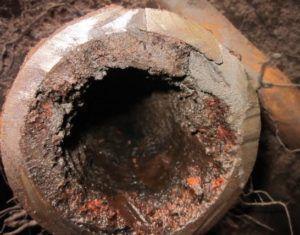
This will lead to a loss of some parameters. Consequently, the water velocity in the pipe in such structures will vary, as the diameters of the new and old networks will in some cases differ significantly. The resistance in the main line will also differ.
Before calculating the required fluid flow parameters, it's important to consider that flow velocity losses in a water pipeline are related to the number of turns, fittings, volume transitions, the presence of shutoff valves, and friction. Moreover, all of these factors should be carefully prepared and measured when calculating flow velocity.
Calculating water consumption using simple methods isn't easy. However, if you encounter any difficulties, you can always seek help from specialists or use an online calculator. This way, you can be sure that your plumbing or heating system will operate at maximum efficiency.
Video: How to calculate water consumption
Answers to current questions
To determine flow rate, use freely available online tables or an online calculator. Perform the mathematical calculation using the formula: Q = π × d²/4 × V. Substitute the generally accepted value of 3.14 for π. The value d refers to the internal diameter of the pipe. V is the water flow velocity. In a water supply system from a tower, the velocity is 0.7-1.9 m/s. For an autonomous water supply, the flow velocity depends on the performance of the pumping equipment. You can find the data in the manufacturer's instructions.
To calculate the fluid flow rate, use an online calculator. A suitable mathematical formula is V = 1000 x Q / S. Substitute the pipe cross-sectional area (mm2) for S. Q is the flow rate (l/s).
Calculate the diameter d online using a calculator or the formula: d = √ (4000 x Q / V / π). Q represents the water flow rate. Replace V with the flow velocity in the pipeline. The average flow velocity for a water supply from a tower is 0.7-1.9 m/s. For a stand-alone water supply system, the flow velocity V depends on the capacity of the pump used. You can find the data in the equipment manual.
The volume of fluid flow depends on the pipeline's internal diameter, pressure, and flow velocity. Flow rate is also affected by the material the pipeline is made of. PVC pipelines have smooth internal walls, which impede flow less than corroded, rough metal.
Circulation occurs in closed hot water supply and heating systems. The circulation flow rate is independent of water consumption by consumers from the hot water supply network. Determine this value using the formula: Q = k x qt/(4.187 x dt). Substitute the heat loss in the main line for qt. Find the difference in water temperature between the inlet and outlet of the system and substitute this value for dt. You will also need to know the circulation misalignment factor k for the utility network.
Calculate the flow rate using the formula: V = 1000 x Q / S. Substitute the cross-sectional area of the pipeline (mm2) for the S value. Q is the liquid flow rate (l/s).
The two quantities are interdependent. As pressure increases, the speed of the liquid working medium through the pipe increases.
Pressure is measured in pascals (P), megapascals (MPa), bars (bar), and atmospheres (atm). One bar is equal to 0.1 MPa, 100,000 Pa, or 0.98692 atm. Household pressure gauges are measured in bars. Plumbers round 1 bar to 1 atmosphere.
The diameter of the main line is determined based on the installation site. Internal wiring and plumbing fixture connections are installed with 15-20 mm pipe. Risers in apartment buildings are installed with a diameter of 25-32 mm. Connecting a private home with an independent water supply to a well is done with a diameter of 32-55 mm. Main lines larger than 55 mm are installed along streets in centralized water supply networks.
You can calculate the volume of a section or the entire pipeline using the formula: V = S x L. Replace S with the cross-sectional area of the pipe. For L, substitute the length of the pipeline for which you are calculating the volume.
Pipelines are designed to transport liquids, gases, bulk solids, and viscous substances. The pressure head (∆p) depends on the density (ρ) of the working fluid. The material from which the pipe is made, with its characteristic friction coefficient (λ), also influences this. For calculations, you will need to know the speed of the working fluid (v) and the internal diameter of the pipeline (d). Substitute the data into the formula: ∆p = λ • L/d • ρ/2 • v².
For a water supply from a tower without pumping equipment, a flow rate of 0.7-1.5 m/s is used in calculations. In autonomous water supply systems, the water flow rate depends on the pump capacity. The parameters are found in the equipment manual.
Use the following formula for mathematical calculations: Q = π×d²/4 ×V. Replace π with 3.14. d refers to the internal diameter of the pipe, and V is the flow velocity.
For precise calculations, use the Darcy-Weisbach formula (ΔP = λ x L/D x V2 /2q x ϸ), which takes into account possible pressure drops along the pipeline. The following values are implied: λ is the friction loss due to the flow against the walls of the pipeline section, V is the velocity, ϸ is the viscosity of the water, and D is the internal diameter of the pipe. The generally accepted constant q is 9.8. L is the length of the pipeline used for the calculations.
The amount of water consumed is determined by a water meter. Average daily rates per person are established. In a private home with running water and sewerage but no bathtub, the consumption will be 95-120 liters. If a bathtub is installed, the rate increases to 180 liters per day.
The average amount of water consumption is calculated by multiplying body weight by 35 for men and by 31 for women. For those involved in sports, the hours of training are multiplied by 600 for men and 400 for women.
Experimentation has established the average water consumption for showering. A thorough bath with soaping uses up to 80 liters of water. Rinsing without soaping requires up to 25 liters.
You can determine your tap water consumption using the formula: Q = S x V. Replace S with the area of the tap opening (find out by multiplying: 3.14 x r2). V is the flow rate in the water main.
Thanks for the calculator, it makes the calculations much easier.
…Where is the calculator?
(in the article) follow the link
How many atmospheres are needed to push 50 cubic meters of water per hour through a short pipe with a diameter of 80 mm?
What is the length of the hose? What is the approximate outlet pressure and water temperature?
Good afternoon
Could you please tell me how I can calculate the main parameters of a hydrant (knowing the pressure at the open and closed columns in the hose) to understand their compliance with regulatory documentation?
Thank you in advance for your prompt response!
Hello. Your request doesn't provide enough information to fully understand the problem. However, based on what we do have, we understand that this issue is highly technical, placing it outside our scope of expertise. Therefore, unfortunately, we are unable to assist you.
Hello. How do I calculate how much water is needed to double the pressure? For a hydraulic test of a PE110 line 150 meters long, I need to increase the pressure from 4 to 8 bar.
Hello. It's best to increase the pressure gradually until the desired value is reached.