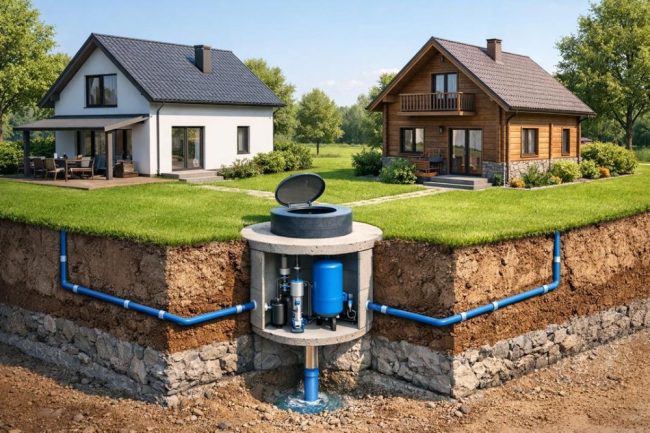
Two houses on adjacent plots or a house + guest house often run into the same problem: water "like in an apartment" - always and with normal pressure. Option "a well for 2 houses" It's quite functional, but only if you understand in advance how much water you actually need, what type of well can handle such a load, and how to properly lay out the system.
- When one source for two houses is really convenient
- A well for two houses: pros and cons
- Sandy or artesian: which will support two houses?
- Sand well
- Artesian well
- Working diagrams for connecting two houses from one well
- One line and one hydraulic accumulator
- Two lines and two hydraulic accumulators
- Storage tanks
- Pump control and conflict protection
- Common well maintenance
- Pre-drilling agreements
- Maintenance regulations
- Technical nuances that hold the pressure
- Result
When one source for two houses is really convenient
A common well usually "fires" in three cases:
- There is no central water supply or connecting to it is too expensive/complicated.
- I want to split the budget for drilling and development between two owners.
- The houses are close together, and the routes are short - without unnecessary turns and pressure losses.
In practice, issues related to calculating drilling parameters and options for arranging a common source are often considered using solutions described by the company.
A well for two houses: pros and cons
Pros Cons Savings: drilling, installation, and maintenance costs are shared Higher load: flow reserve and proper pump selection required Space savings: one source instead of two Disputes possible: water consumption, electricity bills, repairs Easier to monitor the system: one caisson, one automation Selling a plot becomes more complicated if the new owner is against the overall plan With the right calculations, an artesian source can supply two houses reliably A caisson is often needed, which adds costs
The key point: the idea of "one well for two" is neither good nor bad. Calculations and design are crucial. If you do it by eye, problems usually arise at the most inconvenient moment—when the shower, washing machine, and irrigation are turned on at the same time.
Sandy or artesian: which will support two houses?
For two houses, two things are important: How much water can a well produce consistently? And How much does flow rate change seasonally?A visual comparison of the types can be found in the article.
Sand well
Sand wells are often drilled on 30–80 mIn terms of debit, they often give 500–1000 l/hourFor one house, this is often "normal." But for two houses, there's a risk that the water supply will only be sufficient during steady-state consumption—without peaks.
Why the sand option may not be able to handle two houses:
- consumption has increased - the pressure started to wander;
- during the hot period the water level may drop;
- possible over time siltation and drop in flow rate.
The conclusion is simple: a sand well for two houses is possible if water consumption is low (summer cottage style, minimal plumbing, no regular watering, and year-round living).
Artesian well
An artesian spring draws water from deep limestone layers 30–200 mIn terms of debit, it often gives 2500–3000 l/hour, so two houses are usually closed with a reserve - especially if one house periodically has guests or has a bathhouse/watering system.
Why is an artesian well more convenient for two houses:
- water usually flows more stable, fewer surprises during the season;
- resource above with proper arrangement;
- less dependence on drought and load fluctuations.
A caveat: the entry fee is usually higher, plus artesian springs may have additional documentation requirements. It's best to discuss this upfront, before drilling, to avoid having to redesign the system later.
Working diagrams for connecting two houses from one well
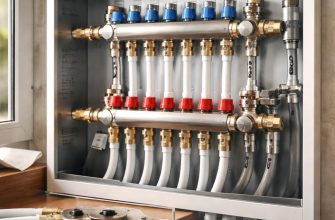
A dual-user system begins with the "heart"—the node housing the automation and wiring (caisson/adapter, freeze protection, and easy access). Next, a well connection scheme for the two houses is selected, and it's important not to overcomplicate things unnecessarily, but also not to skimp on the bottom line.
One line and one hydraulic accumulator
The hydraulic tank and automation are located in a caisson. After the distribution unit, the water flows to two houses through a tee.
Suitable if:
- houses nearby;
- water consumption is approximately the same;
- there are few points of analysis.
Cons that are often overlooked:
- If there is a "disassembly" in one house, there may be a second one drop the pressure;
- failure of the hydraulic accumulator or relay - and Both houses are left without water.
Two lines and two hydraulic accumulators
There are two lines coming from the well, and each has its own hydraulic tank (and therefore its own “behavior” in terms of pressure and water reserves in the system).
Pros:
- the pressure is more stable;
- each house is more autonomous;
- It's easier to balance expenses when one house is "living more actively."
Cons:
- more equipment and settings;
- installation is more complicated and expensive.
Storage tanks
Water is first collected in tanks and then supplied to the house as needed.
Pros:
- there is a supply of water "just in case";
- the pump works more smoothly, without frequent starts;
- It's easier to survive consumption peaks.
Cons:
- space is needed for containers;
- The system is more expensive and requires careful installation.
Pump control and conflict protection
If the well is shared, not only the water pressure but also the operational aspects are important. To avoid arguments about who turned on the water and who's to blame, it's best to plan the management and metering in advance.
Practical approaches:
- a single automation unit in the caisson + clear access regulations;
- separate lines (if the flow rate is different);
- Water and electricity metering: meters eliminate unnecessary conversations.
Common well maintenance
A water well for two houses lasts a long time when there is order and clear rules.
Pre-drilling agreements
- where the well and caisson will be (and who has access);
- How are electricity and consumables paid for?
- How the repairs are divided: equally or according to a pre-agreed scheme;
- Who calls the technician and how decisions are made.
Maintenance regulations
- year-round operation: check twice a year;
- seasonal: check once a year before conservation.
What is usually checked:
- pump and cable;
- filters/mud traps;
- hydraulic accumulator and pressure;
- tightness of connections and operation of automation.
Technical nuances that hold the pressure
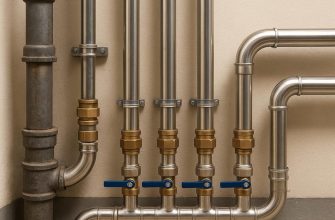
- fewer unnecessary turns and narrowings on the route;
- normal pipe laying depth is below freezing;
- insulation of inputs and nodes where it most often “seizes”.
Result
Connecting two houses to a single well can be done without compromising comfort if you do everything carefully: estimate your total water consumption, select a source with sufficient flow rate, and tailor a distribution system to your actual conditions (distance between houses, seasonality, irrigation). To prevent the system from becoming a "pressure lottery," it's important to agree on payment and maintenance in advance and not skimp on automation and proper piping.