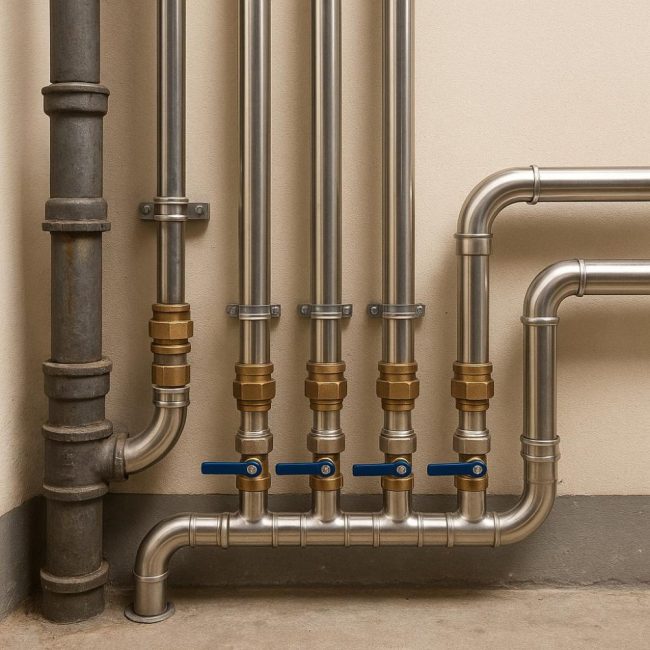
Hot water supply in multi-story buildings is one of the most complex engineering systems in residential buildings. It must ensure stable temperatures, sufficient pressure, and sanitary safety while operating 24/7 under variable loads. Errors during the design and installation stages lead to complaints from residents, excessive resource consumption, accelerated equipment wear, and an increased risk of bacterial contamination.
Many older homes still use risers made of standard carbon steel with worn-out galvanization, while modern designs increasingly rely on stainless steel pipes and polymer systems designed to last for decades without corrosion or frequent failures. The contrast between these generations of solutions clearly illustrates the evolution of approaches to safety, energy efficiency, and comfort.
- Historical diagram: old risers and open hot water supply systems
- The main problems of old hot water supply systems
- Corrosion and fouling of pipelines
- Temperature instability and complaints from residents
- Sanitary risks and bacterial load
- Transition to closed systems and the role of individual heating units
- The principle of a closed system
- Individual heating units (IHU)
- Modern pipeline materials: comparison and areas of application
- Carbon and galvanized steel
- Stainless steel
- Polymer materials (PP-R, PEX, metal-polymer)
- Hydraulic balancing and circulation: the key to comfortable temperatures
- Purpose of circulation
- Balancing of risers
- Sanitary aspects of modern hot water supply
- Temperature conditions and Legionella
- Material quality and migration of substances
- Energy efficiency: thermal insulation, automation and metering
- Thermal insulation of pipelines
- Automatic regulation
- Metering units
- Approaches to modernization of existing hot water supply systems
- Examination and diagnostics
- Partial replacement of risers
- Comprehensive reconstruction with circuit replacement
- Trends in the development of hot water supply systems in multi-story buildings
- Conclusion
Historical diagram: old risers and open hot water supply systems
For a long time, the standard model in apartment buildings was so-called open hot water supply systems. Domestic hot water was drawn directly from the heating network; in reality, residents received water from the heating mains, which had undergone only minimal treatment.
Key features of this era:
Pipeline material
- Black steel without internal coating
- Less commonly – galvanized steel
Low resistance to scale deposition and corrosion
Wiring diagrams
- Vertical risers running through all floors
- Top or bottom wiring
Lack of individual regulation at the apartment level
Hydraulic modes
- Unstable pressure
- Seasonal temperature variations
- The dependence of the quality of hot water supply on the state of the main heat supply networks
Such systems were designed to meet different standards and tariffs. Water loss, imperfect thermal insulation, and partial corrosion were considered acceptable, and sanitary risks were assessed less strictly than today.
The main problems of old hot water supply systems
As buildings age and sanitary regulations become more stringent, traditional solutions have become the source of a whole host of problems.
Corrosion and fouling of pipelines
The inner surface of steel pipes is subject to:
- electrochemical corrosion;
- scale deposition at high temperatures;
- overgrowth with biofilms and corrosion products.
Consequences:
- reduction of the pipeline cross-section, increase in hydraulic resistance;
- pressure drop on the upper floors;
- local areas of stagnant water;
- deterioration of the organoleptic properties of water (color, odor, turbidity).
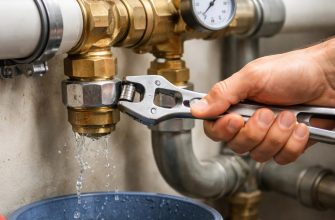
Corrosion damage to connections and areas of greatest stress leads to leaks and failures, often hidden in shafts and ceilings.
Temperature instability and complaints from residents
Old systems were designed for different heat supply modes and consumption profiles. With today's schedules and changing loads, the following arise:
- long wait for hot water when opening the tap;
- temperature fluctuations when flow rate changes (low shower comfort);
- overheating of water at night and underheating during peak hours.
From an energy saving perspective, this type of operation is ineffective: some of the thermal energy is lost in poorly insulated basements and risers, and regulation is difficult.
Sanitary risks and bacterial load
When hot water temperatures drop below 50–55°C and stagnant zones occur, conditions are created for the growth of bacteria, including Legionella. Old risers and units are vulnerable to:
- formation of biofilms on the inner surface;
- accumulation of organic matter and rust;
- difficulties with thermal and chemical disinfection.
As a result, the risks of adverse health effects from long-term use of water in showers and baths increase.
Transition to closed systems and the role of individual heating units
The current stage of development of public utilities infrastructure is associated with the transition to closed heat supply systems and the organization of hot water supply through heat exchangers in heating points - central (CHP) or individual (ITP) to the house.
The principle of a closed system
In a closed circuit:
- the coolant from the heating main does not flow directly to the consumer;
- water for hot water supply is taken from the city water supply (drinking quality);
- Heating is carried out through plate or shell-and-tube heat exchangers.
This improves sanitary safety, simplifies filtration and dosing of reagents, and allows flexible control of the DHW temperature regardless of the heating network supply schedule.
Individual heating units (IHU)
The ITP at the house level performs several functions:
- maintaining a set DHW temperature using automation;
- compensation for changes in consumption (peak loads in the morning and evening);
- protection against overheating and hydraulic shock;
- Thermal energy metering.
This link determines the operating mode of the in-house system: temperature, pressure, and circulation. The quality of the IWP's design and configuration determines residents' comfort no less than the choice of materials for the risers and wiring.
Modern pipeline materials: comparison and areas of application
Updating hot water supply systems is impossible without rethinking the materials used for risers, floor-to-floor wiring, and connections to appliances.
Carbon and galvanized steel
Advantages:
- high mechanical strength;
- resistance to hydraulic shock;
- the familiarity of the installation technology for many installers.
Flaws:
- corrosion due to damage to the zinc layer;
- reduction in service life at constant high temperatures;
- the need for welding or threaded connections with a high risk of leakage during aging.
This material is gradually being replaced by more durable solutions, especially during major renovations and new construction.
Stainless steel
Stainless steel alloys (most often based on chromium and nickel) have:
- high corrosion resistance in hot water;
- smooth inner surface, less susceptible to deposits;
- stability of characteristics over decades with the correct selection of grade and thickness.
There are two common technologies:
- Welded systems made of stainless steel pipes with orbital or manual welding
- Press systems with profile fittings and seals, allowing for faster installation and a reduction in the amount of welding work
These solutions are suitable for risers and main lines where reliability and long service life are critical.
Polymer materials (PP-R, PEX, metal-polymer)
Polymer and metal-polymer pipes are widely used for intra-apartment wiring:
- corrosion resistant;
- lighter in weight;
- have good hydraulic characteristics;
- help reduce the noise from flowing water.
However, they require strict adherence:
- temperature and pressure conditions;
- installation technologies (welding, press fittings);
- recommendations for protection from ultraviolet radiation and mechanical damage.
For risers in tall buildings, the choice of polymers is limited by pressure and temperature, so they are often combined with metal pipelines.
Hydraulic balancing and circulation: the key to comfortable temperatures
Even when using high-quality materials, the hot water supply system may not operate satisfactorily if the hydraulics and circulation calculations are not correctly calculated.
Purpose of circulation
Circulation lines in the DHW system:
- ensure temperature maintenance in risers and connections;
- reduce the time it takes to wait for hot water when opening the tap;
- prevent stagnation zones, reducing the risk of bacterial growth.
The absence or incorrect adjustment of circulation leads to cooling of water in remote points, increased heat loss and increased water consumption while residents “drain” the cooled volume.
Balancing of risers
In multi-story buildings, risers have different lengths and hydraulic resistances. Without balancing:
- some of the risers overheat and receive excess flow;
- others are not heated enough, the water temperature on the upper floors drops.
Used:
- balancing valves on return lines;
- automatic differential pressure regulators;
- thermostatic valves in circulation sections.
Proper balancing reduces temperature variations, reduces noise and improves the energy efficiency of the entire system.
Sanitary aspects of modern hot water supply
Technical reliability and hydraulic stability are not the only requirements for hot water supply. Sanitary indicators are now considered an equally important quality criterion.
Temperature conditions and Legionella
Optimal temperature range in the DHW system:
- not lower than 55–60 °C in the supply pipeline;
- not less than 50 °C at the most distant point of the system.
Temperatures dropping to 25–45°C create favorable conditions for the development of legionella and other microorganisms. To limit the risk, the following measures are used:
- regular thermal disinfections (raising the temperature to 70 °C for a limited time);
- preventive flushing and construction of systems that prevent stagnation;
- Pipeline materials with a smooth surface and low tendency to form biofilms.
Material quality and migration of substances
Pipe and fitting materials must have:
- hygienic certificates and approvals for use in drinking water supply systems;
- resistance to hot water and cleaning solutions;
- minimal migration of components into water during long-term use.
Particular attention is paid to polymeric materials and sealing elements operating in hot water with the addition of reagents.
Energy efficiency: thermal insulation, automation and metering
Modern hot water supply systems are considered not only as a means of delivering hot water, but also as part of an energy saving complex.
Thermal insulation of pipelines
Proper insulation:
- risers in unheated areas (basements, attics);
- circulation lines;
- piping in places where it passes through cold rooms,
reduces heat loss and allows:
- stabilize the temperature;
- reduce the load on heat sources and circulation pumps;
- reduce the risk of condensation on the surface of pipes.
Automatic regulation
Modern ITPs and CTPs are equipped with:
- weather-dependent automation;
- DHW temperature regulators;
- frequency-controlled pumps.
These systems maintain a set temperature and pressure, responding to changes in consumption and heating network parameters. This results in reduced heat and water consumption, and fewer complaints about overheating and underheating.
Metering units
Installation of heat meters and water meters:
- makes resource consumption transparent;
- encourages management companies to optimize operating modes;
- creates a basis for a fair distribution of costs among residents.
When reconstructing a hot water supply system, it is recommended to provide for metering already at the design stage.
Approaches to modernization of existing hot water supply systems
Completely replacing all risers and plumbing in an existing building is a complex and costly project, especially in established buildings. In practice, a phased approach is used.
Examination and diagnostics
Before choosing technical solutions, the following is carried out:
- hydraulic testing and actual pressure measurements;
- assessment of temperature at control points;
- endoscopy or selective opening of pipeline sections;
- Analysis of residents' complaints about risers and entrances.
Based on the results, a repair program is developed: from minor repairs to complete reconstruction.
Partial replacement of risers
The most worn and problematic risers are replaced first:
- frequent leaks are eliminated;
- the pressure increases on the upper floors;
- The risk of accidents during the heating season is reduced.
It is important to ensure the compatibility of new materials with old components to avoid creating “weak spots” at the transitions.
Comprehensive reconstruction with circuit replacement
During a major overhaul it is possible to:
- replacement of an open system with a closed one with a central heating point;
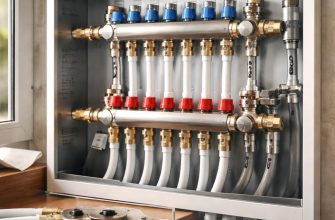
- changing the wiring diagram (for example, switching to horizontal wiring with manifold cabinets on the floors);
- installation of new circulation lines and balancing units.
This approach requires detailed design development, but allows for a transition to a modern level of comfort and energy efficiency.
Trends in the development of hot water supply systems in multi-story buildings
The current stage of development of engineering systems is characterized by several stable trends:
- Growing sanitary safety requirements
Emphasis on preventing the development of legionella, using materials with improved hygienic characteristics, and implementing cleaning and disinfection regulations. - Further proliferation of closed systems
Transition to water heating through heat exchangers with the ability to flexibly configure modes and record thermal energy. - Extensive use of corrosion-resistant materials
The rejection of untreated steel, the use of stainless and polymer pipes in combination with modern fitting systems. - Integration of automation and monitoring
The transition from manual control to intelligent control systems capable of analyzing data and maintaining the regime within optimal limits. - Life cycle orientation
Evaluation of solutions not only by the initial installation cost, but also by the total costs over 20–30 years of operation: repairs, accidents, heat loss, complaints from residents.
Conclusion
Hot water supply systems in multi-story buildings are undergoing a major modernization. Old, corroding steel risers, unstable systems, and lack of metering are gradually giving way to comprehensive solutions focused on sanitary safety, comfort, and energy efficiency.
The choice of pipe material, circulation pattern, heating station settings, and installation quality create a unified technical and operational picture. With proper renovation and implementation of modern technologies, it is possible to significantly extend the lifespan of buildings, reduce costs, and provide residents with consistent hot water quality that meets current standards and expectations.