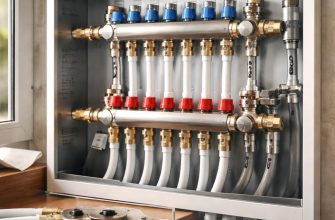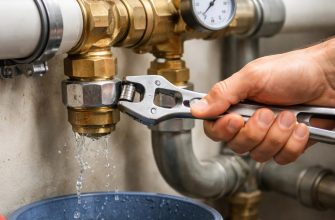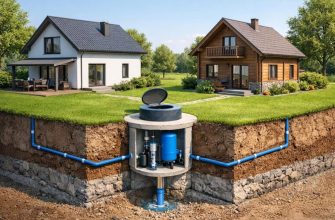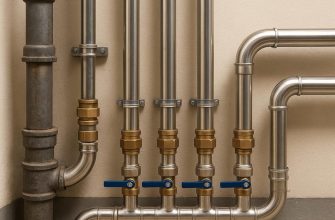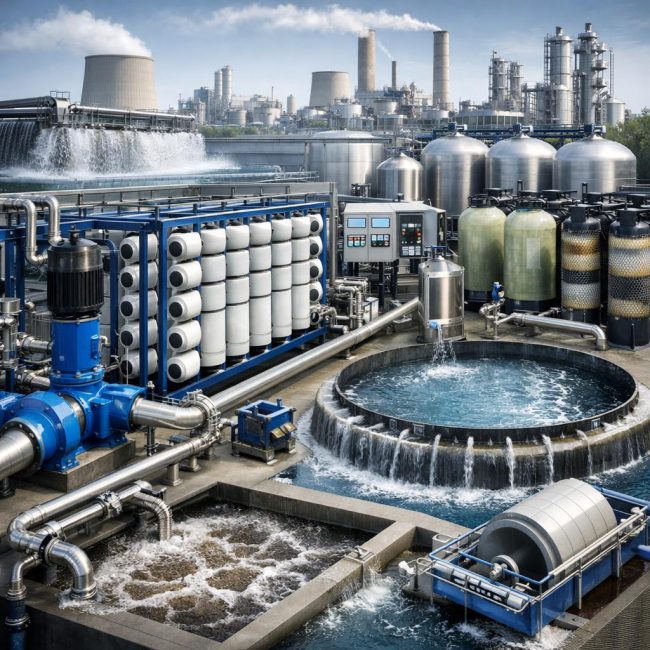
Water supply systems in industrial facilities are more than just a water supply; they are complex engineering systems that ensure the smooth operation of technological processes. The stability of production, energy consumption, and environmental safety depend on the efficiency of industrial water supply.
A properly designed water supply system allows businesses to maintain optimal equipment operating conditions, conserve resources, and meet water quality requirements. Modern technologies enable not only a stable supply but also the efficient use of water resources.
Tasks and features of industrial water supply systems
The main goal of such systems is to provide production with water of the required quality and volume with minimal losses. To achieve this, facilities employ various water supply, treatment, and recycling systems.
Among the key tasks of industrial water supply systems are:
- supply of water to technological processes and for production needs;
- ensuring fire and sanitary safety;
- regulation of water pressure and temperature;
- purification, filtration and reuse of water.
Each industry has its own requirements. For example, the food industry requires sterile water, while metallurgy requires water with specific physical and chemical properties. Therefore, the design takes into account the parameters of the source water, the composition of the wastewater, and environmental safety standards.
Types of industrial water supply systems
Depending on the method of water use, systems are divided into three main types:
- Straight-through pumps are the simplest type, using water once and then discharging it into the sewer. They are used in facilities with low consumption volumes.
- Recirculating water—water is purified and returned to the system after use. This is the most economical option.
- Closed-loop systems are completely autonomous, with minimal losses. They are used in facilities with high environmental standards.
Each system is individually selected. During the design stage, specialists determine the optimal pipeline diameter, pumping equipment capacity, and treatment system.
Technologies and equipment
Modern industrial water supply systems are equipped with automation that regulates water pressure and flow based on current production needs. This reduces the load on equipment and improves energy efficiency.
Pumping equipment plays a vital role. Its reliability and performance directly impact the uninterrupted water supply. When selecting pumps, the volume of liquid being pumped, the water composition, and the operating conditions are taken into account.
In practice, many companies turn to engineering companies that design and implement systems tailored to specific needs. Information on modern solutions .
Energy efficiency and environmental aspects
In today's environment, businesses strive to minimize water and energy consumption. One solution is to use recirculating systems that reuse purified water. This not only reduces costs but also reduces the burden on natural resources.
Automation also plays a vital role: flow and pressure sensors and intelligent pump control systems allow for monitoring of water delivery and leak prevention. This increases efficiency and reduces the risk of accidents.
In addition, many companies are implementing wastewater heat recovery technologies, which further reduces energy costs.
Prospects for the development of the industry
Modern industrial water supply is evolving towards integrated systems that combine automatic control, filtration, monitoring, and energy conservation.
The future belongs to smart grids, which are capable of analyzing indicators in real time and independently optimizing equipment operation.
Greening remains an important focus—reducing water consumption, using closed-loop systems, and treating wastewater to safe levels. Such solutions not only ensure compliance with legal requirements but also foster a responsible attitude toward natural resources.
Conclusion
Industrial water supply is a complex engineering system that ensures the smooth operation of enterprises and the safety of technological processes. Effective design and automation help reduce costs, improve reliability, and minimize environmental impact.
Modern technologies make it possible to create flexible, sustainable and energy-efficient solutions that meet the demands of the times.