Modern water supply systems are increasingly less like simple systems with a minimal set of pipes and connections. The number of water drawoff points is growing, pressure stability requirements are increasing, and access to hidden utilities is becoming limited. Under these conditions, plumbing fixtures are increasingly being designed as an integrated system, where not only the reliability of individual components is important, but also the logic of their integration.
A collector-based water distribution system is the perfect solution to this problem. It allows for streamlining pipelines, distributing the load between consumers, and making the system easy to operate, especially in apartments and houses with complex layouts.
- What is a manifold wiring system and how does it work?
- Why does a collector bring order to the system?
- Stable pressure
- Transparency of the system
- Controllability
- Collector and service: fewer risks, fewer problems
- Minimum connections in walls
- Quick troubleshooting
- Ease of upgrade
- Collector diagram and types of pipes
- Where are collectors placed?
- Typical mistakes in collector wiring
- Range and compatibility of elements
- When is manifold wiring particularly appropriate?
- Result
What is a manifold wiring system and how does it work?
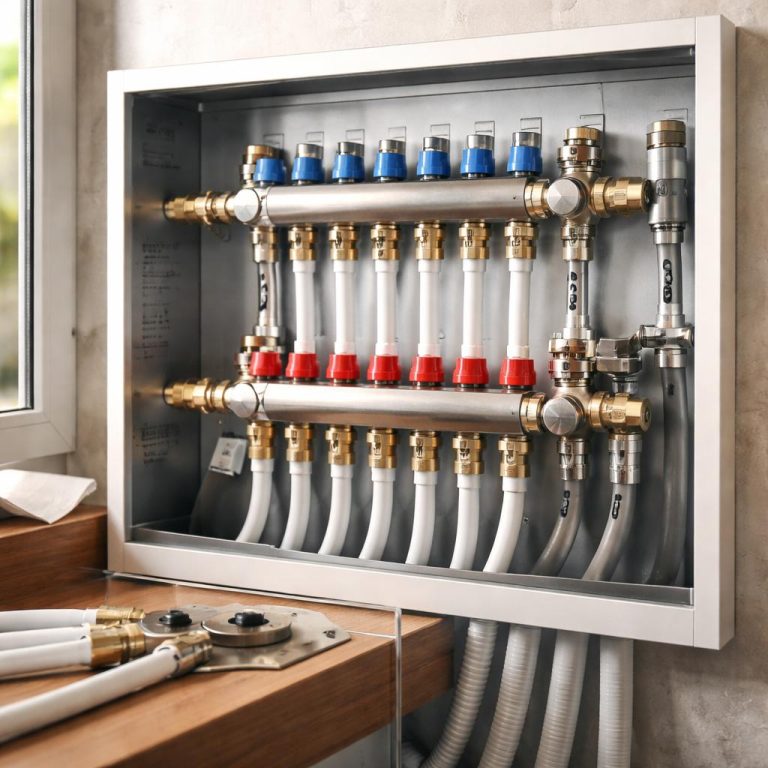
The manifold system is built around a distribution unit—a cold and hot water manifold. From there, a separate line runs to each consumer: the faucet, toilet, washing machine, boiler, and dishwasher.
Unlike a sequential system with tees, there are no "common" sections through which the entire flow passes. Each device receives water directly from the manifold.
Basic composition of the system:
- water supply to an apartment or house;
- coarse and fine filters;
- pressure reducers (if necessary);
- cold and hot water collectors;
- individual shut-off valves at each outlet;
- separate pipes to consumption points.
This device immediately sets a different level of control and comfort.
Why does a collector bring order to the system?
The main difference of the collector circuit is the independence of consumers from each other.
Stable pressure
When several faucets are opened at once, the pressure doesn't drop. The shower doesn't react to the washing machine, and the kitchen doesn't suffer from the toilet cistern.
Transparency of the system
Each line is clear: where it comes from, where it goes, and what it does. This is especially valuable for concealed installations, when pipes are hidden in walls or screeds.
Controllability
Any device can be switched off separately:
- without covering the entire apartment;
- without emergency situations;
- without haste and unnecessary manipulations.
This is convenient when replacing a faucet, repairing equipment or performing preventive maintenance.
Collector and service: fewer risks, fewer problems
From an operational point of view, the collector wiring system wins in several ways.
Minimum connections in walls
Each line runs as a single piece of pipe without intermediate fittings. This dramatically reduces the likelihood of leaks in hidden areas.
Quick troubleshooting
If a problem occurs, there's no need to guess which section is at fault. The specific circuit is closed, and the system resumes normal operation.
Ease of upgrade
Adding a new device or changing the configuration is easier: free manifold outputs allow the system to be expanded without reworking the entire wiring.
Collector diagram and types of pipes
Collector wiring is compatible with various materials, but is especially well suited to modern pipes:
- PEX and PERT - flexible, easy to lay in solid lines;
- metal-plastic — stable geometry, clear installation;
- polypropylene — is used less frequently due to the difficulty of laying long routes without connections.
The choice of material affects not only the installation but also the pipe diameter. In manifold systems, smaller diameters are often used, as there is no need to handle a large flow rate through a single common channel.
Where are collectors placed?
Most often, the collector unit is located:
- in a plumbing cabinet;
- in a niche with an inspection hatch;
- in the technical room.
It is important to ensure:
- free access to taps;
- legible line markings;
- neat laying of pipes without crossings and tension.
A properly assembled manifold looks like an orderly scheme, and not like a chaotic knot of pipes and taps.
Typical mistakes in collector wiring
Even with obvious advantages, there are errors that reduce the effect:
- lack of pressure reducer with unstable input;
- use of low-quality shut-off valves;
- savings on filtration;
- overloaded collector without output reserve;
- lack of signatures and logic in the wiring.
The manifold itself does not solve everything - it requires a well-thought-out assembly.
Range and compatibility of elements
A manifold system requires precise coordination of all components. Manifolds, shut-off valves, pipes, fittings, and mounting elements must match in connection types, diameters, and operating characteristics. Errors at this stage often don't become apparent immediately, but rather during operation—in the form of noise, uneven pressure, or maintenance difficulties.
Experience shows that it's more convenient to work with a systematized set of items, where elements are categorized by functional group. When preparing a specification, manifold assemblies, valves, piping systems, and components are typically compared using a single product range, such as that presented in the Trade House catalog. This simplifies compatibility checking and allows the system to be viewed as a coherent set of components rather than a collection of random parts.
When is manifold wiring particularly appropriate?
She is practically irreplaceable:
- in apartments with two or more bathrooms;
- in houses with boilers and DHW recirculation;
- for hidden installation of pipes;
- when using expensive finishes;
- in projects with high comfort requirements.
Even in a small apartment, the collector system quickly demonstrates its advantages in everyday use.
Result
A collector-based water distribution system doesn't complicate things, it simplifies life. It makes the system logical, manageable, and safe. Order in the pipes isn't reflected in appearance, but in how the system functions every day: without pressure surges, without unnecessary risks, and with straightforward maintenance.
This is why manifolds are increasingly becoming not just an option, but a basic element of modern plumbing systems, designed for long-term, trouble-free operation.