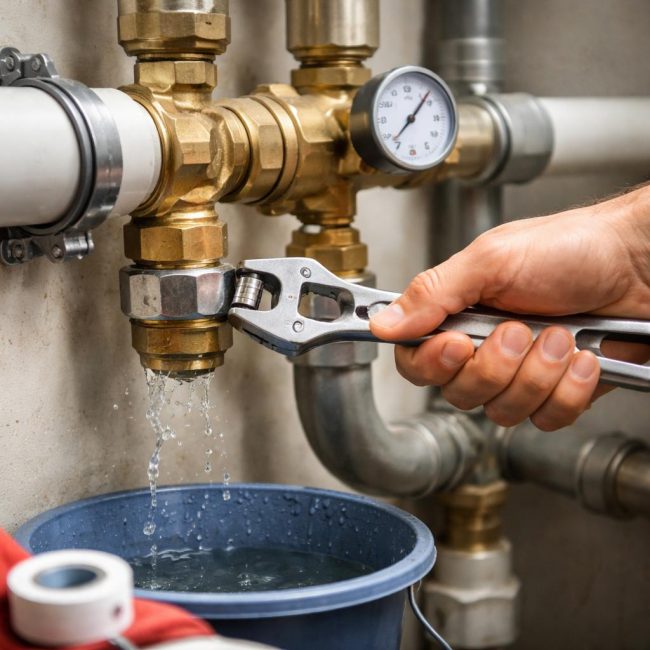
Leaks in water supply and heating systems remain one of the most common problems in building maintenance. They occur in both new and existing systems and often lead not only to material damage but also to complex repairs. In most cases, the cause lies not in the pipes themselves, but in the connections and errors made during installation.
Experience shows that system reliability is largely determined by the quality of the connecting elements and their suitability for operating conditions. In pressure sections, where temperature and pressure fluctuate, solutions such as pressure clamps play a key role in preventing leaks and maintaining a tight seal throughout the entire service life.
It's important to understand: a leak isn't an accident, but the result of specific errors or omissions. In most cases, it could have been prevented in advance.
- Why leaks occur: the main reasons
- Errors at the design stage
- Incorrect selection of connecting elements
- Violations of installation technology
- Wear and tear of the system
- The most vulnerable areas of water supply and heating systems
- Pipe connections
- Transitions between materials
- Areas with vibration
- Hidden communications
- How to Prevent Leaks: A Systematic Approach
- Competent selection of materials
- Using reliable connection solutions
- Installation quality control
- Testing before commissioning
- Regular maintenance
- Features of heating systems
- What to do if there have already been leaks
- Results
Why leaks occur: the main reasons
To effectively combat the problem, you first need to understand its sources. The causes of leaks can be roughly divided into several groups.
Errors at the design stage
Even high-quality materials won't save a system if it's designed incorrectly. Common mistakes:
- incorrect calculation of working pressure;
- ignoring thermal expansion;
- lack of compensation areas;
- Incorrectly selected pipe diameter.
As a result, local overloads occur in the system, which over time destroy connections.
Incorrect selection of connecting elements
One of the main causes of leaks is the use of improper fasteners. For example:
- household clamps are used where increased force is required;
- connections are not designed for vibration or water hammer;
- materials are not compatible with each other (galvanic corrosion).
The connecting element must match pressure, temperature and type of environment, and not just the pipe diameter.
Violations of installation technology
Even high-quality components don't work on their own. Common mistakes installers make:
- insufficient or excessive tightening;
- connection skew;
- damage to seals during assembly;
- contamination of contact surfaces.
Particularly dangerous are “almost invisible” defects that appear not immediately, but after months of use.
Wear and tear of the system
Every system has a resource. Over time:
- rubber seals lose elasticity;
- the metal is subject to corrosion;
- Plastic ages under the influence of temperature.
If prevention is not carried out, a leak becomes only a matter of time.
The most vulnerable areas of water supply and heating systems
Operating practice shows that most accidents occur not on straight sections of pipes, but at nodes.
Pipe connections
Couplings, fittings, and threaded joints are high-risk areas, especially when subject to temperature and pressure changes.
Transitions between materials
Metal-plastic and steel-HDPE connections require a special approach and correctly selected elements.
Areas with vibration
Pumps, boilers, and building connections create micro-movements that gradually weaken connections.
Hidden communications
Leaks in grooves and ceilings are detected late, when the damage is already significant.
How to Prevent Leaks: A Systematic Approach
Problems can only be avoided with a comprehensive approach – from design to regular maintenance.
Competent selection of materials
The materials of pipes and connections must be selected taking into account:
- working and peak pressure;
- maximum temperature;
- chemical composition of water;
- operating conditions (outdoors, indoors, humidity).
Saving at this stage almost always results in costs in the future.
Using reliable connection solutions
For areas with high loads, solutions designed specifically for these conditions must be used. This applies to:
- pressure systems;
- areas with water hammer;
- heating systems with high temperatures.
Here, uniform compression, vibration resistance and durability of the connection are especially important.
Installation quality control
Even if you have a project, it is important:
- observe tightening torques;
- use a torque tool where necessary;
- avoid distortions;
- Check the cleanliness of surfaces before assembly.
After installation, the system must be pressure tested.
Testing before commissioning
Pressure testing is not a formality, but a key step. It allows us to identify:
- weak connections;
- defects in materials;
- assembly errors.
The test pressure is usually higher than the working pressure, which creates a safety margin.
Regular maintenance
Even a properly installed system requires monitoring. It is recommended:
- inspect connections periodically;
- check for corrosion;
- monitor pressure changes;
- replace worn out parts in time.
Prevention is always cheaper than emergency repairs.
Features of heating systems
Heating places more stringent demands on connections than water supply:
- high temperature;
- continuous heating-cooling cycles;
- thermal expansion of pipes.
Therefore, it is especially important to take into account the compensation of deformations and the resistance of connections to cyclic loads.
What to do if there have already been leaks
If the system has already developed a leak, you can't limit yourself to local repairs. You must:
- Analyze the cause of the accident.
- Check similar nodes.
- Assess the overall health of the system.
- If necessary, replace the connection type with a more reliable one.
Ignoring the causes almost guarantees that the problem will recur.
Results
Leaks in water supply and heating systems are not inevitable, but rather the result of specific decisions and actions. They arise from design errors, improper selection of fittings, improper installation, and lack of maintenance.
You can avoid them if:
- approach the system comprehensively;
- take into account actual operating conditions;
- do not skimp on critical components;
- Conduct regular diagnostics.
A reliable system isn't just pipes and water inside them. It's a well-thought-out engineering design, where every connection contributes to the overall result: safety, durability and peace of mind for the owner.