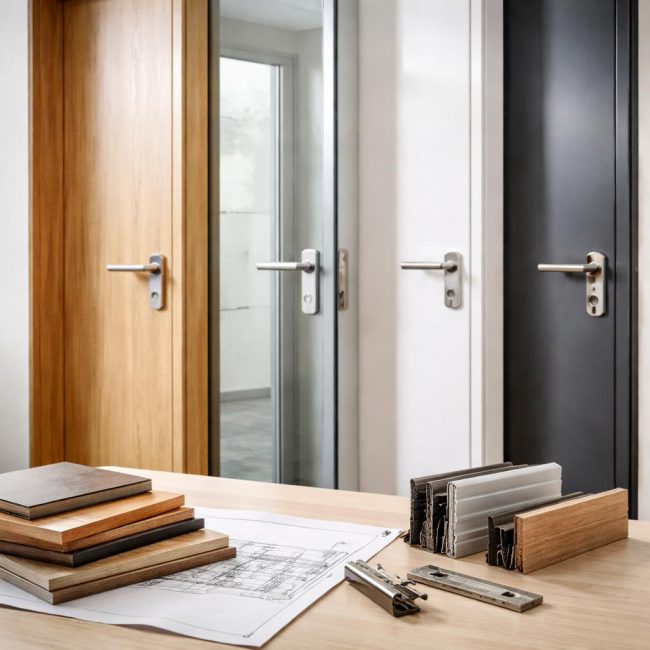
Organizing a workspace requires careful attention to detail, and office doors play a key role in this process. They affect not only the interior's appearance but also acoustics, privacy, security, and even how visitors perceive the company. The choice of material is key, determining the durability of the structure, ease of use, and its appropriateness to the style of the space.
- The Importance of Material in the Office Environment
- Wooden doors: classic and prestigious
- Glass doors: light and openness
- Plastic doors: practicality and affordability
- Metal doors: reliability and protection
- Combined solutions: a balance of properties
- The influence of material on acoustics
- Wear resistance and care
- Design and perception of space
- Safety and regulations
- Results
The Importance of Material in the Office Environment
Office doors are subject to intense use: daily opening and closing, and the movement of employees and clients. The material must withstand the load without losing its appearance or functionality. In addition to durability, other parameters are also important:
- soundproofing;
- wear resistance;
- ease of care;
- compliance with interior design;
- safety.
Different materials perform these tasks differently, and there is no one-size-fits-all solution. The choice depends on the specifics of the space: a meeting room, an executive office, an open space, or a technical area.
Wooden doors: classic and prestigious
Wood is traditionally associated with reliability and prestige. Such doors are often chosen for executive offices and conference rooms.
Advantages:
- high strength;
- good sound insulation;
- presentable appearance;
- possibility of restoration.
Flaws:
- sensitivity to changes in humidity;
- the need for regular care;
- higher cost compared to alternatives.
Solid wood creates a sense of solidity, but for high-traffic offices, veneered options are more often used—they are lighter and require less maintenance.
Glass doors: light and openness
Glass is widely used in modern offices, especially in spaces with transparency and teamwork concepts.
Advantages:
- visual expansion of space;
- transmission of natural light;
- modern appearance;
- moisture resistance.
Flaws:
- limited sound insulation;
- need for frequent cleaning;
- psychological factor - not all employees feel comfortable in completely transparent spaces.
Frosted glass, tinted glass, or decorative films are used to enhance privacy. Tempered glass provides security and impact resistance.
Plastic doors: practicality and affordability
PVC structures are often used in technical and utility rooms.
Advantages:
- low cost;
- moisture resistance;
- ease of care;
- lightness of construction.
Flaws:
- less presentable appearance;
- limited strength;
- poor sound insulation.
These doors are suitable for bathrooms, warehouses, and areas with low design requirements.
Metal doors: reliability and protection
Metal is used where security is a priority: server rooms, archives, entrance areas.
Advantages:
- high strength;
- protection against hacking;
- durability;
- resistance to mechanical damage.
Flaws:
- significant weight;
- cold appearance;
- the need for additional finishing to harmonize with the interior.
Metal doors are often combined with decorative panels to improve their appearance.
Combined solutions: a balance of properties
Modern offices are increasingly using doors that combine multiple materials, such as glass panels in a metal or wood frame.
Such designs allow for an optimal combination of:
- strength;
- aesthetics;
- functionality;
- cost.
Aluminum profiles are often used in frame systems, providing structural rigidity while maintaining a relatively low weight. They are corrosion-resistant, resist deformation over time, and combine well with glass and other materials, making them popular for office partitions and doors.
The influence of material on acoustics
One of the key factors is the door's ability to insulate sound. In offices, this is especially important for conference rooms and private offices.
- Wood and solid structures absorb noise best.
- Glass transmits sound, but can be strengthened through multi-layer solutions.
- Plastic and lightweight panels provide minimal insulation.
To improve acoustic comfort, seals, double panels and special inserts are used.
Wear resistance and care
Under conditions of continuous use, it is important to consider how the material will behave over time:
- laminated surfaces are scratch resistant;
- glass is not afraid of moisture, but requires regular cleaning;
- the wood needs protection from damage and periodic renewal of the coating;
- The metal is virtually wear-resistant, but may require anti-corrosion treatment.
The correct choice of coating often plays no less a role than the material itself.
Design and perception of space
The door material influences the office atmosphere:
- wood creates a sense of stability and status;
- glass - openness and modernity;
- metal - rigor and functionality;
- plastic - utility.
It is important to consider the overall style of the interior so that the doors do not stand out from the overall concept.
Safety and regulations
When choosing, it is necessary to take into account safety requirements:
- use of tempered glass;
- presence of fire-resistant characteristics;
- eco-friendliness of materials;
- compliance with sanitary standards.
Particular attention is paid to doors in public areas, where not only strength but also safety in emergency situations is important.
Results
Choosing a material for office doors is a combination of practical considerations and aesthetic preferences. There's no one-size-fits-all solution: different options are suitable for different areas. Wood emphasizes status, glass adds light, metal provides security, and combined designs offer design flexibility.
A smart approach allows you to create a comfortable, functional, and visually harmonious work environment, where every detail contributes to the overall result.