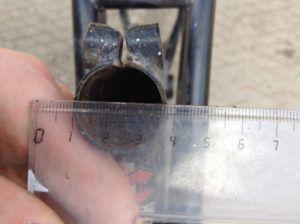
 Many DIYers are interested in how to measure a pipe's diameter. After all, troubleshooting problems with water supply or drainage systems often requires replacing pipes or repairing old ones.
This is required not only for the systems listed above, but also when installing a gas system or chimney. Professional plumbers know well how to select the correct pipe sizes for a water supply system, or any other system.
When repairing a water supply or sewerage system, it is necessary to accurately determine the diameter of the main line.
Metric and inch units of measurement
Before measuring the size of the assortment, it should be taken into account that the technological features of laying and carrying out calculations when working with steel and plastic pipelines are different.
For this reason, it is necessary to first understand the standard sizes of pipe materials for pipelines and only then measure them. Without this knowledge It is impossible to determine the size of the assortment in millimeters or inches.
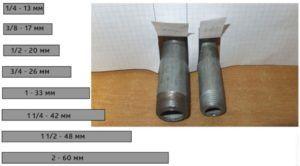
Rolled steel tubing is primarily defined by its internal volume, measured in inches. These units are used to designate rolled steel tubing as "inch" or "half-inch." One inch equals 25.4 mm, and half an inch is defined as 12.7 mm.
Plumbers don't rush to measure the outside diameter of plumbing fixtures. Installation can often be completed without it. Measuring this value is necessary when measuring a main pipe connected by threaded joints.
It is usually cut into outer part The volume of a tubular product depends on its wall dimensions. When doing this, remember that if you measure pipes with different internal volumes, the wall dimensions will vary.
To simplify measuring and calculating the required amount of materials for a pipeline, a special thread system can be used to measure the external volume of rolled pipe products. These values differ from the standard volume, which is measured in mm.
To correctly determine the size of tubular products in millimeters or find out their dimensions in inches, you need to take into account the following information.
For example, if the diameter of a metric threaded rolling element is designated M16, then the tubular product has an external volume of 16 mm. This is different for a pipe threaded version. In inches, these calculations are slightly different.
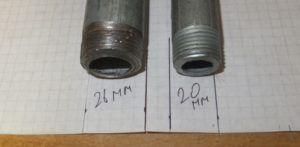
The outer diameter of a half-inch product is less than 21 millimeters, and its threaded knurling is the same size. The name "half-inch" refers to the internal volume. In inches, this value is denoted as ½. To easily convert inches to mm, it is recommended to use special tables.
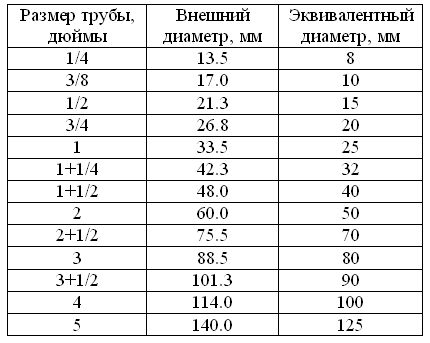
Methods for measuring external and internal volume
Before starting work and learning how to measure diameter, it's important to determine the exact volume needed for a specific task. All pipe for any pipeline is measured and classified by its internal diameter. This is called the "nominal bore" because it determines the network's throughput capacity.
If the internal diameter is measured, it is designated as Dу, and the external diameter as Dн. The wall thickness is indicated as h. These designations make it convenient to measure, perform calculations, and design various pipelines for residential and industrial buildings.
When it comes to measuring the volume of tubular products, the first thing to note is that their characteristics vary depending on the conditions. These must be taken into account, otherwise, many errors can occur.
The choice of one option or another depends on how accessible the object being measured is. Now, let's look at some of the methods in more detail.
What tool do you need for each method?
Before selecting the pipe diameter for heating, or any other system, it is necessary to know what is used in such situations.
Well known calipers A vernier caliper is used more often than other tools for measuring. However, it may not be included in your home tool kit. Therefore, you have to figure out how to measure a pipe diameter without a caliper.
It's also impossible to determine the exact dimensions of a large-diameter heating or water supply pipe using this device. In such situations, the required length and volume of the pipe can be measured using simpler devices:
- flexible ruler;
- tape measure;
- knowledge of the value of Pi, which is 3.14.
If access to the network is not difficult, a tape measure or metal ruler is a better option for calculating the size. However, a hard ruler is only useful for calculating the size of the end portions of the main line being measured.
Watch the video
Another option for measuring the inside or outside circumference of a pipe is by copying it. In this case, a ruler is held against the pipe, for example. This section of the pipeline is then photographed. Further measurements should be taken using the photograph to obtain the full set of necessary information. The resulting figures are accurately measured after scaling the photographs.
In addition, the diameter can be found using the following formula:
D = L:3.14.
In it, D indicates the diameter, and L is the circumference of the tubular product. A simple example would look like this: The circumference of the pipe is 62.8 cm. This number is divided by 3.14, resulting in 200 mm.
This formula isn't just used by home plumbers. It's also used in industrial settings, with a slight adjustment. The formula remains the same, but the final result is subtracted by twice the tape measure thickness and 0.2. This number includes an adjustment for the tape measure's fit to the surface of the main pipe.
How to measure with a ruler or tape measure
Before measuring a pipe's diameter with a tape measure or flexible ruler, it's important to know that this method is simple and can be accomplished even by inexperienced pipe fitters. It only requires one measurement.
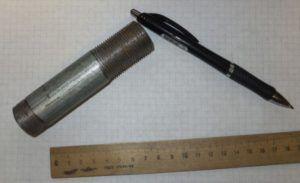
The pipeline's circumference needs to be measured. The resulting value is divided by pi. To obtain more accurate measurements, use 3.1416 instead of 3.14. However, to find the outside diameter of a large pipe, a ruler won't suffice. A tape measure will be needed.
To determine the pipe volume, the wall thickness is also measured. This can be measured with the same instruments. Calipers can also be used. The wall thickness is subtracted from the external volume.
When installing pipelines, it's important to know that the internal volume of the imported product must be determined by ensuring that it is supplied with accompanying documentation.
Watch the video
Another interesting method is presented below.
How to measure with a caliper
If you ask a professional plumber how to measure with a caliper, the answer will be: "A caliper is the most convenient tool for this kind of work, and you can easily measure the required dimensions without any additional calculations. However, this method can only be used for measuring pipes with dimensions up to fifteen centimeters."
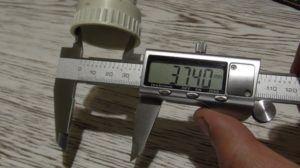 The jaws of the device should be pressed firmly against the wall of the workpiece, but applying excessive force is not recommended. You can then measure and determine the dimensions in centimeters and, if necessary, in millimeters.
You can also use a caliper to measure and determine the size of the end piece. If this part of the line is in a hard-to-reach place and the connection is permanent, this tool will come in very handy.
However, the length of its legs should not exceed half the pipeline's volume. To determine the measurement, the measuring device is applied to the pipe at its widest point.
Watch the video
How to measure with a micrometer
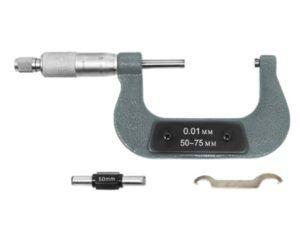 When determining the diameter of a metal or other pipe, each measurement can be made with high precision (down to 0.01 mm) using a micrometer. The device resembles a clamp. On one side is a heel, a support, and on the other is a stem and high-precision thread equipped with a micrometer screw. The micrometer screw contains a metric scale.
To find out how to find the volume indicator of a product using a micrometer on a metal or other rolled pipe, you need to place the part between the heel and the end, then begin turning the screw.
Continue until you hear three clicks. Next, find the reading on the stem where there's a millimeter scale, and add the reading from the second scale (hundredths of a millimeter) to those numbers. The sum of these two readings determines the desired value. And, as you can see, finding it isn't difficult at all.
Micrometers equipped with an electronic digital readout provide the most accurate pipe diameter measurement. They are the most convenient to use and provide an accuracy of up to 0.001 mm. If the battery in such a device runs out, it can be used as a standard micrometer.
The only drawback in this case is the high cost of the devices, which is not always acceptable for a home handyman. Therefore, such devices are rarely used to accurately measure at home.
Laser sensors
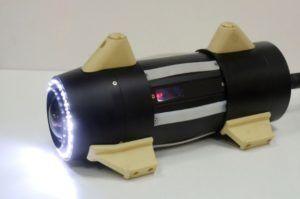 The diameter of a metal or any other round pipe can be measured using scanning laser sensors. How do these devices determine pipe diameter? It's simple.
These devices consist of a receiver and a receiver. They utilize a plane of light generated by a laser, which is deflected by a rotating prism and directed through a lens.
In the receiver, the laser is focused on a diode. It takes time for the laser to make a subsequent pass over a metal or other structure.
How to measure water pressure in a pipeline
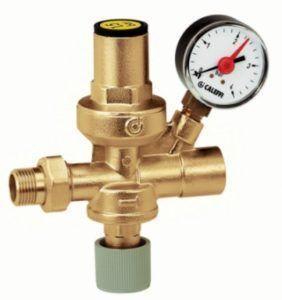 Fluid pressure in a line can be measured using a simple device called a pressure gauge. It's extremely simple; just glance at the gauge's scale. The readings from this gauge are taken with a slight margin of error.
However, there are other ways to determine the volume of water in a pipe. These are done using homemade devices and calculation formulas based on the rules of hydrodynamics. With experimental methods, the pressure can be determined using a hose, and then the calculations are based on the flow rate.
Determining a pipe's circumference based on water flow rate is easy, and finding formulas for this online is easy. However, the resulting indicative value will be significantly inaccurate. It's more practical to determine and use the diameter measurement based on flow rate as a reference.
Knowing the diameter, you can calculate the area of a pipe using the same formulas. Simply plug in the found and known values, and with a simple calculation, you can determine the area of the pipeline in the desired section.
The formula itself looks like this:
S=Pi*(D/2-N)^2.
In it: S is the cross-sectional area inside the workpiece; Pi is equal to 3.14; D denotes the external volume of the complex product, and N is the wall thickness.
Calculating the area and other dimensions accurately is essential, otherwise the constructed structure will be of poor quality and unreliable. Knowing the exact area of the structure not only allows you to build a highly reliable pipeline but also save on purchasing unnecessary construction materials.
All the material presented here helps solve the crucial question of calculating a pipe's diameter. It's clear from the material that this isn't difficult at all. All the necessary quantities can be calculated with basic school-level knowledge.
Similarly, calculating all the required parameters is possible with careful use of simple tools, which will greatly simplify the entire process. Any DIYer can easily measure and calculate all the necessary parameters, and design a high-quality pipeline.
If you're having trouble choosing the right pipe diameter or calculating it based on its circumference, you can always contact our specialists for help. They'll quickly select and calculate the correct diameter based on the pipe's circumference.
Watch the video