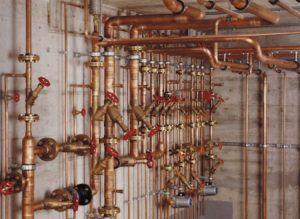
 This technological operation, which involves changing the shape of one or both ends of a pipe, is used when joining individual parts during the joining process. Do-it-yourself flaring of copper tubes can be performed during the installation of pipeline networks, the assembly and repair of various types of heat exchangers, etc.
A characteristic feature of such connections is the use of small tubes. In these cases, the flow area at the joint can be reduced to critical values.
Therefore, when performing this operation, one pipe is expanded and the connecting part is installed inside it without losing the through size.
The main types of connections for which this technological operation is used are: socket jointing and soldering.
- Technology and features of the flaring process
- Copper Tube Flaring Process Steps – A Step-by-Step Description + Video Tutorials
- Tools and fixtures for flaring copper tubes
- Set of hand tools for processing pipes
- Copper tube flaring machine Jonnesway AN040043 48573
- Copper pipe flaring machine Mastak 102 12016s
- Refco Inch Copper Tube Flaring Tool
- Mechanical flaring machines
- Electric flaring machine
- Tips for choosing a tool
Technology and features of the flaring process
Joining pipeline components is the most critical step during installation. The key process involves sizing the end of the component to match the outside dimension of the pipe.
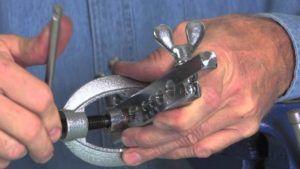 When mating using fittings, flaring increases the contact surface between the two parts, and the natural ductility of the material ensures tight, gap-free contact. Furthermore, the resulting 45-degree chamfer increases the contact surface.
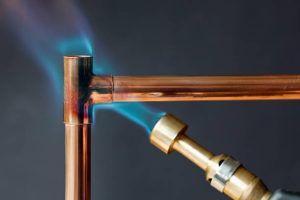
When connecting copper parts by soldering The end of the pipe is expanded. The internal diameter of the processed end should be 0.12-0.2 mm larger than the external diameter of the tube.
This gap allows a layer of solder to be applied to its surface. The thin end is then inserted into the hole, and the joint is heated with a blowtorch, gas torch, or any other available method.
Copper Tube Flaring Process Steps – A Step-by-Step Description + Video Tutorials
To prepare copper pipe for connection, you'll need a specialized tool called a flaring tool (we'll discuss tools, their types, and selection tips in more detail below). The process involves applying mechanical force to the end to shape it.
Typically, this is a cone. This process involves a certain amount of elongation of the metal due to a reduction in the thickness of the pipe walls. When performed correctly, the alignment of the component elements remains unchanged.
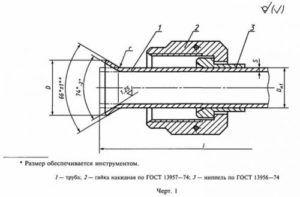
To create a joint using a fitting, the cone size must be be approximately 74 degrees in accordance with the requirements of GOST 13954-74When using industrial equipment or devices and observing all process requirements, the result should correspond to the diagram provided.
What to look for when selecting tubes;
- Wall thickness variations (uneven wall thicknesses across the cross-section) are not permitted. During deformation, the stretching in the thin wall zone is greater than in the opposite direction, where stretching may be absent altogether. This disrupts the alignment of the internal channel, creating the risk of wall rupture or cracking.
- Annealed copper tubes should be used for flaring. The annealing process changes the crystalline structure of the material, making it more ductile.
- To connect copper tubes, products with a wall thickness of at least 0.8 millimeters are used.
- The ends of the pipe being flared must be free of mechanical damage and strictly perpendicular to the longitudinal axis. To ensure this, the pipe end must be flared using a special tool—a pipe cutter.
- Flaring tools come in various sizes, meeting standard requirements for both threaded and soldered connections. If you purchase tooling manufactured in Asia, it's important to check it against our standards; otherwise, mismatches are inevitable.
It's also important to pay attention to the condition of the flaring tool used for copper tubes. Flaring is done with a punch. Before starting work, it must be thoroughly cleaned of dust and dirt.
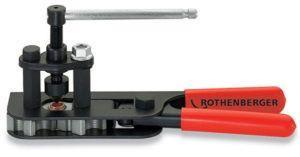 If this is not done, solid particles can damage the copper pipe surface, which can later develop into cracks. Furthermore, uneven surfaces can cause leaks.
The work is performed using a special fixture for flaring copper tubes, which is equipped with a holding device calibrated for each standard size with replaceable jaws. The working element—the punch—can also be replaced using the same principle.
The punch is moved manually using a screw. The copper tube flaring process is monitored visually.
When using motorized expanders for this purpose, flaring is accomplished using a rotating holder with a rolling roller. The process is accomplished by inserting the spindle into the tube bore.
Watch the video
This process involves rolling the part's wall, increasing its diameter. It's worth noting that the flaring process significantly improves the quality of the inner surface in the treated area. Furthermore, wall thickness variations are evened out if any.
Thicker sections are rolled to a greater extent, while thinner sections are rolled less. This rolling improves the mechanical properties of the material, which contributes to the reliability and strength of the joint.
For the home, flaring kits for copper tubes are practical, including a holding device and a set of equipment for different tube sizes.
Ultimately, the flaring stages can be represented as follows:
- Strip the end of the copper tube to be processed.
- Place a special coupling on the part.
- Secure the tube in the clamping device.
- Install a punch of the required size.
- Rotate the gate until the working screw reaches the stop.
- Remove the part from the fixture and check the quality of the operation performed.
Watch the video
Tools and fixtures for flaring copper tubes
Various tools, including homemade ones, can be used to accomplish this type of work. A good method is to use a ball from an old bearing.
Finding the right size isn't difficult, and you can use several items in sequence to achieve the desired size. But this is only for a one-time job.
If you have copper piping in your home, you should have at least a one-time flaring kit for copper pipes on hand.
Set of hand tools for processing pipes
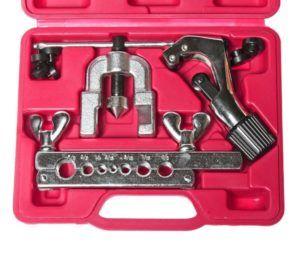 A crucial component of the flaring kit is the pipe cutter. When used to trim or cut pipes, it ensures a strictly perpendicular cut.
This is one of the crucial conditions for high-quality flaring. At the same time, the use of a rotating cutter ensures high-quality cutting without nicks or burrs.
Copper tube flaring machine Jonnesway AN040043 48573
This hand tool set is designed for use in auto repair shops and for emergency repairs on the road. Therefore, the kit includes equipment for processing pipes used in the following applications:
- air conditioning and ventilation systems;
- brake systems in which copper tubes are widely used.
All kits are equipped with pipe cutters for high-quality pipe end facing. The cutting inserts are made of high-carbon steel with a hardening coating.
The warranty period for the set is lifetime.
Copper pipe flaring machine Mastak 102 12016s
This professional tool kit is designed for working with copper, aluminum, and mild steel tubing when preparing for soldering. The kit's design allows it to be used with both metric and imperial tubing sizes.
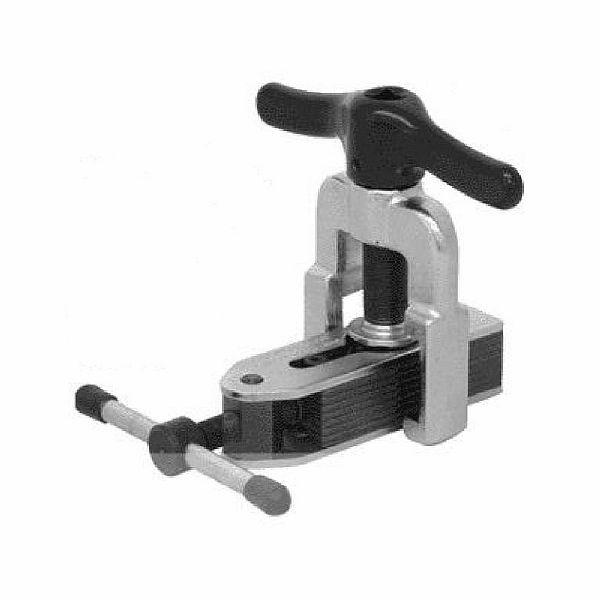
The kit is designed for service station workshops and industrial production. It is manufactured using tool steel, an oxidation coating, and plastics. The kit fits into a carrying case; the total weight is 900 grams.
Refco Inch Copper Tube Flaring Tool
This is a professional Swiss-made kit that is used to shape the end of a pipe at a 45 degree angle.
Can be used for repair and installation work on vehicles. Comes with a disc pipe cutter and comes in a carrying case.
Mechanical flaring machines
You don't always have to rush to a hardware store or construction market to perform flaring.
If you need to complete a small, one-off job, you can use the resources you have on hand. It's easy to solve the problem: if you have access to a lathe, you can make a template.
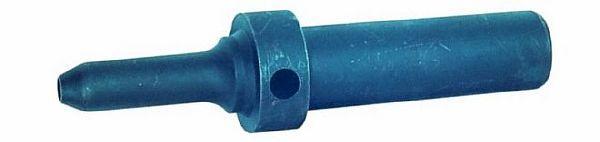
The template is a rod of the required diameter with a well-polished surface.
Ordinary steel construction rebar can be used to make this tool. The preferred grade is 35GS.
It contains a significant amount of carbon, which imparts strength to the product, while the presence of manganese increases the wear resistance of the surface. This device can be reused multiple times.
Electric flaring machine
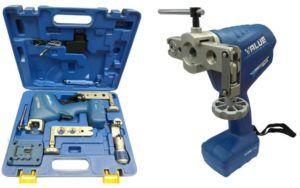 This tool operates on a completely different principle. Essentially, it rolls the metal wall of the pipe, increasing the diameter of the product while simultaneously increasing the internal diameter.
Internal, as the part is rolled from the inside. Since the rolling process is done in several stages, the deformation occurs gradually, without overloading the metal with high loads.
Multiple rolling improves the quality of the inner surface, which allows for a stronger connection when soldering.
Tips for choosing a tool
It should be noted right away that having a tube flaring tool in the home significantly expands the possibilities for trouble-free operation, especially when it comes to a private country house.
Small-diameter copper pipes are used to connect gas cylinders to stoves. Naturally, a leak can dramatically disrupt the flow of life at home.
Video on how to make a flaring punch
Even long-lasting and reliable heating systems made of copper pipes can eventually fail and require immediate intervention to restore functionality, especially if problems occur during the heating season.
Therefore, a residential building usually has a backup heating system that can be quickly activated in an emergency.
But such a tool is not cheap, and it may only be needed in the next life. Of course, for someone who has installed a copper heating or plumbing system in their home, such an expense isn't critical. But by nature, they can't afford unnecessary expenses.
But if you do decide to purchase a copper tube flaring tool, you can opt for the bare minimum, as the ability to trim the end and flare it to the desired shape is sufficient to fix virtually any problem.
When purchasing tools, make sure they match the type of pipe being used—metric or imperial. The tooling should be tailored to the dimensions used in the piping system; fortunately, these are standardized and easy to find.
There's another way to avoid unnecessary expenses. Currently, a system for renting tools and equipment on a daily basis has become widespread. It's designed specifically for such situations and allows you to use tools rented for a short period.
But it is best to use the invitation of an emergency service specialist who will eliminate the damage professionally and quickly.
A woman's desire to have beautiful, perfect legs emerges as soon as she leaves behind the daily grind of work and yearns to immerse herself in an ocean of relaxation. This is especially true in spring and summer, when the warm air inspires and awakens the awakening of nature.