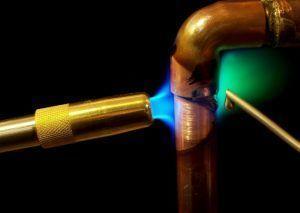
 Before soldering copper pipes, it is necessary to study in detail the characteristics of this pipe product range.
First of all, it should be noted that these materials are more flexible and more resistant to the external environment when compared to steel options.
Therefore, when choosing, copper is the preferred choice. This type of pipe will last as long as the building itself. Provided these components are soldered together, they can be safely concealed in a wall or under concrete.
Copper pipes of the highest quality are manufactured for heating and plumbing systems. Their vast array of positive characteristics remains undiminished throughout their lifespan.
The only thing that discourages the use of this building material is its high price. However, in this case, the high quality more than justifies the high price.
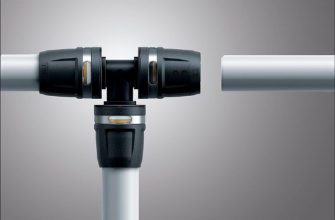
Threaded connection - copper fittings for crimping
Copper compression fittings allow for a detachable connection, which is characterized by low reliability.
During operation, it will need constant monitoring. It cannot withstand high pressure and will require constant tightening.
First, the blanks are cut to the required size. If there is an insulating layer on the end, it is removed. The burrs are removed from the end portion.
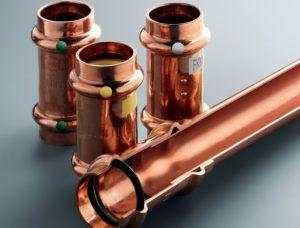
A union nut and compression ring are placed on it. After the nut is connected to the fitting, the connection—the thread—is tightened.
If adapters are used from steel products to copper ones, then sealing is done with fum tapeIt is screwed onto the thread and then screwed into the fitting.
Such joints are suitable in areas where there is the possibility of continuous inspection.
Soldering Features
To properly solder copper heating pipes and water supply, it is recommended to familiarize yourself with the features of this process.
This type of joint is used in situations where pipes run through a wall or floor, as well as in other places with limited access, to allow visual inspection of the joints.

The soldering process is based on the capillary effect. This process deposits the solder in an even layer across the pipe cross-section. Special fittings are also used in the process, which are selected individually for each pipe diameter.
IMPORTANT! The recommended gap dimensions for open flame soldering should be between 0.01 and 0.0015 cm.
Solder and flux are also used in the process. The soldering method itself is divided into two subtypes:
- high temperature;
- low temperature.
Low-temperature (soft) solderingIt is used in the construction of pipelines for transporting liquids and gases.
The operating temperature during the process exceeds 110 degrees. This method is used for products with a volume of 0.7 to 11 cm. Pipes with a wall thickness greater than 0.16 cm and a volume greater than 11 cm are joined by welding.
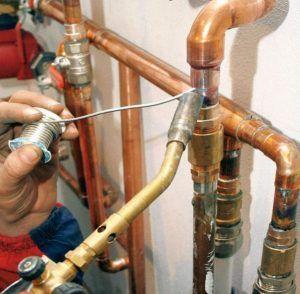 High-temperature (hard) solderingThis type of soldering is almost never used in domestic pipelines. This method is used to join components for networks operating in high-temperature environments.
Process sequence:
- An element of the required size is prepared with the thermal insulation removed and burrs removed.
- The mating area and fitting are cleaned from oxide film.
- The dust is removed and flux is applied to the top.
- The end of the workpiece is inserted into the fitting (the gap remains no more than 0.04 cm).
- The joint is heated with a torch and the seams are sealed with solder.
Solders
Soldering copper pipes with cold and hot solder is used to create a strong and high-quality joint.
It is made from powder, rods, wire, and paste. When choosing, pay attention to the operating temperature and the soldering method itself.
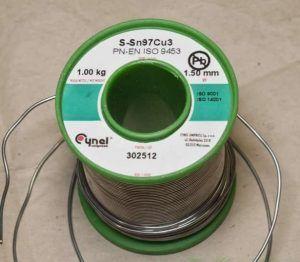
Of the soft types, L-SN AG5 and L-SN SB5 are most commonly used for copper products. Tin versions with small additions of silver and antimony are highly sought after.
The operating temperature of such products is within the range two hundred and forty degrees. They are approved for use in heating networks and for supplying various types of water in the food industry.
The numbers 40, 50, and 60 indicate the percentage of tin in these alloys. Their melting points are 190, 210, and 235 degrees Celsius. Higher tin content alloys have lower melting points during soldering.
Hard solder
This category also includes products with a silver content of at least one-quarter of the alloy. The melting point of this material is 600-800 degrees Celsius.
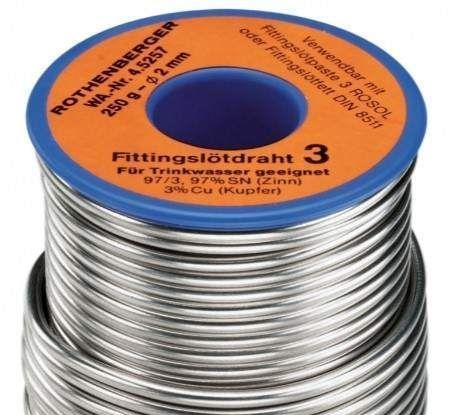
It is also necessary to note the type L-AG 40CDIt also contains 20% silver. Its melting point ranges from 600 to 635 degrees Celsius. It can be found in work with not only copper blanks but also other metals.
To create the strongest possible joints using soft, copper and silver alloys, it is recommended to leave a mounting gap of 0.02-0.04 cm.
More detailed information on the performance of alloys can be obtained from the DIN markings or by asking a professional for advice.
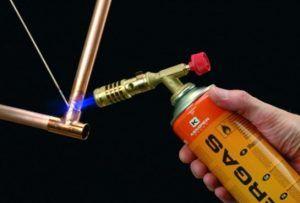 Flux for brazing copper pipes is a very important element. Its main component is boron compounds. To enhance their activity, fluorine compounds are added.
Copper soldering can be done using pure borax. It's a universal flux for high-temperature soldering.
Fluxes are produced in different forms:
- powdered;
- liquid;
- crystalline.
Large diameter pipes
Not everyone knows how to properly solder large-diameter copper pipes. The overall process is no different from soldering other pipes.
Only when high-temperature soldering such items is the solder applied to two opposite points on the pipe. Both this and other types of soldering can be accomplished by anyone.
Insulation of pipes in the heating network
Heating pipes are insulated to reduce heat loss. Uninsulated copper pipes increase heat loss fivefold, as this metal has a high thermal conductivity.
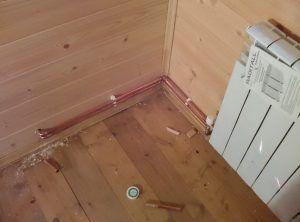
Under such conditions, radiators are required lessBut if they are installed in a sealed enclosure, they require careful insulation. Otherwise, the coolant will transfer its heat to the walls.
When it comes to insulating copper heating pipes hidden in a monolith (floor, walls), the solution is as follows. They are perfectly protected from mechanical damage caused by temperature fluctuations in the coolant. will protect the corrugation.
Copper plumbing system
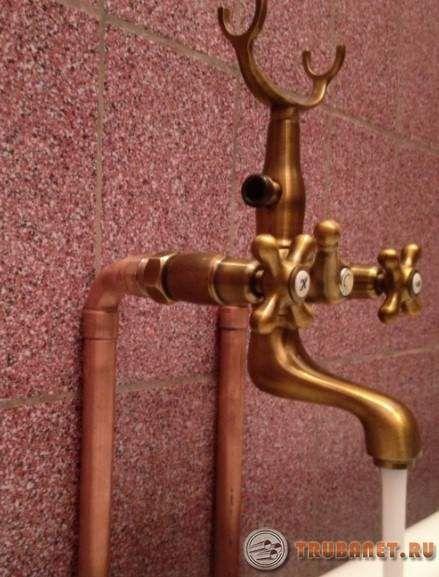 Many people try to learn how to solder copper pipes for plumbing. Due to intensive use, water mains wear out quickly, but copper pipes will last forever.
To connect a water supply system made of copper pipes, the capillary welding method (low-temperature and high-temperature) is used.
The chlorine in the water is to blame. To prevent this type of corrosion, you must:
- do not allow solder to get into the middle of the joint when soldering;
- purchase products from a trusted manufacturer;
- use water filters.
Copper pipe for air conditioners
This type of rolled pipe is used when installing an air conditioning network consisting of an indoor and outdoor unit.
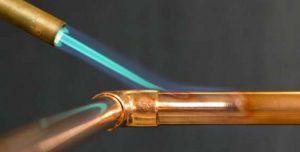
Haldagen transports two copper pipes of different diameters. The smaller diameter pipe transports liquid freon, while the other transports gaseous freon.
This metal was chosen for a reason in this situation; it is highly resistant to freon.
These air conditioner hoses are easy to solder. Recommended solder phosphorus-copper and silver typeThe units themselves demonstrate high tensile strength.
If I were to briefly describe how to solder copper pipes for air conditioners, it would look like this:
- First, remove the oxide film. This is done with sandpaper.
- After this, flux is applied to the cleaned areas.
- The fitting will be connected to the pipe. Remember to leave a half-millimeter gap.
- The joint is heated to a temperature of almost three hundred degrees Celsius using a gas torch. This is done evenly, with the flame moving smoothly along the structure.
- After soldering is complete, it is essential to flush the system; otherwise, flux residue will cause metal corrosion, which will lead to air conditioner failure.
Dremel soldering irons
The problem of soldering copper pipes is easily solved with a Dremel soldering iron. These small gas-powered torches can burn, solder, and cut. They easily remove old paint, defrost, and heat pipes for bending.
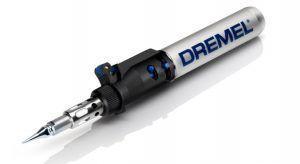
A Dremel soldering iron costs around 2,000 rubles. With this device, you can forget about lengthy warm-up times and a large heat gun.
The Dremel soldering iron comes complete with:
- soldering iron;
- torch nozzle;
- two knives of different sizes;
- reflector and crevice nozzle.
For ease of use, the device comes with several keys for changing attachments, a protective cap for the mechanism, and solder for soldering.
The hole is quite convenient direct heated air onto heat shrink tubing, and they can be installed without the use of reflective attachments.
The device is filled with butane gas for gas lighters. One refill of the Dremel soldering iron lasts for an hour of operation.
This device is for home use. Professional equivalents cost 5,000 rubles and up. Soldering with this tool becomes a pleasure.
It's clear how to solder copper pipes, and the effectiveness of this method is clear. After all, it doesn't require expensive specialized equipment. Importantly, the structure of the material itself remains intact.
The end result is a strong and reliable joint that will last a lifetime. The key is to follow the proper procedure and work carefully.