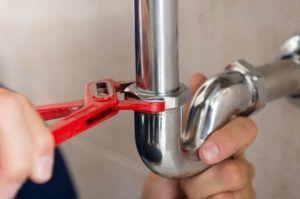
 Reliable sealing of threaded connections in plumbing and heating systems is a necessary requirement. Failure to do so will inevitably result in leaks of varying magnitude, which will cause numerous problems and render operation ineffective.
Water under pressure of several atmospheres will leak through even the smallest gap and cause problems such as:
- A humid environment that is ideal for the growth of harmful bacteria and fungi.
- Negative impact on adjacent structures and finishes. Metal components of heating and plumbing systems are particularly vulnerable.
- Flooding, which can be quite significant (and also hot for heating).
Each existing pipe joint must be sealed and individually tested. Despite all the advances in science, they still haven't been made leak-proof from the start.
If you're inexperienced, it's a good idea to seek the help of a qualified plumber. This work takes time, but if done correctly, you can avoid problems for years to come.
Factors influencing the method of sealing threaded connections
In practice, many proven methods are used to seal threaded connections. Modern sealing materials for heating and plumbing systems offer many advantages.
Firstly, they are technologically advanced and easy to use. Secondly, they can be used immediately, without prior preparation. Thirdly, with good results, they do not connect the pipes tightly, as was previously the case with oil paint. Fourthly, the appearance of the pipeline is not damaged - everything remains inside. Fifthly, there are no significant restrictions on use, which is important considering that the pipe part, like the fittings, can be made of different materials. Fifthly, all of them are inexpensive and can be used even in everyday life without thinking about the cost.
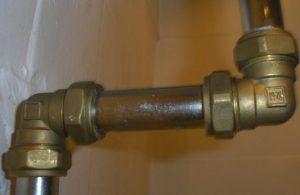 When choosing a specific sealing technology, it is important to consider the following factors:
- The water supply system pressure can exceed 10 atmospheres. It's best to allow for some reserve pressure.
- The presence of negative influences on pipes, such as heating, chemically active substances (including household solvents, which rubber does not like), vibration.
- The need to separate a joint and then reconnect it. This is not a common practice, but there are situations in which such an approach is justified.
- The responsibility of the plumbing unit is the requirements for tightness.
- Contractor qualifications. Installation requires an understanding of the processes and a certain level of skill. When choosing a new type of sealing, it's worth familiarizing yourself with the theory.
- Versatility. When creating a unified plumbing system, it's best to stick to one thing.
- Resistance to elevated temperatures. Heating and hot water supply systems experience significant heat, and this heat is constant throughout their operation.
If possible, threaded connection sealing, like installation, should be entrusted to a qualified professional. This will ensure the system's functionality and long service life. In this case, the effectiveness is immediately noticeable and clearly understood. A secure pipe connection ensures no water leakage.
We use sealant for threaded connections
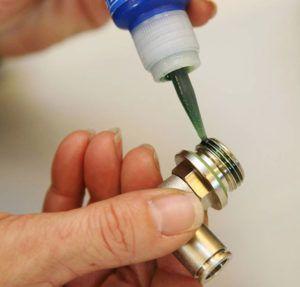 The easiest way is to use thread sealant., which is sold in tubes of various sizes and requires no additional preparation. This substance is applied directly to pipe threads or to the backing (an additional fibrous material, such as linen).
It fills all the resulting internal cavities well and, after drying, forms a leak barrier. Its main drawback is that it cannot be disassembled. If the joint does need to be disassembled, it must be cleaned and resealed when reassembling. This is not technically difficult, but it requires time and the appropriate components.
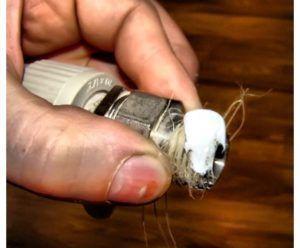
Sealants applied directly to the surface are also called plumber's adhesives, although their adhesive properties are not particularly strong. The backed version is considered more reliable, as the fibers swell over time and seal the gaps tightly.
When choosing a sealing method, you need to consider the pressure inside the plumbing system - if it is low, then gluing with silicone sealant will be quite sufficient.
Watch the video: Thread sealing methods
Anaerobic sealants are currently the most popular choice for plumbing fixtures in this group. Their application requires several standard steps.
- Preparing the pipe surfaces for sealing: washing, degreasing, and drying. The cleaner they are, the more reliable the adhesion to the metal will be.
- Apply the material to the threads where the connection will take place. This should be continuous and done immediately before assembly. Waiting too long can negatively impact the quality of the joint. Different manufacturers have different application times, and it's important to familiarize yourself with them beforehand. It's important to apply enough anaerobic adhesive to fill the entire internal space (to bond the threads together).
- Securely tighten the connection. Naturally, manual force is not enough, and wrenches should be used in all situations. Excess sealant can be removed from the pipe immediately.
- Wait the specified time for curing and development of the desired properties. This information is provided on the packaging, and typically, 15-30 minutes is required for basic polymerization. Full curing and development of performance properties takes several hours. After this time, do not tighten the nut, as any movement will affect the sealing properties.
The entire process of applying anaerobic thread sealant to threaded connections takes little time and is suitable for DIY use at home. The nozzle on the tube simplifies the process and prevents contamination.
A specially developed classification defines not only the operating temperature (for heating and hot water supply) and the permissible pipe diameter, but also the force required to separate the joint—light, medium, or heavy. The latter type is recommended for pipes with a diameter greater than 2.5 inches, and preheating is recommended during disassembly.
Before sealing a water pipe joint, make sure the plumbing adhesive is environmentally friendly—the label on the tube will indicate this: "Sanitary." Otherwise, unwanted chemicals may leach into the water.
FUM tape for sealing
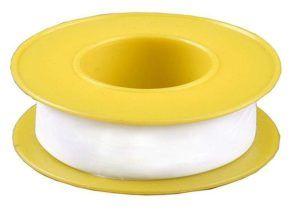 FUM tape is a very thin polymer sheet (0.08 to 0.12 mm thick) that can seal even the smallest gap and does not interfere with the installation of any thread (even with very precise dimensions and a virtually complete absence of tolerances).
This is a suitable option not only for laying plumbing systems, but also for installing precise measuring instruments for heating or water supply.
The application technique is simple and does not require any special skills – the main thing is to follow a few simple rules:
- Use only a clean surface that is free of any chemically active substances or solid particles that could damage the thread sealant used and affect its properties.
- Apply a slight tension to the fum tape when winding it to ensure increased density.
- Avoid twisting the tape.
- Do not allow it to break. This applies both to winding and to subsequent screwing of metal parts.
- Place the turns of FUM tape with a slight overlap over the entire expected length of the threaded connection.
If the seal is insufficient, the layer thickness must be increased. In complex situations, the layer thickness must be adjusted experimentally. An obvious advantage of FUM tape is that the joint is immediately ready for use—there's no waiting period, as with plumbing sealant.
Immediately after the work is completed, the plumbing fixture can be used to its full potential.
When disassembling a joint, the tape application procedure is repeated for subsequent reassembly. In addition to plumbing, FUM tape is also suitable for sealing gas pipes. For industrial applications, it is necessary to ensure that the gas does not pose a risk to the polymer structure and that the pressure is moderate. Overall, this is one of the most versatile sealants.
Sealing thread for sealing
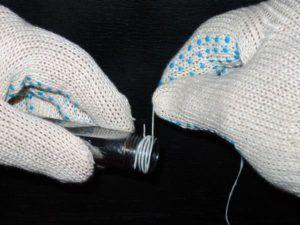 A relatively new approach to thread sealing involves wrapping a special polymer thread around the external thread. Its structure allows for excellent stretchability, tangling resistance, and secure adhesion to the metal base.
It also has the property of elasticity, that is, when compressed, it tends to return to shape and therefore reliably fills the space between the internal and external threads.
When sealing water pipes, it's important to follow a number of rules: apply the seal clockwise and from the outer edge, ensuring the required number of layers. Apply the seal along the threaded recesses—it's best to take your time and lay it out carefully and evenly. As with the tape method, you can increase the number of layers to better fill the gap.
There are several types of standard sealing thread:
- Polyamide. This sealing thread can withstand temperatures up to 130 degrees Celsius and pressures up to 16 atmospheres. This is more than sufficient for household use, and it is the type most often found in specialty stores.
- Fluoroplastic. This type of thread can withstand cooling and heating up to 150 degrees Celsius (both above and below zero). It's also important to note its pressure rating of 30 atmospheres and good chemical resistance. These seals are used in challenging conditions, and in everyday life, there's no need to resort to unnecessary expenses, even for heating.
Watch the video: Sealing threads with anaerobic adhesive sealant
When choosing plumbing sealing tape, it's best to consider reputable brands and avoid sacrificing quality for cost savings. The packaging is convenient—it comes in a spool. This makes it easy to apply and store the tape, preventing it from tangling and ensuring smooth installation.
We use polymer gaskets
Polymer gaskets are used in almost all plumbing fixtures: faucets, connecting hoses, filters, etc. Good old rubber has been replaced by a wider range of options, which have improved properties and require no on-site adjustment.
The sealing ring for threaded connections has a number of useful properties:
- A fairly strong design, capable of withstanding tens of atmospheres.
- Low cost and retail availability. This is the most affordable option compared to sealant, glue, or FUM tape.
- Suitable for large end gaps—up to one millimeter. There are many situations where, for example, using a plumbing line is technically difficult and impractical.
- A range designed for different types of plumbing fixtures. They are often sold in sets, allowing you to choose the optimal design.
- Reconnection is possible without additional surface preparation. Frequent compression is not recommended, as it can damage the structure of the joint, ultimately compromising its integrity.
- Possibility of increased functionality. For example, when installing faucets, it's a good idea to install rings with coarse mesh filters at the connection points to trap mechanical particles and prevent future clogging.
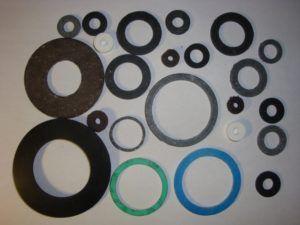
The disadvantage is the limited use for plumbing threaded connections.
– one can name many configurations of heating or plumbing systems in which the ring-shaped gasket will simply have nothing to rest against.
The installation technology is as follows:
- Ensure that the seal itself is not externally damaged and fits the installation site. This applies to both the outer and inner diameters (reducing the bore is not recommended).
- Check the installation location, which should not be contaminated.
- Carefully assemble and tighten the threaded connection. Tighten with a wrench. This method does not require significant force to avoid deforming the gasket.
Important! If everything is done correctly, then applying additional sealant to the thread itself is not required.
If leaks occur after connection, tightening the nut is usually sufficient. If this doesn't help, the gasket is defective or was selected incorrectly. Over time, replacement may be necessary due to wear or damage to the polymer structure.
Natural sealants for sealing threaded joints
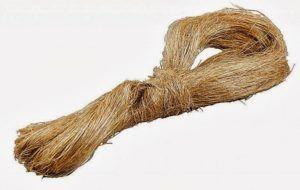 This category includes obsolete linen, tow, and jute. Their properties lag significantly behind modern polymer materials and should not be considered as an alternative (they are not a natural alternative to sealant thread, as one might think). Furthermore, it is believed that when exposed to water, natural sealants intensify the corrosion of the metal.
As a result, even a slight shift or a significant impact on the pipes can affect their tightness. If, for whatever reason, they are chosen, it's preferable to combine them with more advanced solutions—for example, silicone sealant for plumbing connections.
Natural materials for sealing heating and water supply systems are not as common as they once were, but they are still readily available. Their attractiveness lies in their low cost, allowing buyers to acquire significant quantities.
Watch the video: 3 types of threaded sealing
It's not uncommon to encounter the opinion on amateur and even specialized forums that traditional threaded connections are the best, but the volume of use speaks for itself, and new connection solutions are confidently gaining the upper hand.