Today, we'd like to tell you how to make a simple pipe bender for profile pipes yourself. Many of us need this tool, especially at our summer cottages, when we need to bend profile pipes to build a greenhouse or gazebo.
There is no point in buying professional equipment, since we don’t need it often in everyday life.
We'll be building a simple DIY profile bending machine that any DIY enthusiast can create on their own.
- How a pipe bender works
- Types of profile bending machines and their devices
- By drive type
- By bending method
- By the location of the movable shaft
- What materials and tools will we need?
- Instructions on how to make a profile bending machine yourself
- Manual pipe bender
- Hydraulic pipe bender
- Bending defects and how to avoid them
- How to reduce manufacturing costs
- Video instructions
How a pipe bender works
We offer step-by-step instructions on how to do it. pipe bender for round pipe on one's own.
The operating principle of a pipe bender is quite simple: a profile pipe is subjected to an impact, which leads to a temperature change, and the steel becomes softer.
The blank is placed in the rolling zone of the bending machine, between rollers that also act as a template. The angle of the profile bend depends on the positioning and diameter of the rollers.
Rollers are:
- guides - they hold the part;
- clamping - gives the bending angle.
There are two guides and one pressure shaft.
It is worth noting that repeated changes in the shape of rolled profile pipes (heating and bending) should not be done, as this reduces their strength.
Types of profile bending machines and their devices
Profile pipes have different wall thicknesses and diameters, so they require different pipe benders. Bending mechanisms for profile pipes have design differences from standard pipe benders for round pipes. Profile pipes are highly resistant to bending, and their bending radii are typically larger.
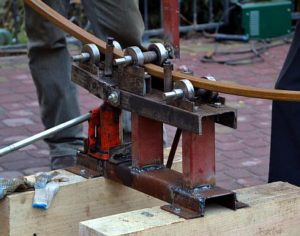
The main types of pipe benders for profile products:
- by drive type;
- by bending method;
- according to the location of the movable roller.
By drive type
The choice of bending machine depends on the bending angle, as well as the material of the profile pipe and the required accuracy. There are various types:
- Hydraulic bending machines are designed for bending three-inch elements. They offer high productivity, precision, and speed. They are available in manual and automatic versions. This is the most powerful profile bending machine, capable of bending any pipe. It includes a channel (wide and narrow sections, three of each), a hinge lock, three rollers (mounted on bearing assemblies), a transmission handle with a bushing, and a machine jack.
- Electric benders are recommended for bending large-diameter profile pipes. They are most often used for main pipelines. The device consists of:
- frames made of channels;
- metal rolling shafts - 2 pcs;
- three gears;
- metal chain;
- gearbox, electric motor with mechanical drive.
- Manual – these are operated by human strength. They are designed for small-diameter profiles. The tool operates like a rolling mill. The main components are mostly metal:
- support roller;
- rollers;
- chassis elements;
- adjustment screw;
- feed handle.
By bending method
The same part can be bent in different ways, using different types of pipe benders:
- segmental - their popularity lies in the fact that the part can be pulled through to obtain several rotating fragments;
- crossbow - the essence of the work is to stretch the metal and bend it in one place;
- spring - designed for plastic products.
By the location of the movable shaft
The movable roller can be located in the middle, or on the sides (right or left):
- A design in which the movable roller is located in the center, and the outer rollers are fixed to its housing. They are slightly raised above the base. The middle roller is mounted on a specially assembled U-shaped base, in the center of which a large pressure screw is attached. A pressure roller is welded to the screw at the bottom edge. As this screw rotates, the profile is lowered or raised, causing it to bend. A handle is welded to one fixed roller; it is used to move the profile around the machine. To facilitate the rolling process, the fixed rollers are connected by a chain.
- With a movable shaft at the edge—it can be positioned on the right or left. It rotates with the base section, which is connected to the frame with metal hinges. The angle of curvature is affected by the table's elevation, which is adjusted with a jack. The structure rotates using a central roller, to which a handle is welded. To reduce the force required, the device can be equipped with a chain.
To sum it up, we can say that the most suitable type of pipe bender for giving the required bend to a profile pipe when installing a greenhouse or some other structure on a private plot is with manual driveAfter all, the size of the profile blank and the volume of work are small.
What materials and tools will we need?
Before you begin building a pipe bending machine for square profile pipes, we recommend stocking up on tools and materials. Otherwise, you'll be distracted during the process, which will ultimately take longer.
To make a profile bending machine we will need:
- for the base of a homemade profile bender - a channel or two welded corners, the thickness of the shelves is no more than 3 mm;
- High quality steel rollers, ideally hardened, they should not be smooth, but have small ridges on the edges.
These are the remaining parts of any pipe bender. Depending on the model and type of device, a number of other components may be required.
In terms of tools, you should have on hand a grinder, a drill, a hammer, a wrench, a straight edge with a reliable and impressive base, and a welding inverter if you are welding the machine elements rather than bolting the parts on.
Instructions on how to make a profile bending machine yourself
So, let's move on to making a pipe bender without turning. We decided to make two different models. You can check out both the video tutorial and the step-by-step written guide.
Manual pipe bender
We will need 8 pieces of size 33 bearings, a 40 by 80 channel for the base, an 18 construction stud, 18 size washers, a 25 metal corner, and a piece of rectangular plate.
Since this is our first time making a manual pipe bender for a profile pipe, we decided to prepare a drawing of our device – this will simplify the work.

After this, we began to manufacture the pipe bender itself:
- We cut the channel to the required length and clean it from rust with a grinder.


- We clean the threads from the construction stud, also using a grinder. This is necessary to ensure the bearings can move freely along them.

- Prepare the washers by using a hammer to slightly shape the washer into a cone. This shape will allow the bearing to move freely.

- We assemble the two rollers: we install 18-mm nuts on the stud at the edges, and three bearings in the middle. Slightly curved washers avoid the edges of the bearings, allowing them to move freely.


- We tighten the nuts with a wrench and cut off the excess studs.

- We tack weld the edges.


- We cut four 25 cm pieces from the metal angle. These will serve as guides for the drive and pressure rollers.


- We weld the corners to the channel. The distance between two adjacent pieces is determined by the size of the stud; it should fit freely into the gap.


- We make a drive roller by placing a 25mm diameter pipe on an 18mm stud. The space between the pipe and the stud is filled with 40mm nails, the heads of which we cut off first.

- To ensure the reliability of the structure, we also weld the edges, having first clamped the workpiece in a vice.

- We put 33 bearings on the ends of the shaft.

- Let's move on to making the sliding carriage. For this, we'll take two pieces of 20 x 40 mm profile pipe, each 30 mm long, and a rectangular metal plate 80 x 50 mm.

- We weld sections of the profile to the plate, and the drive rollers to it.

- Using a drill, we drill a hole at the bottom of the carriage, locating its midpoint. The hole should be the same size as the diameter of the 18mm stud.

- Let's begin assembling the lifting mechanism. We'll need a stud and three nuts. Insert the stud into the carriage hole, then screw a nut onto it from the inside and weld it in place. Then, from the other side, place a second nut onto the stud and weld it in place.


- We cut a blank from a rectangular metal plate measuring 70 by 13, which will serve as a stop for the lifting mechanism.

- We measure the middle of the workpiece and make a hole of 18 mm.

- Let's begin assembling the pipe bender. We install the carriage with the drive roller on the channel base. We place the plate on top and tighten the nut, tack welding it in place.


- We weld rollers to the edges of the base and a handle to the lifting mechanism.


- We'll make a manual drive using a 20x20 profile and a drill handle, which we screw to the profile. We'll tack weld a section of pipe to the drive shaft.

The pipe bender for profile pipes is ready, we can proceed to testing.
Hydraulic pipe bender
We decided to try making a more powerful device powered by a hydraulic drive, which turned out to be not so difficult to do.

- First, we prepared the frame. We constructed it from a channel, angles, and a metal plate by welding these elements together. We also needed two rollers, a semicircular attachment, and a machine jack.

- We make 6 adjustment holes on both sides of the base of the frame, in which the rollers will be fixed, depending on the required bending angle.

- We install the rollers into the holes made in the frame.

- We put the semicircular attachment on the stealth mechanism and place it under the rollers.

- The device is ready; we insert the profile between the rollers and the jack. By lifting the mechanism, we bend the profile pipe.

Bending defects and how to avoid them
To make bending profile pipes easier and avoid defects, we've decided to share with you the steps that can cause them.
Homemade pipe benders often experience stretching and ripples at the narrowest point—where the area is reduced. This, in turn, can lead to microcracks, although this isn't a concern for building greenhouses and gazebos.
Another defect that occurs when bending square tubing is that it twists around its axis during the bending process. It will be impossible to repair such a tube for use as a greenhouse arch. This "propeller" behavior is caused by an asymmetrical load distribution during the bending process.
But the main reason for the formation of defects when bending a profile is the choice of an incorrect bending radius, and the presence of a small technological “tail” (the distance from the beginning of the pipe - closest to the bending point, to the bending point).
The “tail” not only securely fixes the profile pipe, but also absorbs the impact of process stress.
How to reduce manufacturing costs
To reduce the cost of making a pipe bender, you can use scrap parts. For example, instead of rollers, you can use the wheels from an old bicycle. They won't withstand heavy loads, but they'll be fine for bending a 20x40 profile pipe. If you don't have a washer, you can replace it with a metal circle of a suitable diameter.
Don't buy new bearings for this DIY project; used ones, easily found at auto repair shops, will do. Many components can also be found at scrap metal recycling centers.
Today, we tried making two homemade pipe benders for profile pipes—and we were up to the task. But if you don't need a complex device and just need to bend a profile pipe one-time, you can make a simpler bending device—a lever-type, a template-type, or a crossbow-type—which are quicker and easier to assemble.
We hope that, using our article as a guide, you'll be able to easily assemble a profile bending machine from available materials and bend a pipe to the desired radius for building a greenhouse or veranda.