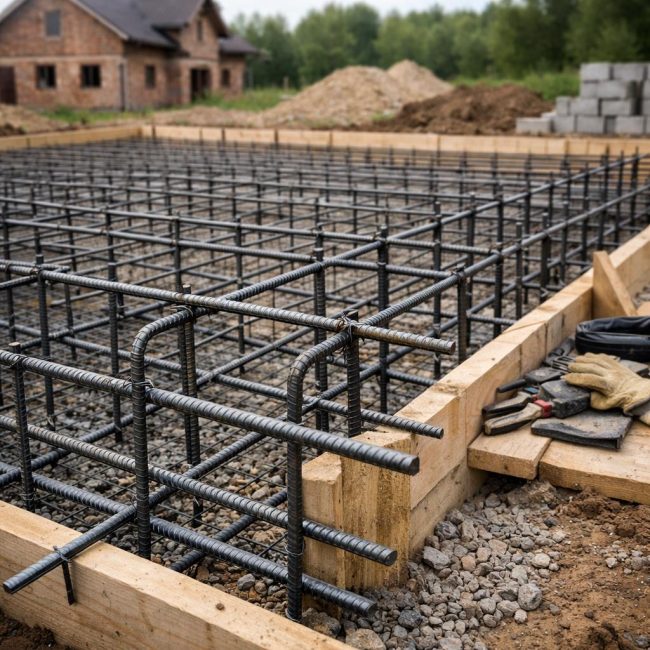
The construction of any house begins with the foundation. The foundation is the foundation that determines whether a wall will crack in a couple of years or whether the building will stand for decades. Many beginners make the critical mistake of believing that the strength of a foundation depends solely on the grade of concrete. In fact, concrete is excellent at handling compression but extremely poorly under tension. This task is handled by a steel skeleton—the reinforcing frame.
If you've decided to build a summer house or garage yourself, it's important to understand the differences in the types of rolled metal. Often, it's used for auxiliary elements, such as mounting loops or creating lightweight mesh. A240 fittings, which is characterized by a smooth surface and good ductility. It is indispensable where metal must be bent at an acute angle without the risk of microcracks, which is often required when installing clamps in strip foundations.
- Why is metal needed in concrete?
- The main types of reinforcement for the do-it-yourselfer
- Diameter calculation: the golden mean
- Longitudinal and transverse reinforcement
- DIY frame knitting technology
- The protective layer rule
- Tools for work
- Typical mistakes in reinforcement
- Reinforcement overlap
- Choosing between steel and composite
- Storage of metal on site
- Preparing for pouring: checklist
Why is metal needed in concrete?
Concrete is structurally similar to artificial stone. It's hard but brittle. When the soil beneath the house begins to move (spring heaving or subsidence), the foundation experiences bending loads. Without the steel rods inside, the monolith would simply crack. Steel and concrete have similar coefficients of thermal expansion, so they function as a single unit.
When choosing materials for private home building, not only GOST requirements are taken into account, but also the characteristics of the metal used. For example, reinforcement Prometex, complies with the standardized flowability and weldability parameters used in construction. The surface condition of the rods is particularly important: deep corrosion and peeling are unacceptable, as they impair adhesion to the concrete mixture.
Interesting fact: The adhesion of ribbed reinforcement to concrete is almost 2-3 times higher than that of smooth reinforcement. This is why only rebars with a periodic profile are used for the main work areas (the lower and upper foundation chords).
The main types of reinforcement for the do-it-yourselfer
In modern construction, two grades of steel are most commonly used: A240 (smooth) and A500C (corrugated). The letter "C" in the grade designation indicates that the steel is weldable. However, in the private sector, I recommend wire bonding. Welding at the joints weakens the metal and makes the frame too rigid, which is not always ideal in areas with uneven ground settlement.
Diameter calculation: the golden mean
For most single-story houses made of aerated concrete or timber, 10mm or 12mm diameter rebar is considered the optimal choice for longitudinal reinforcement. If the site has complex soil (peat bogs or high groundwater levels), 14mm diameter rebar is recommended. It's important to remember the rule: the total cross-sectional area of the rebar must be at least 0.1% of the cross-sectional area of the foundation itself. This is a basic requirement of SNiP (Building Code and Regulations), which guarantees the durability of the structure.
Longitudinal and transverse reinforcement
The frame consists of two types of rods:
- Working fittings. These are the longitudinal rods that bear the main load. They must be ribbed.
- Structural (distribution) reinforcement. These are crossbars and vertical posts. They hold the working rods in the desired position. Here, you can save money by using smooth rods of smaller diameter.
DIY frame knitting technology
Many people ask: is it possible to simply throw steel into a trench and fill it with concrete? The answer is a resounding no. The reinforcement must be positioned firmly within the concrete, not touching the ground or the formwork walls. This is called a "protective layer."
The protective layer rule
The protective layer of concrete (the distance from the edge of the metal to the edge of the foundation) should be 3-5 cm. This is necessary to protect the steel from moisture and subsequent corrosion. If the reinforcement is exposed or lying on the ground, it will rot within 5-7 years, and the foundation will lose its strength.
Tools for work
To assemble the frame you will need:
- Crochet hook (manual or semi-automatic).
- Knitting wire (usually 1.2–1.4 mm in diameter).
- Angle grinder with cutting discs for metal.
- Plastic fasteners ("chairs" or "stars") to create a protective layer.
Typical mistakes in reinforcement
The first and most dangerous mistake is improper corner design. Simply crossing the rods at the corner is not enough. The corner is the point of maximum stress. Here, L-shaped or U-shaped reinforcements must be used to connect the outer and inner rods on opposite sides of the tape.
Expert advice: Never use broken bricks or pieces of wood instead of professional cement spacers. The wood will rot, creating a void, and the brick can absorb moisture, leading to localized deterioration of the concrete from within.
Reinforcement overlap
Rebar is typically sold in 6 or 11.7 meter lengths. Naturally, they must be joined lengthwise. The overlap should be at least 40-50 times the diameter of the rebar. For example, for a 10-meter-long foundation, the overlap should be approximately 50 cm. Joints in adjacent rows should be staggered to avoid creating a weak spot in one section of the foundation.
Choosing between steel and composite
In recent years, fiberglass (composite) rebar has been heavily promoted. It's lightweight and rust-resistant. But as a builder, I caution: using it for a residential foundation is risky. Composite has too high a coefficient of elongation. Simply put, the plastic will stretch under load before the concrete can begin to work, leading to cracks. Steel is much more reliable and predictable in this regard.
Storage of metal on site
If you've purchased metal profiles in advance, don't leave them on the bare ground. Provide support using boards or lumber. A small coating of rust isn't a problem, but if the metal starts to flake, you'll have to clean it with a wire brush, which is very labor-intensive.
Preparing for pouring: checklist
Before ordering a concrete mixer, please check the following points:
- The frame is rigidly fixed and does not shift when walking on it.
- There is no construction waste, sawdust or snow inside the formwork.
- All connections for utilities (sewage, water supply) are installed and tied to the frame.
- The gaps of the protective layer are maintained on all sides.
Following these simple rules will allow you to create a foundation that will provide a reliable support for your home for decades to come. Remember that skimping on the quantity or quality of metal in the foundation is the most costly form of savings, potentially requiring colossal expenditures on foundation reinforcement and wall repairs in the future.