Modern interiors increasingly strive for a balance between functionality and aesthetics. People seek not only comfort in their furnishings, but also individuality, the ability to highlight the character of the space and its occupants. This is why handcrafted, signature elements are becoming so popular. Among these, forged pieces occupy a special place, combining the strength of metal, graceful lines, and durability. Today, artistic forging workshops, such as the "Forging to Order" studio, offer solutions that integrate metal into residential and public spaces without creating a heavy feel, but instead, with an emphasis on harmony and style.
- Why are forged details so valuable in interior design?
- Small accents that change the atmosphere
- Forged lamps
- Railings and fences
- Decorative grilles
- Furniture with forged elements
- Forged accessories
- Combination of forging with other materials
- How to incorporate forged elements into different styles
- Custom order as a way to emphasize style
- Practical tips for choosing forged parts
- Conclusion
Why are forged details so valuable in interior design?
Metal is a material with character. It's cool, strong, malleable in the hands of a craftsman, and practically eternal when properly crafted. Forged pieces possess a special energy: their lines are smooth and vibrant, as if they've absorbed some of the warmth from the blacksmith's hand. This is why a forged piece in an interior is perceived not just as a decorative element, but as an object of art.
In addition, forging has a number of advantages:
- Uniqueness. Each product is handcrafted, so it is impossible to repeat it exactly.
- Durability. Metal that has undergone proper heat treatment and protective coating will last for decades.
- Versatility of style. Forging is suitable for both classic interiors and minimalist or loft styles.
- Functionality. Metal is not only beautiful, but also practical: durable railings, reliable furniture frames, wear-resistant elements.
Small accents that change the atmosphere
Wrought iron can be incorporated into interiors in a variety of forms. You don't necessarily need massive gates or staircases. Sometimes, small details are enough to transform a space.
Forged lamps
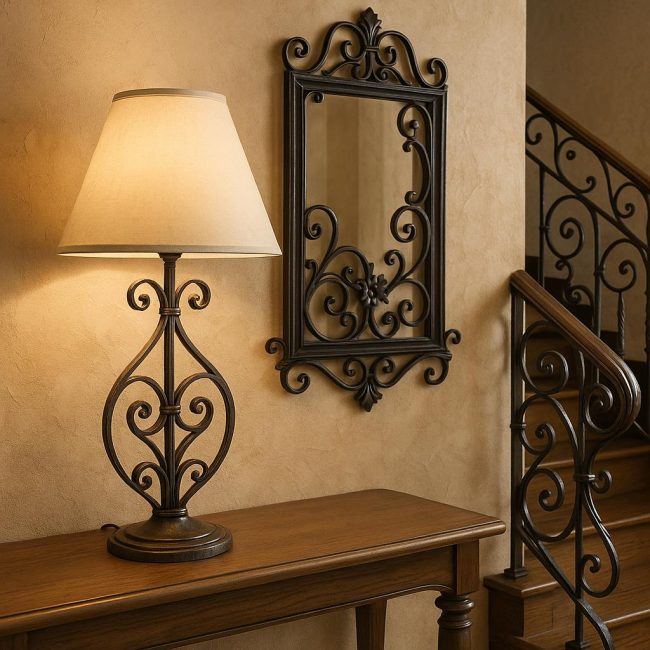
Shades, pendants, or floor lamps with metal elements lend a special softness to the light. Curls framing the glass create a play of shadows on the walls and ceiling, and the lamp itself becomes a focal point in the room.
Railings and fences
Even in a small apartment, you can highlight the space of a staircase or mezzanine with artistic railings. They don't weigh down the interior, but rather add a touch of sophistication, especially if the lines are light and delicate.
Decorative grilles
Window or fireplace grates are not only a practical solution but also an expressive artistic element. They can be designed in geometric patterns or flowing floral motifs.
Furniture with forged elements
Tables, chairs, beds, and even ottomans with metal frames look elegant rather than bulky when the designer works with subtle lines. Metal pairs beautifully with wood, glass, and fabric, allowing for harmonious ensembles.
Forged accessories
Candlesticks, curtain rods, mirror frames, and flower stands are small accents that create a sense of completeness. They can be used sparingly without overpowering the space.
Combination of forging with other materials
To ensure that forged parts look organic, it is important to choose the right combinations.
- Metal + wood. A classic solution for a warm and cozy interior. Suitable for country, chalet, and Scandi-style homes.
- Metal + glass. A modern duo, appropriate for minimalism, high-tech, and art deco. Particularly striking when used as tables or partitions.
- Metal + fabric. The furniture upholstery, curtains and wrought iron frame create a soft and elegant ensemble.
- Metal + stone. Ideal for fireplaces, staircases and outdoor areas, metal highlights the natural texture of stone.
How to incorporate forged elements into different styles
Forging is universal and can be adapted to any interior style.
- Classic. Rich ornaments, smooth lines, gilding or patina.
- Loft. Simple geometric shapes, rough processing, black metal.
- Modern. Curved lines, plant motifs, light shades.
- Minimalism. Clean lines without frills, emphasis on the texture of the metal.
- Provence. Light and delicate elements, white or pastel colors.
Custom order as a way to emphasize style
Many designers note that ready-made, off-the-shelf solutions don't always fit a specific project. This is why forged elements are most often custom-made. The craftsman takes into account the size, style, and client's wishes. The result is a detail that becomes the signature of the home, its unique feature.
For example, a railing with a pattern that echoes the tile pattern; a grille that echoes the wallpaper motifs; a lamp whose shape resembles a family crest. Such details make the space individual and unique.
Practical tips for choosing forged parts
- Don't overload the interior. One or two expressive forged details in the room are enough.
- Pay attention to quality. Hand forging is characterized by smooth lines and the absence of sharp seams.
- Think about functionality. A forged item should not only decorate, but also fulfill its purpose.
- Choose a protective coating. This is especially important for areas with high humidity or for outdoor products.
- Coordinate with the designer. If the interior has already been designed, the new detail should fit into it organically.
Conclusion
Wrought iron elements are not a relic of the past, but a stylish and modern design tool. They add character to a home, create accents, and highlight individuality. In skilled hands, metal becomes a true art form, capable of enlivening even the most formal interior.
That's why more and more people are turning to custom solutions. After all, a small forged detail can say more about a home and its owners than dozens of faceless, mass-produced items.