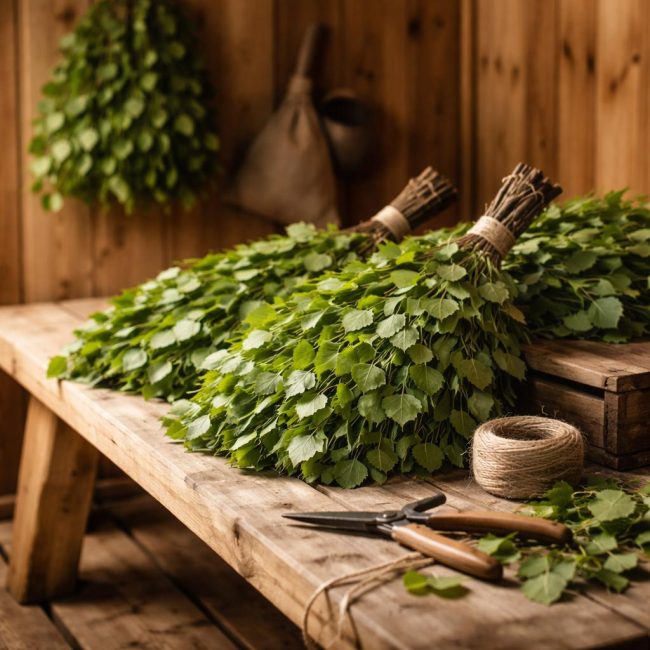
Bath whisks are one of those details of the Russian banya that people don't immediately think about, but without them, the steaming experience loses half its meaning. The question usually arises in two situations: when someone first considers making their own instead of store-bought ones, and when they've already tried them, but the results were far from what they expected—the whisk quickly crumbled, turned out stiff, "dusty," or produced almost no aroma. On the surface, everything seems simple: branches, leaves, a bundle. In practice, there are many more nuances, and they determine whether the whisk will work in the steam room or remain a formality.
- What really makes a broom "right"
- Why does wood species matter?
- Harvesting time as a quality factor, not a calendar date
- The structure of a broom and its “work” in a steam room
- Drying as a stage of preservation, not drying
- Storage and its influence on the final effect
- How a bath broom works in a sauna and why it's important to consider this in advance.
- Common misconceptions that ruin results
- Why the topic of brooms is more complex than it seems
What really makes a broom "right"
A bathhouse whisk isn't a traditional tool or a decorative attribute. It functions on several levels: mechanical, thermal, and aromatic. The leaves retain steam, creating an air cushion against the skin, the branches provide elasticity and range of motion, and the essential oils create the scent and overall feeling of a "living" bathhouse. If even one of these levels is compromised, the whisk ceases to fulfill its function.
Therefore, a discussion about how to properly make bath whisks always begins not with the steps, but with an understanding of the properties of the material. A whisk should be neither too loose nor too dense. It doesn't have to be perfectly symmetrical, but it should retain its shape when wet and heated. And most importantly, it should be predictable in the steam room: it shouldn't fall apart or turn into a stiff "broom-brush."
Why does wood species matter?
The choice of wood species is not a matter of tradition for its own sake, but rather a matter of physical and biochemical properties. Leaves vary in density, vein thickness, ability to retain moisture, and ability to release fragrance when heated. Birch brooms are prized for their softness and flexibility, oak for their density and resistance to high temperatures, and linden for their light aroma and delicate effect.
It's important to understand that there's no one-size-fits-all solution. What works perfectly in a dry, hot steam room may be excessive in a humid one. Similarly, a whisk that's comfortable for a relaxing steam bath may not be suitable for intense treatments. The right solution here is a match between the sauna conditions and the desired effect, not an abstract "standard."
Harvesting time as a quality factor, not a calendar date
One of the most common sources of error is following dates literally. It's believed that the broom must be harvested "at a certain time," and this is often perceived as a rigid rule. In practice, the condition of the leaf is more important than the calendar date. It should be mature but not overripe, firm, not brittle, and not excessively stiff.
If the leaves are too young, they don't hold well and quickly fall off. If they're too dense and mature, the broom loses its flexibility and becomes heavy. Therefore, experienced bathhouse attendants rely not on the date, but on tactile and visual cues, which are difficult to replace with formal instructions.
The structure of a broom and its “work” in a steam room
Even with good material, a broom can fail due to its internal structure. The broom functions as a single unit, and its performance depends on the distribution of the branches and leaves. A core that's too thick makes the broom coarse, while one that's too thin makes it unstable. A core that's too skewed to one side results in uneven action and rapid wear.
It's important to understand the principle here: a broom must be balanced in density, not simply bunched together. The leaves provide contact with the body, while the branches provide elasticity and return movement. When these elements are not coordinated, the broom either "sinks" or strikes too harshly.
Drying as a stage of preservation, not drying
Many people perceive drying brooms as a task of "removing moisture." This is a simplified and not entirely accurate understanding. The goal of drying is to preserve the leaf's shape, elasticity, and aromatic properties, not to make the material brittle. An overdried broom may look neat, but in a steam room, it quickly loses its leaves and becomes stiff.
It's important to remember that the leaf changes structure as it dries. If the process is too rapid or uneven, the natural shape is disrupted, and the broom stops "opening" under the steam. Therefore, the key here lies in moderation and stability of conditions, rather than in rushing the results.
Storage and its influence on the final effect
Even a well-prepared broom can be ruined by improper storage. A common mistake is to assume that after drying, the broom is "ready forever." In fact, it remains a living material, sensitive to humidity, temperature, and air exchange. Under unfavorable conditions, the leaves lose their aroma, become brittle, or, conversely, become damp.
Proper storage doesn't require complex solutions, but it does require understanding: the broom must "breathe," not accumulate condensation, and not dry out. This isn't so much a technical issue as an extension of the general approach to treating the material as natural, not inert.
How a bath broom works in a sauna and why it's important to consider this in advance.
The performance of a bath whisk in the steam room is the best indicator of its proper manufacture. A good bath whisk opens gradually, retains steam, and produces a gentle yet noticeable effect. It requires no effort to get going and is tiring for neither the person giving the steam nor the person being steamed.
If a broom immediately becomes stiff, loses leaves, or, conversely, droops, the cause almost always lies in the early stages—the choice of material, its condition, or its overall structure. Therefore, the correctness of a broom is assessed not at the time of preparation, but in the bathhouse, where any compromises made become apparent.
Common misconceptions that ruin results
One common misconception is the desire to make a broom "thicker." It seems that more branches means better quality, but in practice, excessive density impairs the broom's performance and reduces comfort. Another mistake is focusing solely on appearance: a neat shape does not guarantee proper performance under fallow.
The influence of sauna conditions is also often underestimated. A sauna whisk doesn't exist in isolation—it works within a specific temperature and humidity range. What works well in one sauna may be inappropriate in another, and that's okay.
Why the topic of brooms is more complex than it seems
The question of how to properly make bath whisks rarely boils down to a set of steps. Rather, it's about understanding the material, conditions, and purpose. A whisk is the result of many small decisions, each of which, individually, seems insignificant, but together, shapes the overall feel of the bathhouse.
Therefore, experience with bath whisks always accumulates gradually. First comes an understanding of the leaf, then the shape, then how it all works in the steam room. And at some point, it becomes clear: the right bath whisk is not one made "according to the rules," but one that behaves naturally and confidently in the sauna, without distracting from the steaming experience itself.