Many homeowners dream of having their own sauna, where they can relax, rejuvenate, and spend time in comfort. But the idea becomes especially relevant when it comes to a sauna located right inside a residential building. This solution requires a well-thought-out approach: from design and engineering calculations to material selection and compliance with safety standards. In this article, we'll detail what you need to know and consider to ensure that a sauna in your home is not only possible, but also comfortable, durable, and safe.
- Benefits of a sauna in the house
- Types of saunas suitable for installation in a home
- Finnish sauna
- Russian bathhouse
- Turkish hammam
- Preparation and design
- Construction and finishing requirements
- Hydro- and vapor insulation
- Insulation
- Ventilation
- Finishing materials
- Stove for a home sauna
- Wood-burning stove
- Electric oven
- Gas oven
- Communications
- Water supply and drainage
- Wiring
- Security measures
- Interior and comfort
- Examples of layouts
- Legal aspects
- Conclusion
Benefits of a sauna in the house
Organizing a steam room in the home has a number of significant advantages:
- ConvenienceThere is no need to go outside during the cold season or build a separate room.
- Saving spaceThis is especially relevant in areas with limited space.
- Reducing construction and heating costsThere is no need for a separate foundation, communications or heating system.
- Integration into the interiorModern solutions allow you to seamlessly integrate a sauna into your home's layout.
- Health benefitsRegular access to steam therapy improves well-being and strengthens the immune system.
Types of saunas suitable for installation in a home
Before starting construction, it's important to decide on the type of sauna. There are several options:
Finnish sauna
This is a dry sauna with high temperatures (up to 100–110°C) and low humidity (10–20%). It requires good thermal insulation and effective ventilation. It heats up quickly and is energy-efficient.
Russian bathhouse
Temperatures up to 60–70°C, high humidity (50–70%). A sealed steam room, a heater, and a system for supplying water to the stones are required. This type is the most demanding in terms of waterproofing and ventilation.
Turkish hammam
Temperature 40–50°C, humidity almost 100%. Walls and floors are usually covered with ceramic or marble. A steam generator and insulation with moisture-resistant materials are required.
Preparation and design
Creating a sauna in your home begins with proper design. It's important to consider:
- SquareThe minimum size of a steam room is 2 m², but to comfortably accommodate 2–3 people, at least 4–6 m² is required.
- LocationIdeally, it should be on the ground floor or in the basement. It's important to have water and sewer lines nearby.
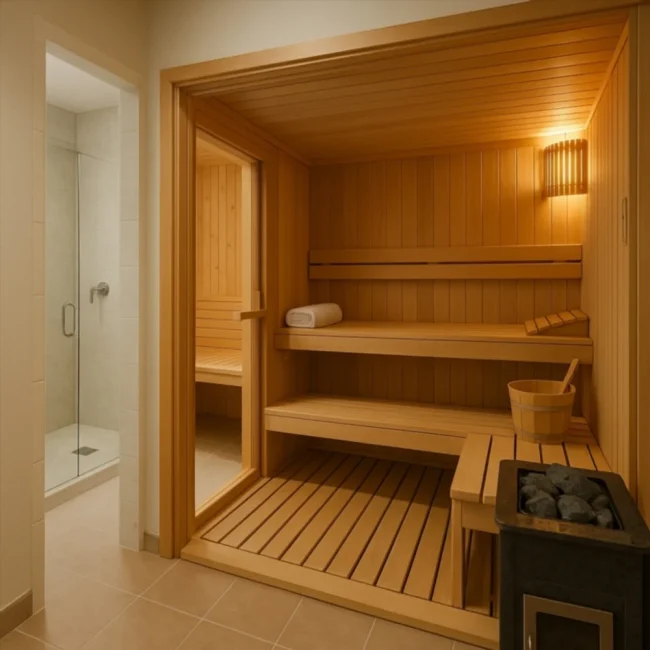
- ZoningIn addition to the steam room, it is advisable to provide a dressing room, a shower area, and a relaxation area.
- Ceiling heightThe height of the steam room should not be higher than 2.2 m—this saves energy and allows for even heating of the air.
Construction and finishing requirements
A bathhouse is a room with an aggressive environment: temperature fluctuations, humidity, and steam. Therefore, special requirements are imposed on its construction and finishing.
Hydro- and vapor insulation
Prevent moisture from penetrating into the walls and ceilings of the house. For protection, use:
- vapor barrier films (foil materials),
- waterproofing membranes,
- sealants at joints.
Pay special attention to corners, ceiling joints, and utility entry points.
Insulation
High-quality thermal insulation is essential to ensure long-term retention of steam in the room. Basalt wool, mineral wool mats, and foil-faced insulation are commonly used.
Ventilation
Supply and exhaust ventilation is a must. It ensures:
- removal of excess moisture,
- protection from mold,
- breathing safety,
- circulation of fresh air.
Ventilation ducts must be protected from heat loss.
Finishing materials
The most popular types of wood are:
- Linden- does not emit resin, has a pleasant aroma, is light and durable.
- Alder- moisture-resistant, smooth, does not warp.
- Cedar- antiseptic effect, aromatherapy.
- Abash (African oak)- practically does not heat up, ideal for shelves.
You cannot use coniferous trees without treatment - the resins can cause burns.
Stove for a home sauna
Choosing a stove is one of the most important steps. There are three main types:
Wood-burning stove
The traditional option. Requires a chimney and regular cleaning. Provides "live" heat and aroma.
Electric oven
Convenient for urban environments. Safe, heats up quickly, and is thermostatically controlled.
Gas oven
Economical, but requires connection to the gas network and approval from regulatory authorities.
It's important to calculate the power correctly: 1 kW for every cubic meter of steam room. For a 6 m² (approximately 14 m³) room, a minimum 9–10 kW heater is needed.
Communications
Water supply and drainage
Cold and hot water must be supplied to the shower and sink. The drain should be connected to a sewer system with a trap and water seal to prevent unpleasant odors.
Wiring
Only concealed wiring using heat-resistant cable is permitted. All outlets and switches are located outside the steam room. Lighting is sealed and has a moisture protection rating of at least IP54.
Security measures
- Installation of RCD (residual current device).
- Refractory insulation around the stove.
- Use of heat-resistant and moisture-resistant materials.
- Regular ventilation check.
- Windows are made of tempered glass or glass blocks only.
Interior and comfort
A well-designed sauna interior combines aesthetics and functionality. Recommended:
- install shelves at different heights (the lower one is for children or those who cannot stand the heat),
- provide a place to store brooms, oils, towels,
- use decorative lighting with soft light,
- Separate the changing room, shower and relaxation area for comfort and hygiene.
Examples of layouts
1. Mini-sauna 2x2 m:
- one shelf along the wall,
- stove in the corner,
- the entrance door is opposite the shelf.
2. Bathhouse 3x3 m:
- two-tiered shelves along two walls,
- shower stall or drain,
- electric furnace with a protective screen,
- dressing room - 1.5x2 m.
Legal aspects
In case of major construction and changes to a residential building, the following is required:
- project,
- coordination with the local administration or BTI,
- compliance with SNiP and SanPiN standards,
- Fire safety certificate for the equipment used.
Conclusion
A sauna in the home isn't just a whim, but a wise investment in your health, comfort, and well-being. With the right approach, proper technology, and the use of high-quality materials, it will become a favorite place to relax and recharge. Modern solutions make it possible to create a safe, effective, and stylish sauna—the key is to consider all the nuances at the design stage.