Electricity has long been an integral part of modern life, and any interruptions in its supply can cause serious inconvenience. This is especially true in private homes, summer cottages, camping areas, or construction sites. Various types of generators are used for autonomous power supply in such cases. One unconventional, but increasingly popular, solution is the 24-volt gasoline generator. In this article, we'll take a detailed look at this device, how it differs from conventional generators, where and how to use it, and what to consider when choosing and operating it.
Features of a 24-volt gasoline generator
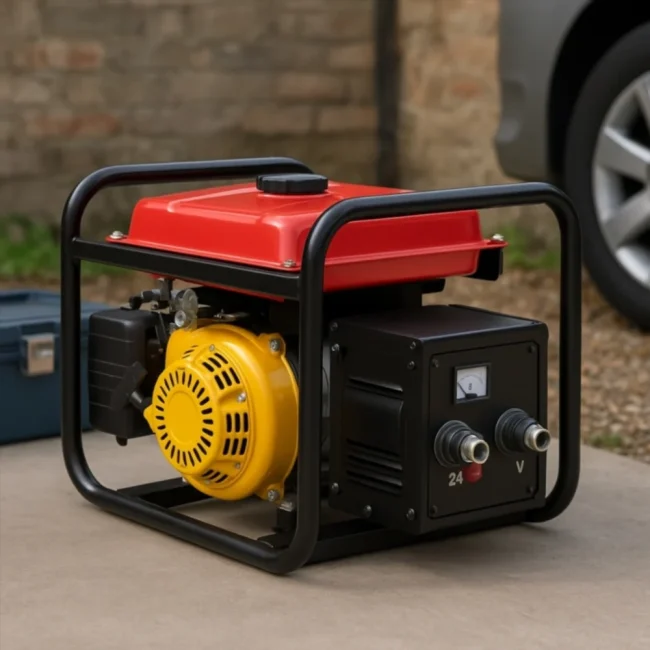
A 24V gasoline generator is a stand-alone DC power source that runs on gasoline and produces 24V DC rather than the traditional 220V AC. This makes it a highly specialized device, but in certain conditions, it proves indispensable.
Key Features:
- 24V DC power supply, ideal for automotive, truck, construction and specialized equipment.
- Compactness and mobility– most models are lighter and smaller than standard 220V generators.
- Narrow specialization– used mainly for charging batteries or powering low-voltage electrical equipment.
- High efficiency when used correctly– the absence of conversion of alternating current to direct current allows to reduce energy losses.
Where is a 24 volt generator used?
24-volt devices are used in a number of areas where the use of standard 220-volt generators is impractical or technically impossible.
Main areas:
- Commercial and industrial transport.
Most trucks, buses, and special equipment operate on 24-volt systems. A gasoline generator allows for quick charging of batteries or powering external devices.
- Military and special equipment.
Many military installations use 24-volt equipment. A generator helps provide autonomous operation for radios, communication systems, launchers, and other equipment.
- Autonomous solar and wind systems.
Often used as a backup power source for recharging batteries in alternative power supply systems.
- Hiking, expeditions, camping.
Provides power to 24V equipment such as satellite communications, lighting, refrigerators and other low-voltage devices.
- Construction sites.
Used to power low-voltage tools or lighting in areas without mains power.
Advantages and disadvantages of 24-volt generators
Like any specialized equipment, 24-volt gasoline generators have their strengths and weaknesses.
Pros:
- Ideal for charging 24V batteries;
- Easy to connect and operate;
- Lower weight and compactness compared to AC generators;
- No inverter required to convert from AC to DC;
- Safety - 24V is considered a safe voltage for most users.
Cons:
- Limited scope of application - not suitable for 220 V household appliances;
- Relatively low power - most models are designed to output up to 1 kW;
- Less choice on the market - the availability of such generators is lower than traditional ones;
- Higher cost of specialized models.
Design and operating principle
The 24V petrol generator consists of the following main components:
- Internal combustion engine.
Typically, this is a single-cylinder gasoline engine running on AI-92 or AI-95 gasoline. It provides mechanical rotation of the generator.
- DC generator.
Unlike a conventional AC alternator, this one uses an excitation device that produces a stable direct current.
- Voltage stabilizer.
The built-in regulator controls the output voltage level, providing protection for connected devices.
- Cooling system.
It can be air- or liquid-cooled. Air-cooled models are more common in low-power models.
- Control Panel.
It contains operation indicators, a voltmeter, connection connectors, and protection against overload and overheating.
How to choose a 24V gasoline generator
Before purchasing, you should clearly understand what tasks you plan to solve with the generator. Key parameters to consider:
- Output power.
It's calculated based on the total power of the consumers you plan to connect. For charging 200–300 Ah batteries, 0.5–1 kW is sufficient.
- Launch type.
There are models with manual and electric starting. Electric starting is more convenient, especially in cold weather.
- Fuel tank capacity.
Determines the battery life. For home use, a 4-8 liter tank is suitable.
- Noise level.
If you plan to use the generator near residential areas or at a campsite, pay attention to the muffler and sound insulation.
- Availability of protection and automation.
It is desirable to have protection against short circuits, overheating and overload, as well as a built-in voltmeter.
- Manufacturer and reviews.
It is recommended to choose proven brands such as Endress, SDMO, Honda, Kipor, or domestic brands with a positive reputation.
Connection and operation
When working with 24V gasoline generators, certain rules must be followed:
- Use a wire of appropriate cross-section.
When working with currents of 30–50 A, the wires must have a cross-section of at least 6–10 mm² to avoid losses and overheating.
- Connect directly to the battery terminals.
When charging batteries, ensure correct polarity. Do not use low-quality alligator clips.
- Do not overload the generator.
Continuous operation at maximum power reduces the service life of the engine and generator.
- Regular maintenance.
Change the oil and filters, check the spark plugs, and check the gaps. Maintenance is recommended every 20–50 engine hours.
- Refuel only when the engine is off.
Failure to comply with this rule may result in fire.
- Using a stabilizer.
Despite the built-in regulation, it is sometimes better to connect an external stabilizer for accurate charging of expensive batteries.
Alternatives and modifications
If you can't find a ready-made 24V gasoline generator, there is the option to modify:
- Use an inverter with conversion.Take a 220 V generator + a 220 V – 24 V inverter, but taking into account efficiency losses.
- Reworking a car generator.A homemade unit can be assembled using a gasoline engine and a car generator with a regulator.
- Industrial solutions.Some manufacturers supply generators with the ability to switch between 12, 24 and 48 volts.
Conclusion
A 24-volt gasoline generator is a reliable solution for those who need a mobile DC power source. It is indispensable in transportation, construction, tourism, and alternative energy. Despite their narrow specialization and limited model selection, these devices are becoming increasingly popular due to their convenience, versatility, and safety.
When choosing, consider your power requirements, frequency of use, operating conditions, and the type of connected devices. A properly selected and maintained 24-volt gasoline generator will last a long time, providing a stable power supply even in the most remote areas without access to a power grid.