Working at height always carries increased risk, even when renovating an apartment or trimming a tree at home. Statistics show that a significant number of household and work-related injuries result from falls from ladders or unstable structures. Therefore, it's important to ensure you select the right equipment from the very beginning. For example, even for simple tasks, a stepladder is much safer than an old, rickety stool or a stepladder.
In this article, we'll explore why safety at height is so important, what the basic rules are, and what equipment helps minimize risks.
- Why is working at height dangerous?
- The right choice of equipment
- Ladder
- Ladder
- Tower-tour
- Step ladder
- Basic safety rules when working at height
- Check equipment before starting work
- Place on a flat surface
- Don't overload the structure
- Use insurance and barriers
- Keep the tool handy
- Organization of the workplace
- Personal protective equipment
- What to do in an emergency
- Conclusion
Why is working at height dangerous?
Even a fall from just five feet can cause serious injuries, including dislocations, fractures, and concussions. This is obvious to professional builders and repairmen, but at the everyday level, many underestimate the danger.
The main risk factors include:
- Unstable structures. Old ladders or haphazardly assembled stands may tip over.
- Incorrect position of the worker. The person leans over the edge, transferring the weight to one side.
- Lack of insurance. Even at low heights, it is useful to use at least minimal restraints.
- External conditions. Slippery floors, rain, strong wind or confined spaces.
The higher the job's position, the more serious the consequences of mistakes. Therefore, it's important to think ahead about how to protect yourself and your colleagues.
The right choice of equipment
Equipment for working at height is selected based on the task at hand. It must be stable, meet standards, and be suitable for the required height. Let's look at the most popular options.
Ladder
A classic ladder is convenient for short tasks: changing a light bulb, reaching something from a high shelf, hanging curtains. However, it's not always safe for long-term work, as it requires constant balance.
Ladder
It's more stable than a ladder, as it has support on both sides. It's suitable for household tasks and minor indoor repairs. However, with ceilings over 3 meters high, a stepladder no longer provides sufficient comfort.
Tower-tour
Used in construction and large-scale façade work, it provides a wide work surface and allows for easy movement. Its downsides include bulkiness and high cost.
Step ladder
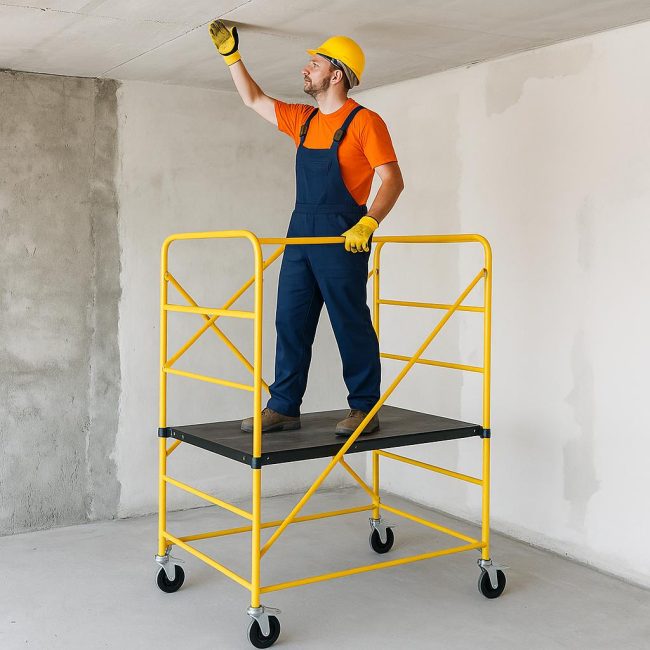
An ideal option for those who need both stability and mobility, it combines the compactness of a stepladder with the safety of a scaffold tower. Thanks to its wide platform and guardrail, a person can work at heights without fear of losing their balance. This is why this design is often chosen by both professional craftsmen and homeowners.
Basic safety rules when working at height
Even if you have high-quality equipment, it is important to follow a number of rules that will help reduce risks.
Check equipment before starting work
- Inspect all fasteners, hinges, and platforms.
- Make sure the surface is dry and free of cracks.
- Do not use structures with play or broken elements.
Place on a flat surface
- Avoid sloping floors or soft ground.
- Use special heel pads if necessary.
- If you are working outdoors, do not place the stepladder on wet grass or loose soil.
Don't overload the structure
- Every ladder or stepladder has a maximum permissible load.
- Sum the weight of the person and the tools.
- Never climb the same section together.
Use insurance and barriers
- For work above 2 meters in production, a safety system is mandatory according to regulations.
- In everyday life, it is useful to have at least a fence around the area.
- Never stand on the top bar unless there are handrails.
Keep the tool handy
- Use a belt with pockets.
- Avoid having to reach for the tool—that's when falls happen.
- Never pass objects up and down at arm's length without a rope or container.
Organization of the workplace
Safety is not only about the ladder or stepladder, but also about the surrounding area.
- Clear the area. Remove debris, wires and sliding objects.
- Think about lighting. Lack of light leads to incorrect movements.
- Fence the area. Especially at a construction site - so that no one accidentally hits the structure.
- Plan breaks. Long-term work at heights is tiring and reduces attention span.
Personal protective equipment
Even in everyday life, people often neglect protection. However, basic measures can protect your health:
- helmet - protects against falling objects;
- gloves - reduce the risk of slipping;
- special footwear with anti-slip soles;
- safety belt (when working above 2–3 meters).
What to do in an emergency
Despite precautions, it's impossible to completely eliminate the risk. Therefore, it's important to know the steps to take:
- Don't panic. If you feel like you're losing your balance, it's better to sit down on the platform rather than try to stay balanced by leaning over.
- Tell your colleagues. Never work at heights completely alone - at least one other person should be nearby.
- When falling, try to group yourself. This reduces the risk of fractures.
- Provide first aid. Even for seemingly minor injuries, it is better to call a doctor.
Conclusion
Working at height requires special attention to detail. You can't leave things to chance or luck. Proper equipment selection allows you to complete tasks more safely and comfortably. Add to this simple rules—equipment inspection, safety equipment, and space management—and the risk of accidents will be significantly reduced.
Ultimately, concern for safety is not only a technical requirement, but also respect for one's own life and health.