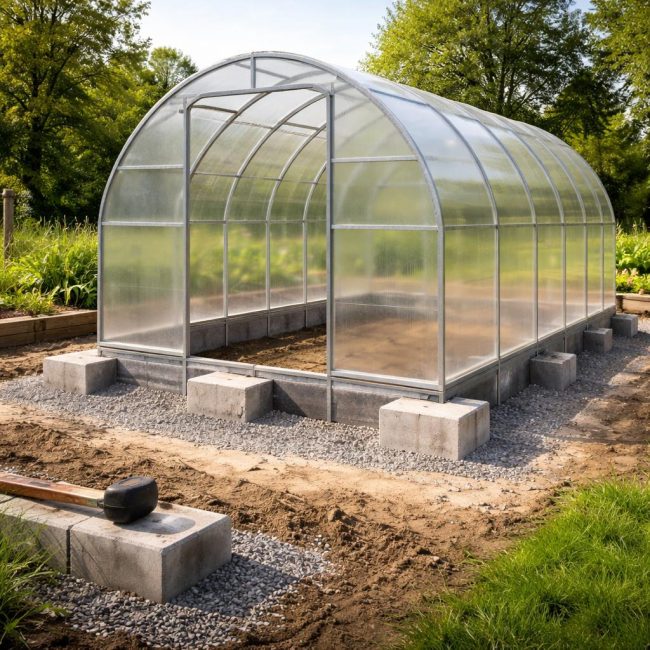
A greenhouse is a lightweight but extensive structure, susceptible to foundation distortion and seasonal ground movement. The type of foundation here determines not so much the load-bearing capacity as the geometric stability, frame durability, and ease of use. A block foundation, in this context, is considered an intermediate solution between temporary ground installation and a permanent strip or slab foundation. It is widely used, but not universally, and its suitability is determined by a combination of conditions, not by the presence of concrete blocks.
- What is meant by a block foundation in greenhouse structures?
- Constructive logic and operating principle
- Types of blocks and their practical differences
- Preparing the base for blocks
- Geometry of the perimeter and the installation step of blocks
- Compatibility with frame materials
- Behavior on different types of soils
- Seasonal deformations and their consequences
- Greenhouse size and weight restrictions
- Common Misconceptions About Block Foundations
- Comparison with alternative foundation types
- When a block foundation is justified
What is meant by a block foundation in greenhouse structures?
In greenhouses, a block foundation typically refers to a foundation made of individual concrete elements—solid or hollow blocks—laid along the perimeter of the structure at a specified spacing. Unlike a strip foundation, there is no monolithic, continuous strip of concrete: the load from the frame is transferred to the ground at points or through short sections.
This type of foundation isn't a regulatory term for capital construction, but in dacha and garden landscaping, it's become established as a designation for this type of foundation. Its purpose is to provide a rigid support for the greenhouse without labor-intensive excavation and concrete work.
Constructive logic and operating principle
A block foundation operates by redistributing the load from the greenhouse frame through the support points to the ground. The greenhouse itself is lightweight, but the length of the walls and the structure's windage require stability around the perimeter.
The blocks perform three functions simultaneously. First, they raise the frame above ground level, reducing exposure to moisture and lowering the risk of corrosion of metal elements or rotting of wooden parts. Second, they form a geometrically precise contour to which the lower frame can be easily attached. Third, they partially compensate for the unevenness of the site without a continuous layout.
An important point is that a block foundation does not "bind" the soil beneath the entire greenhouse. It does not prevent heaving or localized movements, but rather must withstand them without critical distortion.
Types of blocks and their practical differences
Several types of concrete elements are used for greenhouses, and the choice between them affects not so much the strength as the behavior of the foundation over time.
Solid concrete blocks have the greatest mass and stability. They are less susceptible to frost heave, but require more careful foundation preparation. Hollow-core blocks are lighter and easier to install, but are more susceptible to uneven settlement.
Sometimes, small-format foundation blocks or even road curbs are used. Functionally, the difference between them lies in the width of the support and the ease of attaching the frame, rather than in the calculated load-bearing capacity, which is rarely a limiting factor for greenhouses.
Preparing the base for blocks
The key mistake when constructing a block foundation is installing the blocks directly on topsoil or loose soil. In this case, the foundation begins to "sag" within the first season.
The correct preparation logic involves creating a leveling and drainage cushion. This is typically a compacted layer of sand or sand-gravel mix, allowing the block to rest on a relatively stable foundation. This cushion does not prevent soil freezing, but it does reduce the likelihood of localized subsidence.
Moreover, the depth of the foundation for a greenhouse is fundamentally different from that for a permanent foundation: we're talking about tens of centimeters, not below the frost line. Trying to "bury the foundation like a house" for a greenhouse is not only excessive but can also lead to additional problems with water drainage.
Geometry of the perimeter and the installation step of blocks
The placement of blocks around the greenhouse perimeter determines the rigidity of the entire system. The most stable option is considered to be installing blocks at corners and at the points where the frame's supporting posts rest, with additional supports on the long sides.
The smaller the spacing between blocks, the more evenly the load is distributed and the less likely the lower frame will sag. However, excessive support doesn't solve the problem of shifting soil; it only increases the labor intensity of installation.
It's important that the block foundation does not allow for "floating" geometry. After installing the blocks, their upper surfaces must be aligned horizontally, as subsequent adjustments to the already installed greenhouse are difficult.
Compatibility with frame materials
The type of greenhouse frame directly impacts the foundation requirements. Metal structures are sensitive to localized misalignment: even a slight level deviation leads to stress in the arches or profiles. For these structures, a block foundation is acceptable, provided it is precisely aligned and firmly secured.
Wooden frames are more tolerant of minor unevenness but are vulnerable to moisture. Here, blocks are often used to raise the timber above the ground and provide ventilation. In this case, the critical factor is not so much the strength of the blocks as protecting the lower frame from moisture.
Factory-made polycarbonate greenhouses are typically designed for lightweight foundations. However, manufacturing tolerances do not account for specific site soil conditions, and the block foundation must be adapted to accommodate actual wind and snow loads.
Behavior on different types of soils
Block foundations perform most predictably on sandy and sandy loam soils. These foundations are less susceptible to frost heave, and seasonal movement is uniform.
On loams and clays, the situation changes. Here, the blocks may rise or fall unevenly, causing the greenhouse to tilt. In such conditions, a block foundation is only suitable for lightweight structures that can be adjusted periodically.
On peatlands and filled soils, a block foundation is often a temporary solution. It can be used as an interim stage until more serious site development, but not as a long-term base for a permanent greenhouse.
Seasonal deformations and their consequences
A greenhouse is used year-round or for most of the season, and the block foundation inevitably experiences freeze-thaw cycles. The main risk is not the destruction of the blocks themselves, but rather the change in their relative positions.
Minor distortions may not be noticeable visually, but they can lead to poor door and window seals, the appearance of gaps, and accelerated wear of fasteners. Therefore, a block foundation requires periodic inspection, especially after winter.
The advantage of this system is that defects can usually be corrected without dismantling the entire structure. The block can be jacked up, a foundation can be added, or it can be replaced, something unachievable with monolithic solutions.
Greenhouse size and weight restrictions
A block foundation is logically linked to the concept of a lightweight greenhouse. As the structure's area and height increase, wind loads increase, and point supports no longer provide sufficient stability.
For extended industrial-type greenhouses or structures with glass glazing, a block foundation becomes a compromise and potentially problematic solution. Here, either a strip foundation or a combination of grillage and a grillage are required.
Snow load should also be taken into account. Even a lightweight greenhouse with significant snow cover transfers forces to the foundation, which are unevenly distributed with point supports.
Common Misconceptions About Block Foundations
One of the most common misconceptions is that a block foundation "isn't considered a foundation" and therefore doesn't require precision. In practice, it is precisely this type of foundation that is most susceptible to errors in markings and levels.
Another misconception concerns universality. A block foundation is often perceived as a "default" option for any site, whereas its performance is strictly tied to the soil type and the greenhouse's weight.
It's also often assumed that massive blocks automatically solve the heaving problem. While weight does play a role, it doesn't guarantee stability without a properly prepared foundation.
Comparison with alternative foundation types
Compared to a timber frame laid on the ground, a block foundation offers superior durability and dimensional stability. Compared to a strip foundation, it lacks rigidity but is faster and more reversible in installation.
Pile foundations are less commonly used for greenhouses, but they can be more predictable than block foundations on difficult soils. However, the cost and labor intensity of these options are typically higher, making block foundations an attractive compromise.
When a block foundation is justified
A block foundation for a greenhouse is appropriate in conditions where simplicity, ease of repair, and sufficient stability are required. It is well suited for seasonal and semi-permanent greenhouses on relatively level, non-heaving soils.
Its choice is logical if the structure does not require significant loads and the owner is prepared for periodic inspection and adjustment of the foundation. In this case, a block foundation fulfills its purpose—providing support and geometry—without excessive costs and complex construction operations.
When attempting to use it outside these conditions, a block foundation ceases to be a rational solution and begins to be perceived as a source of problems. Understanding its constructive logic allows us to avoid this scenario and use the system within the limits where it is truly effective.