A limited façade budget almost always arises not from a desire to "make it cheap," but from a very practical situation: the house is already built, the main expenses are behind us, and exterior finishing is postponed until the final stage, when funds are almost exhausted. At the same time, the façade cannot be left until later—it directly impacts the protection of the walls, the service life of the structure, and the perception of the house as a finished structure. The main practical question in such a situation is:What facade finishing methods can reduce costs without sacrificing functionality or creating problems that will require reworking in a few years?.
- When a facade becomes an item of savings, not an investment
- Cheaper material doesn't mean a simpler system
- Saving money by eliminating unnecessary layers and its consequences
- Why does a cheap facade often "age" visually rather than deteriorate?
- Cost reduction by simplifying the shape, not the material
- When combining materials really makes sense
- Why "temporary" almost always becomes "permanent"
- Typical misconceptions about budget finishing
- What Really Defines Successful Savings
When a facade becomes an item of savings, not an investment
In the budget segment, the façade is often viewed as a decorative shell that can be "simplified." This is a key mistake. The façade is not an outer layer designed for aesthetics, but a functional element that constantly interacts with moisture, sun, wind, and temperature fluctuations. Savings are only permissible in areas that don't directly protect the walls or don't create hidden loads. As soon as the finish begins to interfere with moisture exchange, retain water, or deteriorate under UV radiation, the initial savings turn into ongoing costs.
Cheaper material doesn't mean a simpler system
A common misconception about budget finishing is that simply choosing the cheapest material will make the façade "as a whole" affordable. In practice, a cheaper material almost always requires additional requirements: a more even base, strict adherence to layers, or frequent maintenance. As a result, the savings on material are offset by the complexity of application or the loss of service life.
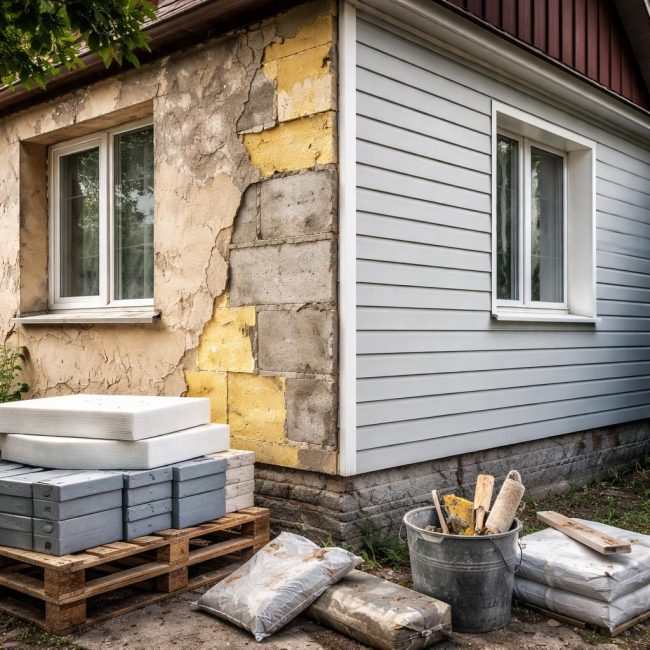
For example, simple plastering solutions seem affordable, but they critically depend on the condition of the substrate and climatic conditions. If the wall is mobile, prone to microcracks, or has uneven geometry, budget plastering will begin to crack within a season. However, the defect itself rarely appears "cosmetic": moisture penetrates the cracks, accelerates the deterioration of the layer, and the façade loses its protective properties.
Saving money by eliminating unnecessary layers and its consequences
One of the most dangerous scenarios for reducing the cost of a façade is omitting intermediate or preparatory layers. Primers, reinforcing layers, wind protection, and ventilation gaps are often perceived as optional elements, especially if they are not visible from the outside. However, it is these layers that determine whether the finish will function as a system or as a temporary shell.
Budget-friendly solutions often sacrifice façade ventilation. This is understandable: a ventilated structure appears complex and expensive. However, the lack of an air gap leads to moisture accumulation in the wall or insulation, which over time causes freezing, peeling of the finish, and accelerated deterioration of the supporting materials. The savings here are only apparent at the purchasing stage, but disappear with the first seasonal loads.
Why does a cheap facade often "age" visually rather than deteriorate?
Interestingly, budget façade finishes often fail visually rather than structurally. Color loss, stains, uneven fading, and moisture stains—all of this doesn't make a house unsafe, but it does dramatically reduce the feeling of well-maintainedness. This is when owners begin to consider remodeling, even though the façade is still technically intact.
The reason is that inexpensive materials typically have poor resistance to UV rays and stains. They absorb dust more quickly, are harder to clean, and age unevenly. As a result, a house begins to look dated after just a few years, even if its structure is sound.
Cost reduction by simplifying the shape, not the material
One of the most reliable ways to save on a façade is not to cut costs on materials, but to simplify architectural solutions. Complex projections, decorative elements, uneven surfaces, and numerous angles increase the cost of construction even when using the most affordable materials. Simple geometry allows for standard solutions without trimming, complex joints, or additional fasteners.
At the same time, such a façade can visually appear neater and more modern than a house overloaded with decor and cheap finishes. Savings are achieved not by sacrificing quality, but by reducing labor intensity and the number of potential problem areas.
When combining materials really makes sense
Combined finishing is often perceived as a design technique, but in a budget-friendly option, it can serve a purely practical purpose. Using a more durable material in high-traffic areas—at the base, around the entrance, in corners—and a simpler one on larger surfaces allows you to redistribute your budget without sacrificing durability.
Mistakes arise when combinations are made for visual effect, without considering the behavior of the materials. Different expansion coefficients and different reactions to moisture and sunlight lead to cracks at the joints. In budget finishing, such errors are especially critical, because correcting them is more expensive than the initial simplification of the solution.
Why "temporary" almost always becomes "permanent"
Many budget façades are designed as temporary: "We'll install it now, replace it later." In practice, replacement is delayed for years, and the temporary solution begins to operate in conditions it wasn't designed for. This leads to the façade not only aging but also damaging the wall beneath, complicating future renovations.
In this sense, a reasonable budget finish should be viewed from the outset as a complete, albeit simple, system, not as a placeholder. Even if the appearance isn't perfect, it shouldn't create hidden problems for the home's structure.
Typical misconceptions about budget finishing
One of the most common misconceptions is that a façade can always be updated with a coat of paint. In reality, painting only works if the underlying surface is intact. If the underlying surface begins to peel, accumulate moisture, or deteriorate, paint only temporarily conceals the problem.
Another distortion stems from a belief in one-size-fits-all solutions. A material that "works well for the neighbor" may be unsuitable for another house due to differences in the walls, orientation, or humidity of the site. Budget finishes are especially sensitive to such nuances because they have a smaller margin of safety.
What Really Defines Successful Savings
If we generalize the practical experience of budget façades, it becomes clear: cost-effectiveness works when decorative excesses and complexity are reduced, rather than basic protective functions. A simple system, clearly understood in its behavior, with a minimum number of vulnerable components, lasts longer than a complex façade made of cheap materials.
Budget finishing isn't about searching for the cheapest option, but choosing a solution that won't require constant attention and won't create problems for the home as a whole. In this case, limited funds become not a constraint, but a framework for more thoughtful and practical decisions.