Lawn care isn't just about regularly mowing the grass. To keep your lawn thick, healthy, richly green, and attractive, it's important to perform other turf maintenance procedures. One of the most important islawn aerationIn this article we will tell you in detail,How to aerate a lawnWe'll also discuss which tools to use depending on the plot size, soil type, and grass cover condition. We'll also discuss the main aeration methods and technologies.
- What is lawn aeration and why is it necessary?
- When to aerate your lawn?
- Methods of lawn aeration
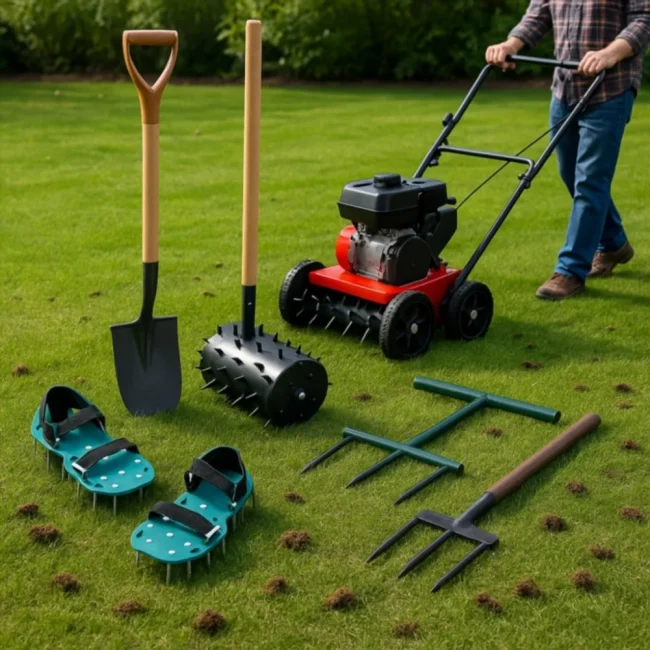
- How to aerate your lawn: tools and equipment
- Aerating sandals (aerator attachments for shoes)
- Spiked pitchfork
- Aerator roller
- Hand aerator with spikes or tubes
- Mechanical (motorized) aerator
- Tractor aerator
- How to choose the right tool?
- Preparing the lawn for aeration
- Proper aeration technology
- Post-aeration care
- How often should aeration be carried out?
- Conclusion
What is lawn aeration and why is it necessary?
Aeration is the process of pricking or cutting the turf to improve the flow of air, moisture, and nutrients to the grass roots. Over time, the topsoil of a lawn compacts, especially in areas with heavy traffic from people, pets, or machinery. This compaction prevents water and oxygen from penetrating the deeper layers, causing the lawn to turn yellow, become thinner, and become covered in moss and dry patches.
The main purposes of aeration:
- Improving air access to the root system;
- Increasing soil permeability for water and fertilizers;
- Acceleration of decomposition of organic matter (straw, dead grass);
- Stimulation of new shoot growth;
- Prevention of mold and fungal diseases.
When to aerate your lawn?
The timing of the procedure depends on the regional climate and the type of grass mixture. In central Russia, the optimal periods are:spring (April-May)Andautumn (September-October)In spring, aeration is carried out to restore the lawn after the winter period, and in autumn, to prepare it for cold weather and increase winter hardiness.
Indications for aeration:
- The lawn is used intensively and regularly;
- Visible signs of compaction: standing water after rain, yellowed spots;
- Formation of moss or fungi;
- Decreased grass growth;
- Poor water penetration during irrigation.
Methods of lawn aeration
There are two main methods of aeration:
- Vertical aeration (vertical)— is carried out by cutting the turf to a depth of 2–7 cm. It is effective in combating thatch and moss, and also improves water and air permeability.
- Puncture aeration— performed by puncturing the soil and extracting the core. It is most often used on heavily compacted lawns, especially those with clay soils.
Both methods can be used either manually or with specialized equipment.
How to aerate your lawn: tools and equipment
The choice of tool depends on the size of the lawn, frequency of aeration, and budget. Below is an overview of the most common aeration products.
Aerating sandals (aerator attachments for shoes)
- They are platforms with spikes that are attached to shoes with straps.
- A simple and affordable solution for small areas.
- Puncture depth: 2–5 cm.
- Pros: budget-friendly, easy to use.
- Disadvantages: low effect, suitable only for light preventative aeration.
Spiked pitchfork
- A modification of a regular garden fork with long, pointed tines.
- Hand tool for cola aeration.
- Allows you to control the depth and location of holes.
- Suitable for small areas and local treatment.
- Effective in heavily compacted soil.
Aerator roller
- A metal cylinder with welded spikes rolls across the lawn.
- Some models have a capacity for weighting (filling with water).
- Suitable for medium-sized areas (up to 5 acres).
- Used primarily for vertical aeration.
Hand aerator with spikes or tubes
- It looks like a pitchfork, but has tubular tips for removing soil.
- Provides deeper and more effective treatment.
- Can be labor-intensive if there is a large volume of work.
Mechanical (motorized) aerator
- Equipped with a motor that rotates a shaft with knives or spikes.
- Works as a vertical scarifier or piercer.
- The productivity allows processing large areas (from 5 acres).
- Suitable for professional and intensive care.
- Can be petrol or electric.
Tractor aerator
- Attachments for mini tractors and riders.
- It is used on the scale of parks, sports areas and football fields.
- It is rarely used in the private sector due to its high cost and size.
How to choose the right tool?
When choosing, it is important to consider the following factors:
- Lawn size: the larger the area, the more rational it is to use mechanical means.
- Soil type: clay soil requires aeration, sandy soil requires less frequent and shallower aeration.
- Grass condition: If there is a lot of straw and moss, choose vertical aerators.
- Budget: from 500 rubles for sandals to 50,000 rubles and more for mechanical models.
- Frequency of care: Regular aeration requires a convenient and quick tool.
Preparing the lawn for aeration
Before starting the procedure, it is necessary to carry out preparatory work:
- Mow the grass— up to a height of 4–5 cm.
- Remove trash and fallen leaves.
- Water the lawn a day before aeration., if the soil is dry, this will make piercing easier.
- If there is a layer of straw more than 1 cm thick, preliminaryvertical loosening(vertical).
Proper aeration technology
- Mow the lawn evenly, going over each section twice - lengthwise and crosswise.
- The punctures should be 5–10 cm deep and 10–15 cm apart.
- After the procedureleave the extracted soil plugs on the surface- they will decompose.
- If compaction is severe, fill the holes with sand (topdressing) to improve drainage.
- After completion it is recommendedfertilize the lawnand water generously.
Post-aeration care
Aeration is stressful for the soil, and it is important to properly organize its restoration:
- Add compost, humus or sand into the holes to improve the soil structure.
- Fertilize with mineral or complex fertilizer (according to the season).
- Avoid putting stress on the lawn for the first 2-3 days after the procedure.
- Water the area regularly, especially in dry weather.
How often should aeration be carried out?
- Preventive— Once a year in spring or autumn.
- Intensive— 2 times a year (spring and autumn) in compacted, weakened or shaded areas.
- On sandy and loose soils, once every 2 years may be sufficient.
Conclusion
Aeration is a key element of professional lawn care. It ensures healthy and dense grass, reduces the risk of disease, and increases resilience. The choice of lawn aerator depends on your goals, the size of the plot, and the soil condition. For small gardens, simple hand tools are suitable, while for larger lawns, mechanical aerators are better.
Don't neglect this step - regular aeration will ensure the long life of your lawn and make it a source of pride.