Choosing a façade material is one of the key tasks when building or renovating a private home. The exterior wall cladding determines not only the building's appearance but also its durability, resistance to climatic stress, and thermal insulation. In recent years, preference has increasingly been given to practical and versatile solutions that address several issues simultaneously. This is why insulated clinker tiles are becoming increasingly popular. Learn more about this material, which simultaneously serves as an exterior decorative finish and provides complete thermal insulation for the building, eliminating the need to install insulation and cladding separately.
Compared to traditional plaster, this complex coating offers a sensible alternative: durable, resistant to external influences, and aesthetically pleasing. In this article, we'll explore the differences between these materials, their strengths and weaknesses, and when it's worth choosing one over the other.
- What is a plaster facade?
- What are insulated clinker tiles?
- Comparison by key parameters
- Thermal insulation
- Durability
- Aesthetics
- Moisture resistance
- Installation
- Advantages of clinker tiles with insulation
- Disadvantages of clinker tiles with insulation
- Where is the use of clinker panels particularly appropriate?
- Conclusion
What is a plaster facade?
Facade plastering is one of the oldest and most common methods of finishing buildings. It can be applied using cement, silicate, silicone, or acrylic resins. The application process involves leveling the surface, applying a reinforcing mesh, and applying a base and finish coat.
Pros:
- Affordable cost of materials.
- Relatively simple application technology.
- Possibility of creating a variety of textures and painting in any color.
Cons:
- Tendency to form cracks when the building settles.
- The surface quickly becomes dirty and fades in the sun.
- It does not have its own thermal insulation properties and requires a separate insulation layer.
- Vulnerability to mechanical damage and moisture.
What are insulated clinker tiles?
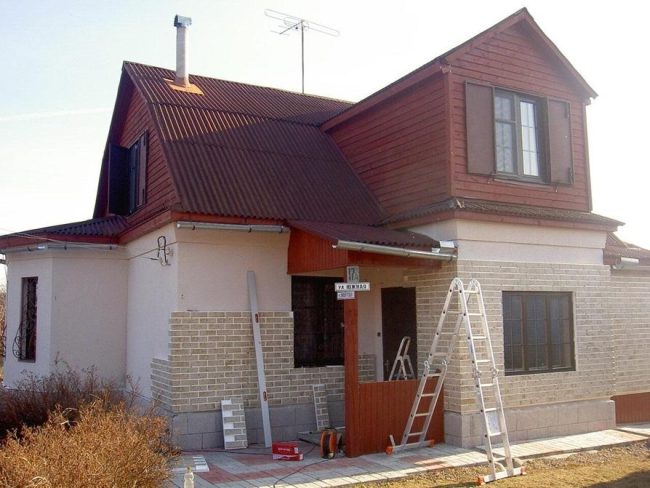
Clinker tiles with insulation These are façade panels that combine a decorative brick finish with a layer of thermal insulation. Typically, the base is polystyrene foam or mineral wool, while the outer layer is made of durable clinker tiles. This solution emerged as an alternative to the classic wet façade, simplifying installation while simultaneously solving several problems.
Panel design:
- Insulation (usually polystyrene foam 40–100 mm thick).
- Clinker tiles firmly glued to the base.
- Grooves for locks and fasteners allow you to quickly connect elements together.
Comparison by key parameters
Thermal insulation
- Plaster: does not have insulating properties, requires mandatory insulation (usually foam or mineral wool + glue + reinforcing mesh).
- Clinker tiles with insulation: has built-in thermal insulation, meets modern energy saving standards.
Durability
- Plaster: service life is about 10-15 years, but if damaged, it requires complete or partial repair.
- Clinker tiles with insulation: lasts 25–30 years without losing its appearance, resistant to temperature changes, frost, and UV radiation.
Aesthetics
- Plaster: a variety of colors and textures, but the appearance deteriorates over time - stains and dirt appear.
- Clinker tiles with insulation: imitates brickwork, retains color and texture for decades, does not require additional finishing.
Moisture resistance
- Plaster: over time it can crack and absorb moisture, which leads to the destruction of the walls.
- Clinker tiles with insulation: thanks to the closed structure of polystyrene foam and moisture-resistant clinker, it is not afraid of rain and snow.
Installation
- Plaster: the process takes longer and requires each layer to dry, especially in cold weather.
- Clinker tiles with insulation: dry installation, panels are fastened with dowels, work is possible even at low temperatures.
Advantages of clinker tiles with insulation
- Saving time and labor costs.
There is no need to install insulation separately or apply base and finishing layers of plaster. - Low thermal conductivity.
The panels provide a high level of heat retention – the walls stay warm longer in winter and cooler in summer. - Protection against mechanical damage.
Clinker is resistant to impacts, scratches and other influences. - Lack of care.
The tiles do not require painting or treatment; simply washing with water from a hose is sufficient. - Durability and climate resistance.
The system does not lose its properties in conditions of high humidity, frost, and scorching sun. - Possibility of self-assembly.
With basic tool skills, the panels can be installed without the involvement of a team.
Disadvantages of clinker tiles with insulation
- Price.
The material is more expensive than plaster. However, when you factor in insulation, adhesive, mesh, and labor, the difference is negligible. - The need for a level base.
The panels require a relatively smooth wall; if there are significant differences in level, the surface will have to be leveled. - Limited choice of appearance.
Although the color palette is quite diverse, it is still inferior to plaster in terms of the number of textures and shades.
Where is the use of clinker panels particularly appropriate?
- In private houses with cold winters.
- In regions with high humidity.
- When reconstructing old buildings with insufficient thermal insulation.
- For quick cladding, without wet work.
- If the house is built in a "brick" style and it is important to maintain the aesthetics.
Conclusion
If you're looking for the most cost-effective finishing option and don't mind regular maintenance and potential repairs, plaster may be a wise choice. But if you want a warm, reliable, and durable façade with minimal maintenance and an elegant appearance, insulated clinker tiles are a solution that will justify the investment.
Modern, next-generation façade panels are becoming increasingly affordable, and their installation is becoming easier. This is one example of how technology is making construction tasks faster and more reliable without sacrificing quality or design.