The challenge for a log house owner is to select exterior insulation that reduces heat loss while maintaining natural ventilation of the wood. The practical question that must be addressed is:Which insulation system should I choose to prevent the walls from becoming damp and losing strength?.
This article is dedicated specifically to the selection of a suitable insulation scheme and the logic of actions when applying it.
- Conditions of applicability
- The key principle: the tree must "breathe" outward.
- Acceptable insulation systems for log houses
- Ventilated facade with mineral wool insulation
- Ventilated facade with ecowool or wood panels
- Insulated cladding without continuous sealing
- What materials are not suitable for log construction?
- The sequence of choosing an insulation system
- Step 1: Assess the condition of the logs
- Step 2: Determine if a ventilation gap is needed
- Step 3. Select vapor-permeable insulation
- Step 4: Design a wind protection layer
- Step 5: Ensure free air flow
- Step 6: Select the exterior cladding
- Typical logic of insulation device
- Typical mistakes when insulating a log house
- Mistake 1. Insulating close to the wood
- Mistake 2: Using sealed materials
- Error 3. Lack of ventilation ducts
- Mistake 4. Replacing wind protection with regular film
- Mistake 5. Ignoring the condition of the old façade
- Limitations and when the instructions are not suitable
- Bottom line: the optimal choice for most log houses
Conditions of applicability
Before choosing insulation, it is important to ensure that the initial conditions are suitable for outdoor work:
- the log house has undergone its main shrinkage and does not exhibit any active movements;
- there is no systematic moisture, fungus or leaks on the logs;
- the walls are not covered with thick films or sealed panels;
- The facade is available for gap and cladding.
If the wood is already constantly wet, deteriorating, or covered with a vapor-impermeable layer, standard external insulation schemes may not work.
The key principle: the tree must "breathe" outward.
A log house differs from brick and block walls in that:
- it regulates humidity;
- removes moisture through the outer surface;
- reacts to the blocking of steam exchange.
Therefore, when it comes to external insulation, the following basic principle applies:
The layers must allow water vapor to pass through from the inside to the outside.
If insulation blocks this process, moisture accumulates within the logs, leading to rotting and loss of thermal insulation properties.
From this principle follows a feasible set of solutions.
Acceptable insulation systems for log houses
In practice, three schemes are consistently used.
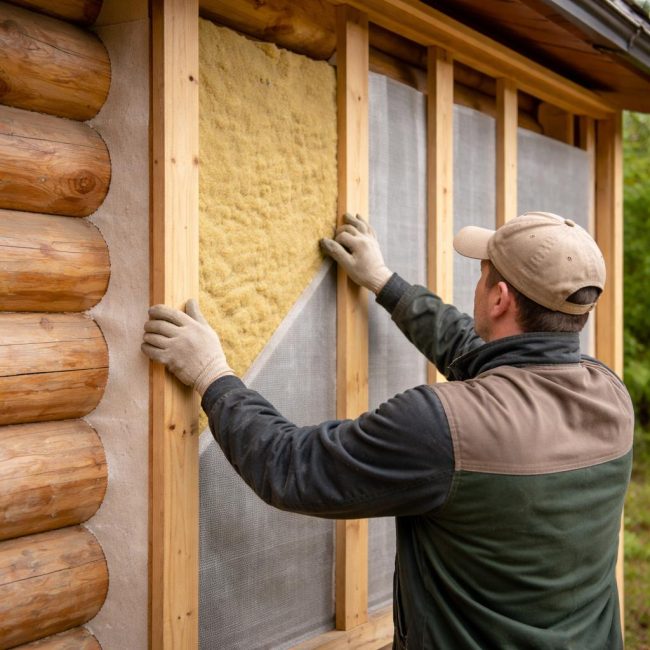
Ventilated facade with mineral wool insulation
This is the most common and predictable option.
System composition:
- wooden or metal lathing;
- vapor-permeable insulation (usually mineral wool);
- windproof membrane;
- ventilation gap;
- external cladding.
A special feature of the design is the presence of an air gap through which moisture is removed.
This system is suitable for most residential log buildings.
Ventilated facade with ecowool or wood panels
It is used less often, but the logic is the same.
The following materials are used as insulation:
- cellulose wadding;
- soft wood fiber boards;
- composite materials based on fibers.
The advantage is moisture exchange properties close to those of wood.
Disadvantage: sensitivity to installation errors.
Insulated cladding without continuous sealing
In some cases, insulation is placed behind decorative masonry or panels, but ventilation must be maintained.
The key condition is that it does not fit tightly to the logs.
Without an air gap, this circuit does not work.
What materials are not suitable for log construction?
For external insulation of a wooden house, the following are usually not used:
- extruded polystyrene foam;
- dense foam without ventilation;
- sprayed sealed insulation;
- "wet facade" systems with plastering.
There is one reason: low vapor permeability and the risk of moisture retention.
Even if such solutions provide temporary relief, over time they create problems in the structure.
The sequence of choosing an insulation system
Step 1: Assess the condition of the logs
Before choosing a scheme, look at:
- are there any dark spots or traces of moisture;
- Are there any cracks with leaks?
- Do the walls dry evenly?
If the tree is already unstable in terms of humidity, this problem is solved first.
Step 2: Determine if a ventilation gap is needed
For log houses, in most cases the answer is yes.
A gap is necessary if:
- the insulation is in contact with the wall;
- the lining is dense;
- region with a humid climate;
- The house is used all year round.
When in doubt, choose a system with ventilation.
Step 3. Select vapor-permeable insulation
They focus on materials that:
- allow water vapor to pass through;
- do not deteriorate when wet;
- restore shape after drying.
In real conditions, the most common choice is mineral wool for facade purposes or wood insulation.
Step 4: Design a wind protection layer
The insulation needs protection from blowing.
For this purpose, special membranes are used, which:
- block the air flow;
- do not prevent moisture from escaping.
Thick polyethylene films are not used for this purpose.
Step 5: Ensure free air flow
The air gap only works when air is moving.
Therefore, the design provides for:
- entrance from below;
- exit from above;
- absence of blind ceilings.
Without this, ventilation becomes formal.
Step 6: Select the exterior cladding
The cladding must:
- protect from precipitation;
- do not block ventilation;
- be repairable.
Usually used:
- wooden lining;
- planken;
- fiber cement panels;
- siding with a ventilated scheme.
Typical logic of insulation device
In simplified form, the process looks like this:
- Preparing the surface of logs.
- Installation of load-bearing lathing.
- Laying insulation.
- Installation of wind protection.
- Formation of an air gap.
- Installation of cladding.
Each layer performs a separate function and does not replace the other.
Violation of this sequence usually reduces the efficiency of the entire system.
Typical mistakes when insulating a log house
Mistake 1. Insulating close to the wood
When the insulation is pressed tightly against the logs without a gap, moisture is retained in the wall.
Externally, the problem may only become apparent after several years.
Mistake 2: Using sealed materials
Dense slabs and sprayed insulation create a “package” effect around the house.
In this mode, wood loses its ability to self-regulate.
Error 3. Lack of ventilation ducts
Even if there is a gap, if air does not circulate, the system does not work.
Stagnant air equals lack of ventilation.
Mistake 4. Replacing wind protection with regular film
Vapor-impermeable films block moisture from escaping from the insulation.
This leads to wetting of the thermal insulation layer.
Mistake 5. Ignoring the condition of the old façade
If damaged areas remain under the insulation, they will continue to deteriorate, but unnoticeably.
Limitations and when the instructions are not suitable
The logic described may not be applicable if:
- the house has historical or conservation value;
- the facade is already covered with a non-detachable structure;
- the walls are made of combined materials;
- The building is used seasonally without heating.
In such cases, the choice of insulation requires a separate assessment of the operating conditions.
Also, external insulation may not be practical if:
- the thickness of the logs already provides sufficient thermal insulation;
- the main losses occur through the roof and floor;
- The house is heated irregularly.
Bottom line: the optimal choice for most log houses
For most residential log houses, the sustainable solution remains:
ventilated facade with vapor-permeable insulation and an air gap.
Such a system:
- reduces heat loss;
- does not disrupt moisture exchange;
- preserves the wood resource;
- allows for repair and modernization.
When choosing materials and design, it's important to focus not on maximum thermal insulation, but on the balance between insulation and the natural performance of the timber wall. This balance determines the durability and stability of a log house.