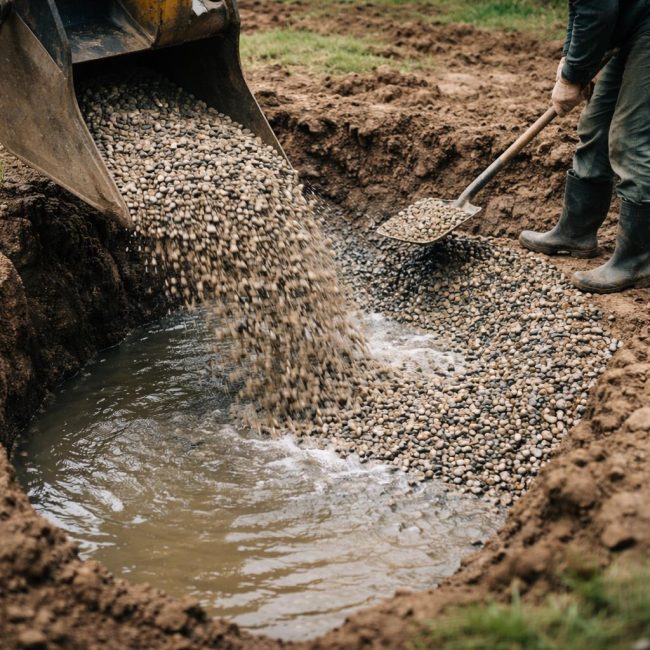
The question of how to fill a water hole often arises during various construction, renovation, or maintenance projects. This is especially relevant when it's necessary to remove excess water on a property or during renovations. The problem can arise in various situations, such as basement flooding, water accumulation in potholes, during construction, trench digging, and other circumstances. Despite the apparent simplicity, the correct choice of backfill material and methods depend on a number of factors that must be considered to effectively solve the problem. In this article, we'll look at various options for filling water holes, as well as practical considerations that will help you make the right decision.
Causes of water holes
Before considering possible solutions, it's important to understand the situations in which it might be necessary to fill a water-filled hole. These scenarios include:
- Basement floodingMoisture penetrating the basement forms localized puddles that must either be pumped out or eliminated during renovation.
- Accumulation of water in pits and trenchesDuring construction or excavation work, water can collect in excavations, which creates inconvenience when further work continues.
- Disruption of the drainage systemWater can accumulate in areas where there is no proper drainage or if the drainage system is faulty.
- Groundwater problemsIn some cases, groundwater levels in certain areas can rise, creating temporary "pools" or pits of water.
The essence of the backfill process
Filling a water-filled pit requires a comprehensive approach, as it's important not only to remove the water but also to consider the possibility of its re-accumulation. To choose the right material and method, several aspects must be considered:
- Water typeIf the water in the pit is fresh, such as rainwater or groundwater, it can be used for further irrigation or other purposes, provided its quality permits. If the water is industrial or wastewater, the need for treatment before pumping should be considered.
- Depth and dimensions of the pitFor small water pits, a simple drainage system will be sufficient, while larger bodies of water require a more complex pumping and backfilling system.
How it works in practice
After pumping out the water, or if this isn't necessary, the hole should be backfilled in a manner that prevents moisture from accumulating again and ensures structural stability (if the structure is being built). Let's look at several popular backfill options:
Using sand and gravel
This is one of the most popular and affordable backfilling methods. After pumping out the water, the pit is filled with coarse gravel first, followed by sand. This method has several advantages:
- Good drainage capacityGravel and sand allow water to drain freely, which helps prevent future water accumulation.
- Availability of materialsSand and gravel are readily available at most building supply stores and are easy to transport and install.
However, it is important to remember that this method may be less effective when working with highly saturated soils or in the case of groundwater, as the sand may simply allow water to penetrate deeper.
Using clay
Clay is a material that offers excellent waterproofing properties and prevents water from penetrating into a backfilled hole. However, it also has its drawbacks:
- Less drainage capacityClay prevents water from penetrating deep into the soil, which can be useful in the case of partial backfill.
- Difficulty in layingTo properly lay clay, proper technology must be followed; otherwise, it can shrink and crack, which can lead to further water accumulation.
Sand and gravel mixture with the addition of cement
To ensure the strength and stability of a backfilled hole, cement can be used. When mixed with sand and gravel, it forms a solid block. This is especially important if the hole is used for the same construction purposes and requires a stronger foundation.
A cementitious mixture creates a durable, moisture-resistant surface that will prevent water from penetrating deep into the surface, but this approach requires care during application and installation, as over-compaction can cause cracks in the future.
Use of construction waste
In some cases, construction debris, such as bricks or concrete blocks, can be used as backfill, filling the space and stabilizing the soil. This method is suitable when a temporary or even permanent solution is needed.
However, it is worth considering that this method does not have good drainage properties and can also lead to the rapid destruction of such materials, which will worsen the backfill result.
Backfilling using synthetic materials
If water accumulates in a pit, whether permanently or temporarily used, synthetic materials such as geotextiles or waterproofing membranes can be used. These materials help prevent water from re-entering the pit and maintain the stability of the backfill layer.
Limitations and nuances
- The need to control groundwater levelsEven after backfilling, it's important to monitor groundwater levels, as they can rise and cause further problems.
- Durability of the materialSand and gravel have a limited lifespan, unlike materials like cement or construction waste, which can last much longer.
- The right choice of material depending on the taskFor example, for drainage purposes, it is better to use porous materials such as sand and gravel, while for water insulation, clay or concrete are better.
Common misconceptions
- Sand is not always the best choiceMany believe that sand and gravel are ideal materials for filling water holes. However, in conditions with high groundwater levels or complex hydrological conditions, this method may be ineffective.
- Using clay for all types of pitsWhile clay is an excellent insulator, it may not be suitable for holes that require drainage or partial drainage, such as foundation pits.
Conclusion
Filling water holes is a crucial step in construction and renovation work. Choosing the right materials and filling methods depends on many factors, including the type of water, the hole's depth, and the terrain. Understanding these nuances will help you make the most effective decisions to avoid future water problems.