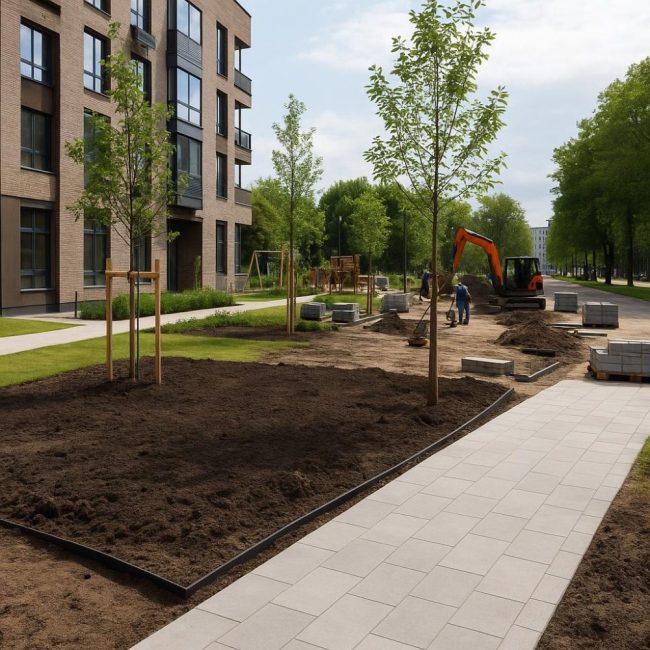
In construction projects, landscaping is often relegated to the background. Priority is given to building construction, utility systems, and commissioning, while work on courtyards, parks, and adjacent spaces is left until later. VIRIDIS has case studies, which you can review, where landscaping began after the project was commissioned—and this is a solvable problem with proper planning. This scenario, although fraught with additional challenges, allows for a commendable result if a clear strategy is followed and the interests of future users are taken into account.
- Why is landscaping often postponed?
- The main risks when relocating landscaping
- Checklist: How to organize after-care improvements without losses
- Conduct an audit of the territory
- Agree on use cases
- Revise the project taking into account the new conditions
- Set priorities
- Organize work with the contractor
- Practical advice for developers
- Examples of successful approaches
- Conclusion
Why is landscaping often postponed?
There are several reasons:
- Focus on construction — the main focus is on the construction of the “box” and internal systems.
- Budget constraints — They are trying to save money on the external environment or redistribute it in favor of engineering.
- Legal and approval delays — the improvement project requires additional expert assessments, especially if the facility includes public spaces.
- Wrong strategy — There is an opinion that landscaping and small forms can be done “later, without damage.”
In practice, this results in dissatisfaction among residents, conflicts with the management company, and increased costs if the area that has to be redeveloped is already in use.
The main risks when relocating landscaping
- More expensive to implement. When areas are already in use, refurbishing utility lines or surfaces is much more expensive.
- Conflicts with residents and tenants. Work after the commissioning of the facility has caused complaints due to noise and inconvenience.
- Loss of marketing effect. An empty yard or unkempt grounds create a negative first impression for buyers or renters.
- Deterioration of performance characteristics. Temporary solutions (asphalt instead of paving stones, minimal landscaping) quickly become unusable.
Checklist: How to organize after-care improvements without losses
Conduct an audit of the territory
- Check the condition of utility networks, storm drains, and drainage.
- Assess the actual relief and compare it with the design marks.
- Create a map of existing problems: subsidence, puddles, chaotic parking zones.
Agree on use cases
- Determine which areas are truly in demand: playgrounds, quiet areas, transit paths.
- Attract future users: residents, tenants, and the management company.
- Take into account traffic patterns—where people walk and where they don’t linger.
Revise the project taking into account the new conditions
- Reduce redundant elements that are not needed for a particular object.
- Select materials taking into account the operational requirements and limited budget.
- Consider phasing the project: for example, the tiles can be laid later, and the paths can be temporarily made of crushed stone.
Set priorities
- First of all, we need to address safety issues: lighting, hard surfaces, accessibility for people with limited mobility.
- Then we'll focus on functionality: children's and sports areas, parking solutions.
- The final stage includes decorative landscaping and small architectural forms.
Organize work with the contractor
- Fix the deadlines and schedule taking into account the operation of the facility.
- Introduce evening or "quiet" hours if the building is already occupied.
- Quality control: It's important not to lower the bar just because "it's after the delivery."
Practical advice for developers
- Maintain author supervision. Even if landscaping is delayed, the architect must oversee the implementation to ensure the project's ideas are not lost.
- Use modular solutions. Small architectural forms, coverings, and landscaping made in a modular manner are easier to install and replace.
- Don't skimp on drainage systems. Reworking them in a working yard almost always costs more than during construction.
- Make temporary decisions consciously. It is better to make a neat “temporary covering” and immediately plan for replacement times.
- Calculate operating costs. Even if you're on a tight budget, choose flooring and plants that won't require expensive maintenance.
Examples of successful approaches
- Residential complexThe developer left the site bare at the time of handover, but built a high-quality framework—drainage, lighting, and small architectural forms. A year later, when residents moved in, they added trees and recreation areas without reworking the utilities.
- Business centerAsphalt paths were used temporarily, but utilities for lighting and navigation were installed in advance. After two seasons, the area was paved, preserving the existing solutions.
- Public parkDue to budget constraints, the improvements were divided into three phases. First, transit paths and lighting were installed, then sports grounds, and finally, decorative landscaping.
Conclusion
Landscaping isn't an "add-on" to a property, but a crucial factor in its value and appeal. If work is delayed for any reason, it's important to approach the process systematically: conduct an audit, prioritize, engage specialists, and consider user interests. A well-designed checklist and oversight at all stages minimize risks and turn even delayed landscaping into a strength of the project.