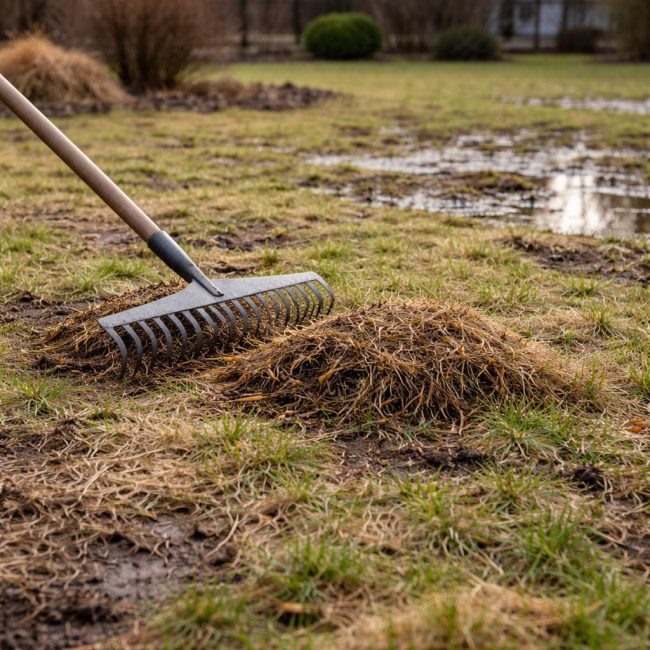
Spring is the time when the condition of the grass suddenly becomes noticeable. After the snow melts, bald spots, soggy areas, last year's dry mass, signs of soil compaction, and uneven growth are revealed. It's at this time that homeowners and property owners begin to feel like something's wrong with their grass, even though it looked perfectly fine in the fall. These concerns arise not from a desire for a perfect lawn, but from practical experience: grass affects drainage, the appearance of the property, the cleanliness around the house, and the overall appearance of well-groomed lawns.
The spring state of grass isn't a standalone problem or the result of a single misstep. It reflects several processes that occurred in the soil and plants over the winter. Understanding these processes allows us to perceive spring changes not as a "breakdown," but as a stage in the cycle, with its own patterns and limitations.
- Why does grass look different in spring than in fall?
- What happens to the soil under the grass in spring?
- Different scenarios for spring grass conditions
- Why is grass often disappointing in spring?
- Spring restrictions
- Common misconceptions about spring grass
- How to perceive spring grass in the context of a site
- A Expanding View on the Topic
Why does grass look different in spring than in fall?
In winter, the grass cover doesn't "rest," as it sometimes seems. Complex processes occur under the snow: the soil compacts, moisture is distributed unevenly, some roots experience a lack of air, while others experience excess moisture. Frequent thaws cause an ice crust to form, which disrupts gas exchange and can lead to rotting of certain areas.
When the snow melts, these processes become visible. The grass may appear withered, flattened, and yellowish or gray in places. This doesn't necessarily mean the plants are dead. More often, it's a temporary loss of ornamental value, due to the above-ground portion of the plant suffering more damage than the root system.
It's also important to note that grass growth begins unevenly in spring. In areas with better warming and drainage, it "wakes up" faster, while in low-lying areas and shaded areas, it lags behind. Visually, this creates a patchy and chaotic appearance, although in reality it reflects the microrelief and characteristics of the area.
What happens to the soil under the grass in spring?
Spring grass is primarily a matter of soil. After winter, it often becomes waterlogged and compacted. This reduces the aeration of the roots, and water can stagnate near the surface. Under these conditions, grass is slow to grow, even when the temperature is favorable.
At the same time, microorganisms in the soil become active, beginning to break down accumulated organic matter. Last year's grass residue, if it hasn't decomposed in the fall, can form a dense layer in the spring. This prevents light and air from reaching the base of the plants and further retains moisture.
From a biological perspective, this is a transitional period when the "grass-soil-moisture" system adjusts for the new season. Any changes at this time are not immediately reflected, but are delayed, so spring decisions often have consequences that are only noticeable by early summer.
Different scenarios for spring grass conditions
In spring, grass can look different, and behind these seemingly similar signs lie different causes. In some places, it's simply buried under the snow and needs time to recover. In other places, the cause may be stagnant water or dense clay soil. It also happens that the grass is gradually replaced by moss or weeds, signaling an imbalance in light and moisture.
There are areas where the grass becomes sparse, exposing the soil. This is often not due to winter per se, but to the stresses of the previous season: heavy foot traffic, parking of vehicles, the placement of buildings or temporary structures. Spring only makes the effects of these stresses more noticeable.
Sometimes, on the contrary, the grass appears too lush and uneven. This can be the result of localized waterlogging or nutrient accumulation in certain areas. Such patches are visually striking, but they are not always a problem in themselves—rather, they indicate the unevenness of the area.
Why is grass often disappointing in spring?
One common expectation is that the lawn will immediately become green and smooth with the first warm days. This expectation is fueled by photographs and examples of spring lawns that look like summer ones. In reality, such images were either taken later or reflect specific conditions—perfect drainage, even terrain, and consistent maintenance.
Spring is a time of instability. Temperature, humidity, and light fluctuate literally by the day. Grass reacts to these fluctuations, and its appearance can change from week to week. What seems like a problem today may disappear without intervention a month later, and what appears healthy will later reveal hidden weaknesses.
Another source of frustration is trying to evaluate grass separately from the rest of the property. In reality, it's closely linked to the condition of paths, paving, drainage, and topography. In spring, all these elements begin to "work" together, and the grass becomes a visual indicator of their coordination.
Spring restrictions
Spring imposes its own limitations on any grass management activities. The soil is still unstable, easily compacted, and poorly recovers from mechanical stress. This isn't always immediately noticeable, but the consequences may become apparent later in the form of slower growth or sparse patches.
Furthermore, it's difficult to accurately assess grass recovery potential in the spring. Plants may appear weak but still have living roots and growing points. Premature conclusions at this time often lead to excessive measures that disrupt the natural recovery cycle.
From a practical standpoint, spring is a time for observation and understanding, not radical change. It allows you to identify a site's weaknesses and its post-winter behavior, but it doesn't always provide the opportunity to immediately correct them.
Common misconceptions about spring grass
One of the most persistent misconceptions is the idea that "good grass should be bright green in spring." In reality, a rich color early in the season is often associated not with plant vigor, but with excess moisture or lighting conditions. Healthy grass may have a subdued appearance, gradually gaining color as conditions stabilize.
Another common misconception is that all spring grass problems are caused by improper care. In reality, many changes are due to objective factors: weather, soil type, and groundwater levels. Even with careful care, grass can behave unpredictably.
The role of a single season is also often overestimated. The spring condition of the grass is the result not only of winter but of the entire previous year. Loads, mowing, drainage solutions, and even the location of buildings gradually shape the picture that emerges in spring.
How to perceive spring grass in the context of a site
More broadly, spring grass is part of the overall "dialogue" between the site and the climate and landscape. It reveals where water is retained, where the soil is compacted, where there is a lack of light or air. In this sense, unevenness and patches are not defects, but information.
For homeowners, this is a good time to understand the layout of the property: how water behaves after snowmelt, which areas warm up first, and which remain cold longer. These observations are important not only for the grass but also for planning paths, seating areas, and plantings.
Over time, our attitude toward spring grass can change. Instead of striving to immediately bring it back to its "summer" state, we come to understand that spring is a transition, not a destination. Grass during this period doesn't have to be perfect, but it can be indicative.
A Expanding View on the Topic
The question of what to do with grass in spring is actually broader than it seems. It's less about specific actions and more about understanding processes and expectations. Spring grass is a moment of truth for a plot: it reflects past decisions and sets the direction for the coming season.
By treating this period as a stage of observation and analysis, you can achieve more stable and predictable results over time. The grass ceases to be a source of constant disturbance and becomes part of a living, changing system around the house, which goes through its spring stage each year—not uniformly, but consistently.