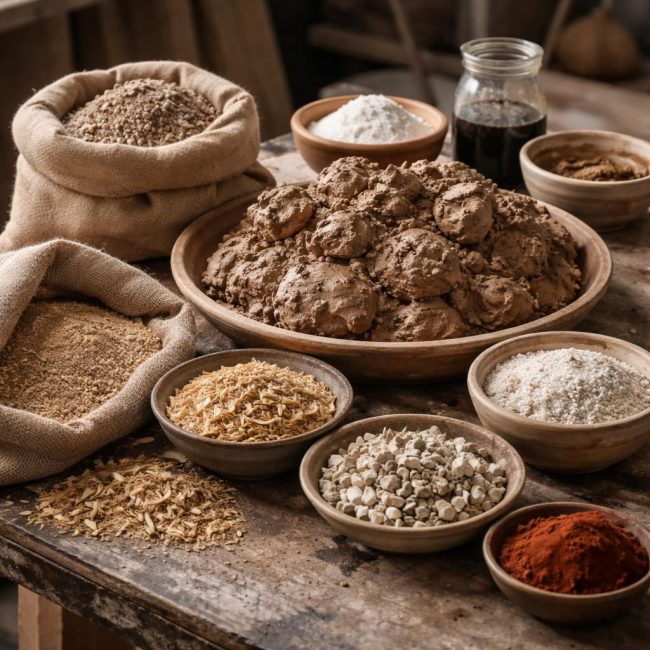
Clay, as a construction and finishing material, is rarely used in its "pure" form. Even traditional materials—from adobe blocks to stove masonry and ceramic tiles—rely not only on the natural properties of clay but also on additives that deliberately modify its behavior. These components are not random impurities: each solves a specific technological problem, from reducing shrinkage to increasing strength after firing. Understanding what exactly is added to clay and why allows for more accurate material selection, predicting their properties, and avoiding common application errors.
- Why is clay modified?
- Sand and mineral fillers
- Fireclay as a shape stabilizer
- Organic additives and their role
- Lime and gypsum: changing the bond chemistry
- Feldspar and fluxes
- Water and plasticizers
- Pigments and color additives
- Additives for moisture resistance
- Common misconceptions about supplements
- How additives influence material selection
- Expanding the view of clay as a material
Why is clay modified?
Natural clay is flexible, retains water, and hardens during drying and firing. However, in this form, it is unstable: it shrinks, cracks, and reacts differently to moisture and temperature. Additives are added to control these properties. Some reduce deformation during drying, others improve moldability, and still others increase mechanical strength or heat resistance. In construction, this means more predictable results, and in ceramics, it means batch consistency and repeatability.
Sand and mineral fillers
The most common group of additives are mineral fillers, primarily quartz sand. It is added to reduce plasticity and shrinkage during drying. The sand "dilutes" the clay matrix, preventing excessive volume compression.
In addition to quartz, crushed fireclay, limestone chips, and feldspar are used. Each option works differently. Fireclay, which is pre-fired and ground clay, increases heat resistance and reduces the risk of cracking in furnace and refractory mortars. Limestone can affect the color and porosity after firing, but requires caution due to possible reactions at high temperatures.
Fireclay as a shape stabilizer
Fireclay occupies a special place because its chemical composition is similar to the original clay, but it has already been fired. This makes it inert during the drying process: it does not shrink or change volume. The addition of fireclay is especially common in bricks, stove mortars, fireplaces, and ceramics, where dimensional stability is important.
The coarser the chamotte grain size, the more noticeably the plasticity decreases and the greater the shape stability. Fine chamotte works more smoothly, while still allowing for hand molding. The ratio of grain sizes is selected depending on the intended use of the product.
Organic additives and their role
In traditional construction, organic fibers such as straw, sawdust, and flax shives are often used. These additives don't increase strength in the traditional sense, but they effectively prevent cracking. The fibers distribute stress during drying and create microchannels through which moisture evaporates.
In adobe blocks, straw serves both as reinforcement and thermal insulation. However, organic matter burns out or decomposes over time, so such additives are only suitable for unfired materials and require protection from moisture.
Lime and gypsum: changing the bond chemistry
Lime is added to clay mortars to improve adhesion and reduce water sensitivity. The interaction of clay and lime changes the structure of the bond: the mortar becomes less plastic but more resistant to repeated wetting. This is especially true for plasters and masonry mortars in dry and moderately humid conditions.
Gypsum acts differently. It accelerates setting and increases early strength, but reduces moisture resistance. Gypsum is used sparingly in clay mixtures, more often in interior compositions where speed of application and surface smoothness are important.
Feldspar and fluxes
Fluxes—substances that lower the melting point—play an important role in ceramics and tile production. Feldspar, nepheline, and certain glassy additives are added to ensure the formation of a strong glassy phase during firing. This increases the density, water resistance, and mechanical strength of the product.
Fluxes require precise dosing. Too much flux leads to deformation during firing, while too little leads to porosity and low strength. In construction practice, such additives are typical for factory-made materials, not hand-mixed mortars.
Water and plasticizers
While water seems like an obvious component, its role goes beyond simple hydration. The quantity and quality of water directly impact plasticity and shrinkage. Excess water facilitates molding but increases the risk of cracking during drying.
Plasticizers—additives that increase the flowability of a mixture without increasing its water content—are used in industry. This helps maintain strength and reduce deformation. Plasticizers are used less frequently in clay mixtures than in cement mixtures, but they play a significant role in ceramic production.
Pigments and color additives
The color of clay doesn't always suit design or architectural needs. To correct this, mineral pigments are added: iron, manganese, and chromium oxides. These substances are resistant to firing and do not fade over time.
It's important to consider that pigments can affect not only color but also processing properties. Some oxides also act as fluxes, altering the behavior of the mass at high temperatures.
Additives for moisture resistance
Pure clay is sensitive to water. To improve moisture resistance in unfired products, bitumen emulsions, oils, and natural resins are used. These reduce capillary water absorption but limit vapor permeability.
In plasters and finishing coats, such additives are used sparingly to maintain a balance between moisture protection and the walls' ability to "breathe." An incorrect balance leads to peeling or condensation accumulation.
Common misconceptions about supplements
It's a common belief that the more additives, the better the material. In practice, each additive serves a specific purpose and can degrade other properties. Sand reduces shrinkage but decreases bond strength. Organic compounds prevent cracks but reduce durability in humid environments. Fluxes increase density but require strict temperature control.
Another misconception concerns the universality of recipes. Clay composition varies greatly depending on the deposit, so the proportions of additives suitable for one raw material may be ineffective for another.
How additives influence material selection
Knowing what's added to clay helps evaluate the finished product. The presence of chamotte indicates heat resistance, while organic inclusions indicate a focus on environmentally friendly, yet demanding, use. Fluxes and pigments are more common in factory-made products with controlled firing.
For home renovation and improvement, this means a more informed approach to choosing plaster, brick, tile, and adobe blocks. Understanding the composition allows you to anticipate the material's performance and avoid conflicts between expectations and actual properties.
Expanding the view of clay as a material
Clay remains relevant precisely because it can be adapted. Additives transform this natural raw material into a whole family of materials with different properties—from flexible mortars to dense ceramics. Viewing clay not as a homogeneous substance, but as the basis for a composition, makes it easier to understand why one clay material lasts for decades, while another requires specific conditions. This approach helps not only choose ready-made solutions but also work effectively with clay in applications where hand-mixing is permitted.