Residual current devices (RCDs) have long been a mandatory part of electrical systems in residential buildings and apartments. They are perceived as a "safety switch" that suddenly de-energizes a line for no apparent reason. In practice, each trip has a specific physical cause. Understanding these causes is important not for interfering with the protection, but for properly assessing the condition of the electrical network and equipment.
- The principle on which the shutdown is based
- Damage to wiring insulation
- Malfunctions of household appliances
- High humidity and condensation
- Errors in the wiring diagram
- Collaboration of multiple consumers
- Features of electronics and switching power supplies
- Wear of the residual current device itself
- Common misconceptions about the reasons for shutdowns
- Why is it important to understand the trigger source?
The principle on which the shutdown is based
An RCD doesn't respond to overloads or short circuits. Its purpose is to detect current leakage, which is a situation where some electricity escapes through a path not intended by the circuit. Under normal conditions, the current flowing through the phase conductor returns entirely through the neutral conductor. If a difference occurs, the device perceives it as potentially dangerous and opens the circuit.
Even a small leak could indicate contact with the device's housing, a damp surface, or damaged insulation. Therefore, RCD sensitivity is measured in milliamps, not amperes, as with circuit breakers.
Damage to wiring insulation
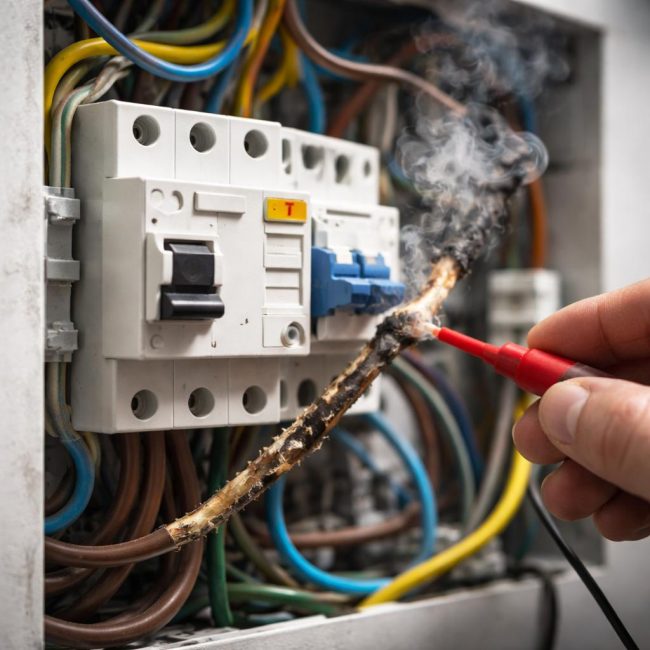
One of the most common causes of tripping is deterioration of cable insulation. This can be due to aging materials, mechanical damage, or installation errors. Microcracks and fractures are not always visible, but they create a path for current leakage onto building structures or grounded elements.
Hidden sections of wiring, where they bend, where they pass through walls and ceilings, and in areas with elevated temperatures, are particularly vulnerable. In such cases, the RCD performs its primary function—signaling a problem that hasn't yet manifested as a fault.
Malfunctions of household appliances
Modern appliances contain interference filters, electronic power supplies, and heating elements, which can lose their seal or proper insulation over time. Washing machines, water heaters, dishwashers, and ovens are at increased risk due to the combination of electricity and moisture.
The leakage in the device's housing may be minimal and imperceptible to the user, but for an RCD, it is sufficient to trip the line. In such situations, the device protects not only from electric shock but also from the gradual destruction of the equipment.
High humidity and condensation
Water is a good conductor, especially when it contains impurities. Condensation can form in bathrooms, basements, kitchens, and unheated spaces even without direct contact with electrical equipment. Moisture on terminals, in outlets, or inside junction boxes creates temporary leakage paths.
A characteristic feature of such trips is their intermittent nature. The RCD may trip at a certain time of day or when the temperature changes, causing condensation, and then operate reliably in dry conditions.
Errors in the wiring diagram
Incorrect connection of neutral conductors after an RCD is a common cause of nuisance or permanent tripping. If the neutral conductor of a line protected by an RCD is electrically connected to the neutral conductor of another line or to ground, the device detects a current imbalance.
Such errors often occur when partially upgrading electrical wiring, replacing a panel, or adding new lines without considering the overall circuit diagram. From the RCD's perspective, this appears as a leak, although there may be no physical damage to the insulation.
Collaboration of multiple consumers
Each individual device may have an acceptable, but non-zero, leakage current. When several devices are connected to a single line, their leakages are summed. As a result, the total value exceeds the RCD trip threshold, and the line is disconnected.
This doesn't indicate a fault with a specific device. Rather, it indicates that the selected RCD is inappropriate for the operating conditions, either in terms of sensitivity or load distribution between lines.
Features of electronics and switching power supplies
Computers, televisions, chargers, and other electronics use pulsed power supplies with interference suppression filters. These filters are designed to create low leakage currents to ground. In most cases, they are safe, but under certain combinations of devices and RCD characteristics, they can cause tripping.
Such situations are especially noticeable in networks with unstable voltage or when turning on equipment with high starting currents.
Wear of the residual current device itself
Although RCDs don't have complex mechanics, their components are still subject to aging. Loss of sensitivity, unstable operation, or, conversely, excessive response can be due to internal changes in their characteristics.
In such cases, trips occur without any apparent connection to the load or environmental conditions. Formally, the cause of the trip is the same—a detected current difference—but its source is now located within the device itself.
Common misconceptions about the reasons for shutdowns
A common mistake is to assume that the RCD trips due to a power overload. The circuit breaker is responsible for the overload, and if it fails to trip and the line is de-energized, the cause is almost always a leak.
Another misconception is to perceive a trip as a malfunction that needs to be "bypassed." Attempts to remove the RCD from the circuit or replace it with a less sensitive one without analyzing the situation eliminate the symptom but not the cause, leaving the network in a potentially dangerous state.
Why is it important to understand the trigger source?
Every RCD trip provides valuable information about how the electrical network is performing under real-world conditions. Sometimes this is a temporary issue, while other times it indicates a growing problem that, over time, can lead to electric shock or property damage.
Understanding what exactly triggers the circuit breaker allows for the correct interpretation of protection signals and the distinction between network design features and signs of a real fault. In this sense, an RCD is not just a protective device, but a diagnostic element of modern home electrical systems.