Modern construction technologies are constantly evolving, offering increasingly efficient materials and solutions. In this race for energy efficiency, installation speed, and cost effectiveness, Teplosten blocks have become a key component. This multilayer composite building material has become a true breakthrough in low-rise housing construction. In this article, we'll take a detailed look at Teplosten blocks, their design features, advantages, applications, and installation considerations.
- What are Teplosten blocks: definition and composition
- Advantages of Teplosten blocks
- Types of Teplosten blocks
- Where are Teplosten blocks used?
- Comparison with other building materials
- Installation of Teplosten blocks: installation technology
- Features of operation of houses made of Teplosten blocks
- Disadvantages of Teplosten blocks
- Environmental friendliness and safety
- Conclusion
What are Teplosten blocks: definition and composition
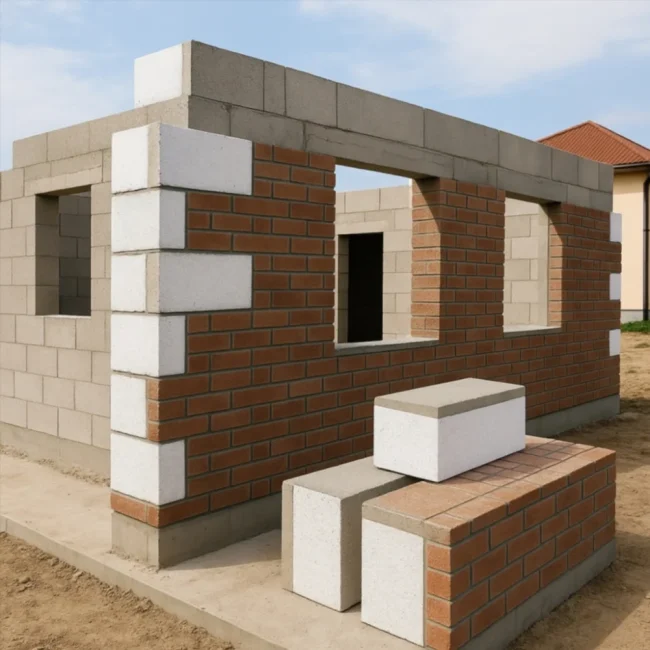
Teplosten blocks are multi-layer, large-format, factory-made building blocks designed for constructing load-bearing and enclosing walls of buildings. They consist of three main layers:
- Inner layer- is a durable structural concrete that provides the load-bearing capacity of the block and serves as the interior of the wall.
- Middle layer— an insulating layer, most often high-density polystyrene foam or extruded polystyrene foam. It provides heat retention.
- Outer layer- decorative and protective, made of facing concrete with various textures (brick, stone, etc.) or other finishing materials.
This three-layer structure is formed using a factory casting method, which ensures high geometric accuracy and a strong connection of all components into a monolithic block.
Advantages of Teplosten blocks
1. Energy efficiency
Thanks to the thermal insulation layer placed inside the block, walls made of Teplosten provide excellent thermal insulation properties. This significantly reduces heating costs in winter and air conditioning costs in summer.
2. Construction speed
Each Teplosten block replaces several construction operations: load-bearing wall construction, insulation, and exterior finishing. This significantly reduces construction time.
3. Minimizing cold bridges
Thanks to a single factory production facility and precise geometry, the blocks are installed with a high fit, and the insulation layer is located in the center of the wall, which eliminates the formation of cold bridges.
4. Strength and reliability
A load-bearing layer made of heavy or reinforced concrete can withstand significant loads, making it possible to build not only single-story houses, but also two-story houses, as well as buildings with an attic.
5. Aesthetics of appearance
The outer layer can be made to imitate brickwork, natural stone, plaster, and other textures. This eliminates the need for external finishing, reducing costs.
6. Durability and moisture resistance
All materials included in the blocks are resistant to moisture, ultraviolet radiation, biological organisms and temperature fluctuations.
Types of Teplosten blocks
1. By type of insulation
- Expanded polystyrene (EPS) is the most common type, characterized by good thermal insulation properties at a low price.
- Extruded polystyrene foam (XPS) is a more durable and moisture-resistant option.
- Mineral wool is used less frequently, but provides good vapor permeability.
2. By the type of decorative layer
- Concrete for bricks (for example, “dry brick”, “crushed stone”).
- Facade plaster.
- Imitation of natural stone.
- Smooth concrete for painting.
3. By form
- Straight blocks.
- Corner elements.
- Additional elements and lintels.
Where are Teplosten blocks used?
The most common area of application islow-rise housing construction: private residential buildings, townhouses, summer houses, cottages. However, the blocks can also be used in the construction of other structures:
- Hotels and boarding houses.
- Administrative buildings.
- Trade pavilions.
- Social infrastructure facilities.
Comparison with other building materials
| Material | Thermal conductivity | Weight | Installation speed | Finishing required |
|---|---|---|---|---|
| Teplosten Block | Very low | Average | High | Not required |
| Aerated concrete | Average | Easy | High | Required |
| Brick | High | Heavy | Low | Required |
| Sandwich panels | Low | Easy | Very high | Not always |
| Panel with trim | Average | Average | Average | No |
Teplosten blocks offer a unique combination of strength, thermal insulation, and decorative qualities, something traditional materials cannot offer in a single solution.
Installation of Teplosten blocks: installation technology
1. Preparing the foundation
The blocks are quite heavy, so a strip or slab foundation capable of supporting the load is required. The surface is leveled and waterproofed.
2. First row
It is laid on a cement-sand mortar and leveled. This is a key step, determining the accuracy of the entire structure.
3. Subsequent laying
The blocks are laid using a special adhesive for concrete foundations or a cement-sand mixture. The vertical and horizontal joints are filled.
4. Reinforcement
Every few rows, it is recommended to place metal mesh or reinforcement rods in the horizontal seams to increase strength.
5. Window and door openings
Special additional elements are used or reinforced lintels are installed.
6. Roof and ceilings
Wooden beams, floor slabs, and wall plates can be attached to walls made of Teplosten blocks.
Features of operation of houses made of Teplosten blocks
1. Comfortable microclimate
Thanks to the internal insulation and the dense structure of the block, the house always maintains an optimal temperature and humidity.
2. Low operating costs
Reducing heat loss during the cold season and overheating in the summer allows you to save on heating and air conditioning.
3. Easy to care for
The facade does not require regular finishing or updating and is resistant to precipitation and fading.
Disadvantages of Teplosten blocks
Despite many advantages, the material also has some disadvantages:
- The cost is higher, than conventional foam blocks or aerated concrete.
- Limited design flexibility— blocks are produced in standard sizes.
- Difficulty in repairing damaged surfaces— if damaged, the decorative layer is difficult to restore without leaving noticeable traces.
Environmental friendliness and safety
The blocks are made from inert and safe materials: concrete, expanded polystyrene (free of freons), and coloring pigments. They do not emit harmful substances, are not subject to biodegradation, and do not contribute to combustion in the event of a fire.
Conclusion
Teplosten blocks are a modern solution that perfectly combines thermal insulation, durability, and aesthetic appeal. Thanks to these characteristics, they are rapidly replacing traditional materials in low-rise construction. Ease of installation, energy efficiency, and durability make them an excellent choice for those who value quality, speed, and comfort.
Using Teplosten blocks, you get "three in one": a supporting structure, insulation, and a finished façade—all in one technologically advanced product that saves you time, money, and effort.