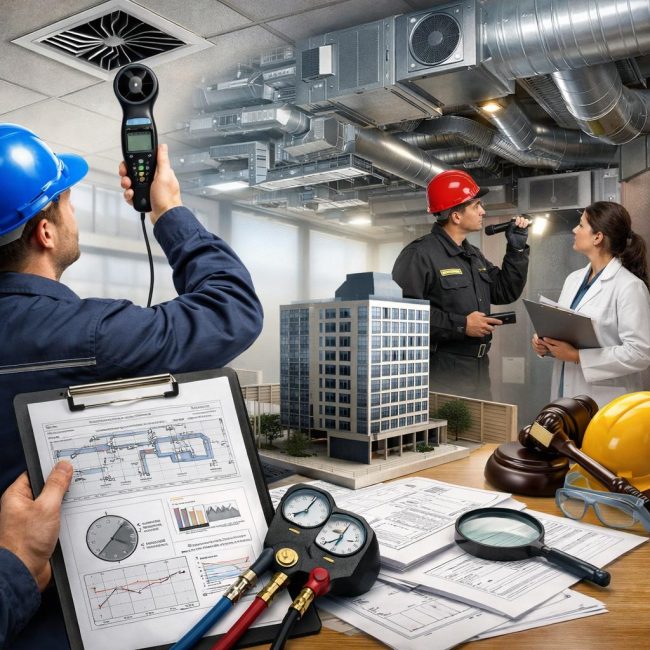
If you own a building or an existing facility, sooner or later questions about your ventilation will arise. These questions are usually not raised by the contractor, but by the fire department, Rospotrebnadzor, the occupational safety service, or the bank holding the property as collateral.
From a legal point of view certification of ventilation systems — the only documented way to confirm that indoor air is supplied, removed, and purified according to standards, and that the equipment is installed and configured properly. Without a passport, any system, even an expensive one, is considered a "nothing but a piece of paper" by inspectors and immediately raises questions from regulators and insurance companies.
Content:
- What is a ventilation passport in simple terms?
- The main objectives of the ventilation passport
- When is a ventilation passport required by law?
- Where is a passport most often asked for?
- What is included in the passport and technical kit?
- Key sections of the passport
- Documents that are usually attached to a passport
- How does passportization work and how does it affect security?
- Basic steps of passportization
What is a ventilation passport in simple terms?
Essentially, a passport is a "dossier" on your ventilation system: how it's designed, what components it consists of, what parameters it's designed for, and what standards it adheres to. The document is compiled based on instrumental measurements and commissioning, and it has legal force: it's used during facility acceptance and inspections.
Specialists record not only the ventilation unit model but also its actual parameters: air flow, temperature, automation operation, and service areas. This data is then linked to the design and current standards—SP, SanPiN, SNiP, and relevant regulations. As a result, the owner receives not just a "pretty piece of paper," but a technical report and a passport, the format of which is difficult to fault.
The main objectives of the ventilation passport
- Confirm compliance with standards. Inspectors look not at the manufacturer's advertising brochure, but at actual measurements taken in accordance with relevant regulations. The certificate demonstrates that the system was designed and installed in compliance with sanitary, fire safety, and construction regulations.
- Record operating parameters. The document specifies air flow, service areas, operating modes, and automation principles. This data can later help determine whether the system's performance has dipped and where to look for the cause.
- Simplify maintenance and repairs. When engineers have a clear diagram, equipment list, and initial measurements, diagnostics and upgrades take less time. There's no need to repeatedly open air ducts and guess the routes.
- Reduce legal risks for the owner. In the event of accidents, employee complaints, or inspections, the inspector first requests documents. Having a properly completed documentation significantly reduces the scope for ventilation-related claims.
In practice, where a construction passport exists and isn't just a "check-the-box" exercise, disputes with oversight typically boil down to specific comments rather than blocking the operation of a workshop or shopping center. The document disciplines everyone—the designer, the installers, and the operations team.
When is a ventilation passport required by law?
The law requires one thing: all businesses and organizations must have a valid certificate for their existing ventilation system. This applies to production facilities, office centers, retail and warehouse spaces, food service establishments, medical facilities, and many other building categories.
Where is a passport most often asked for?
- 1. When commissioning a building or reconstructed facility, the acceptance committee and regulatory authorities inspect not only the construction but also the utility systems. Without a ventilation certificate, accepting the facility for operation is extremely difficult.
- 2. During scheduled and unscheduled inspections. Fire and sanitary authorities assess the actual condition of the ventilation system and request supporting documentation. The certificate is the primary evidence that the system is configured according to standards.
- 3. In real estate transactions and lending. Banks, investors, and insurance companies often request a technical engineering package, including a ventilation data sheet. This influences risk assessment and the suitability of the building for certain types of activities.
- 4. When changing technology or layout. If you're rebuilding a workshop, dividing a floor into new offices, or changing the purpose of the premises, ventilation often needs to be updated. After a major upgrade, it's logical to update the data sheet to reflect the new solutions.
Certification is performed once—at the time of commissioning or after a major upgrade. Regular ventilation checks (measurements, cleaning, balancing) are always necessary, but this constitutes operational monitoring, not a new certification.
What is included in the passport and technical kit?
The specific format may vary slightly among organizations, but the general idea is the same: the data sheet should clearly explain how the system is structured and how it should operate. Therefore, it includes both text and floor-specific diagrams.
Key sections of the passport
- Facility details. Organization name, legal and physical address, building description, list of serviced premises. This information links the ventilation system to a specific facility, not to a single unit.
- System description. Purpose (supply, exhaust, general exchange, local), operating modes, availability of heat recovery, and automation operating principles are included. The zones and workshops assigned to each system are also indicated.
- Equipment list and specifications. Fans, motors, filters, heaters, air conditioners, valves—with brand, index, and key technical parameters. This section makes it easy to understand which spare parts are needed and what the estimated performance is.
- Floor plans and diagrams. Graphic diagrams of air ducts, grilles, and diffusers, indicating flow directions and measurement points. For an engineer, this is essentially a "map" of the building's interior.
- Test and measurement results. Aerodynamic measurements, air parameters in the work area, noise levels, and safety and automation checks. These data demonstrate that the system is not simply installed, but truly operational.
Documents that are usually attached to a passport
- 1. Design documentation with actual changes. The design documentation with notes on all deviations agreed upon with the client, plus signatures and seals. Without such a design, the passport simply has nothing to rely on.
- 2. Equipment factory data sheets and certificates. Documents from the manufacturers of fans, heating units, automation, and other components. These are needed to compare calculated and actual parameters.
- 3. Commissioning and concealed work reports. These confirm that the air ducts have been installed correctly, the connections are tight, and the equipment has passed individual testing.
- 4. Operating instructions. Describes how to start and stop the units, how to respond to alarms, and how often to perform maintenance and cleaning.
Once the entire set is assembled, the owner has a clear picture of what they actually own, what restrictions apply to operating hours, and what figures can be used in disputes with contractors and inspectors.
How does passportization work and how does it affect security?
Work begins with an organization with SRO approval for ventilation and air conditioning installations and an accredited measuring laboratory. This could be an installation company or an independent installation company—it's not the signage that matters, but the approvals and verified instruments.
Basic steps of passportization
- 1. Documentation review and on-site inspection. Specialists review the design, factory data sheets, and old reports and compare them with the actual installation. They also assess the condition of the air ducts and components, as well as ease of access for maintenance.
- 2. Control measurements and testing. Aerodynamic measurements are conducted, air flow along the branches and in the rooms is checked, and the air quality in the work area is assessed. Automation and safety systems are also tested.
- 3. Analysis of results and creation of diagrams. The diagrams mark control points, actual parameter values, and all agreed-upon deviations from the design. Essentially, this is a "snapshot" of the system's state at the time of input.
- 4. Compiling a data sheet and issuing reports. Based on measurements and diagrams, the data sheet itself is created, along with recommendations for fine-tuning, cleaning, or modernization, if necessary. For the owner, this is a clear checklist of where to prioritize investments.
From a safety standpoint, the benefits are very practical. Industrial areas without adequate exhaust ventilation generate employee complaints and pose risks of occupational diseases. Shopping and office centers without adequate ventilation and ventilation control quickly receive complaints from Rospotrebnadzor. Incorrect smoke extraction and pressurization during a fire are a matter of lives, not comfort.
Once the ventilation system is documented and its actual parameters are measured, it becomes clear whether sanitary standards are being met, whether the air exchange rate is sufficient, and how the system will perform in emergency scenarios. If problems are uncovered during the certification process, it's easier and cheaper to fix them immediately than to explain later to inspectors and victims why "no one knew about it."
In short: a ventilation data sheet isn't a formality or just another piece of paperwork. It's a tool that protects the owner, employees, and the facility itself. If you're responsible for a building or production facility, it's better to complete the process once and have a proper technical documentation package in hand than to have to deal with the stress of inspectors every time.