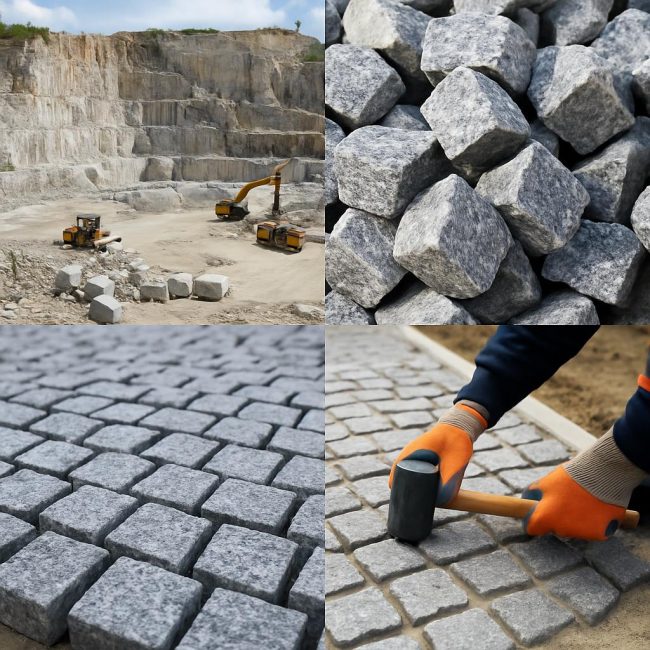
Granite paving stones have long been used in urban environments, private properties, and public spaces. They are chosen for their durability, wear resistance, and distinctive texture, which visually enhances the space's status. However, when planning paving, a natural question arises: how much will it cost?
At first glance, the price of granite paving stones per square meter may seem high, but it depends on many factors: the type of stone, processing technology, logistics, and purchase volume. To objectively assess the cost, it's important to understand the specific parameters that determine the final estimate and how they interact.
- Granite Type and Deposit: How Geology Affects Value
- Processing method: from split to sawn and heat-treated
- Format and thickness: a subtle contribution to price
- Release form: sawn timber or modular system
- Purchase volume and logistics
- Installation and foundation preparation: hidden costs
- Conclusion: How to evaluate price rationally
Granite Type and Deposit: How Geology Affects Value
Granite is an igneous rock with high density, abrasion resistance, and durability. However, not all granite is created equal. The origin plays a significant role. For example:
- Granite from Karelia (Gabbro-diabase, Dymovsky, Vozrozhdenie) is characterized by low water absorption (0.1–0.25%), high compressive strength (up to 250 MPa) and stable color.
- Kurtin granite (Kazakhstan) - coarse-grained, easy to saw, but has a higher percentage of waste.
- Chinese imported granite It often loses out in terms of frost resistance (especially in the northern regions of Russia), but wins in terms of price.
The rarer the deposit, the higher the cost of extraction and logistics, which is directly reflected in the figures.
Processing method: from split to sawn and heat-treated
The price per square meter also depends on the surface treatment method:
- Chopped Paving stones (the most affordable): available in a basic format of 100x100x50 mm, manufactured without sanding. Cost: from 1800–2200 ₽/m².
- Sawn with heat treatment (anti-slip surface): often used in public spaces. Price - from 3200–4500 ₽/m².
- Sawn and sanded or fully polished It is used in decorative paving (terraces, front entrances), and the price can reach up to 6,000–7,000 ₽/m² and above.
Geometric deviations are also important: the more precise the cut, the less adjustment is possible on site, but the more expensive the production.
Format and thickness: a subtle contribution to price
Thickness and dimensions directly impact material consumption and installation complexity. For example:
- Paving stones 100×100×30 mm are suitable for pedestrian areas, but will not withstand traffic loads.
- Size 100×100×60 mm – universal for courtyards, parking lots, passenger vehicles.
- 100×100×80 mm – used in areas with heavy traffic, including freight transport.
The thicker the product, the heavier it is, the higher the logistics cost, and the more difficult the installation. This is reflected in the price list: increasing the thickness from 50 to 80 mm increases the price by 20–30%.
Release form: sawn timber or modular system
Paving stones can be:
- hand-chopped — a budget option with a lively texture, but with tolerances of up to ±10 mm in size;
- sawn with precise geometry - used in modular laying patterns (checkerboard, herringbone);
- calibrated - used in design projects, requires minimal seams.
Modular systems (for example, a set of 100x100 + 200x100) are more expensive due to more complex cutting and sorting.
Purchase volume and logistics
The cost of granite paving stones varies significantly when moving from retail purchases (up to 10 m²) to wholesale supplies (from 50 m²). For example:
- Retail: 3500–4000 ₽/m² (including packaging, delivery and markup).
- In a large order: from 2600 ₽/m², especially when ordering directly from production.
Additionally, the price includes:
- packaging in cubes (wooden containers or Euro pallets);
- loading and unloading operations;
- delivery (depending on the region, type of transport, distance from the quarry).
Installation and foundation preparation: hidden costs
Often, customers focus solely on the "per m2" figure for material, forgetting that the cost of installation can be comparable to, and sometimes even exceed, the cost of the paving stones themselves. On average:
- Preparation of the base (crushed stone, sand, geotextile): 800–1200 ₽/m²
- Manual laying: from 1000 ₽/m²
- Mechanical installation (for large volumes): from 600 ₽/m²
The price will be even higher for installation on a concrete base or binder mortar. It's also important to consider associated costs, such as curbs, drainage, and joint sealing.
Conclusion: How to evaluate price rationally
To compare offers objectively, you need to consider:
- type of granite and its origin;
- type of processing;
- format and dimensional accuracy;
- purchase volume;
- delivery and installation method.
Transparent costing at the planning stage allows you to avoid unforeseen expenses and choose the optimal solution in terms of price/quality ratio. In construction, especially in street infrastructure, it's important to consider not only the purchase price but also the service life. Granite paving stones, when properly installed, serve a long lifespan. more than 50 years without replacement - and this is an investment, not just an expense.