A hydraulic hammer for demolishing concrete, foundations, and asphalt can accomplish what manual jackhammers and angle grinders would struggle with for days. When it comes to breaking up a monolithic foundation under a house, cutting a driveway through an old concrete yard, or removing asphalt pavement for a new utility line, it's not the number of people with the tool that decides, but the impact force and weight of the equipment. For one-off or infrequent jobs in private construction, purchasing the equipment is economically unfeasible: hydraulic hammer for rent It turns out to be much cheaper, and the result is faster and more predictable.
Next, we'll explore what tasks a hydraulic hammer can actually accomplish, where mini excavators are appropriate, and where 20-ton excavator loaders are needed, and how to choose attachment models for specific site conditions without overpaying for rental services. You'll also receive a checklist of questions for the contractor so you can provide clear initial information from the first call and receive an accurate price without surprises.
- What can a hydraulic hammer do when demolishing concrete, foundations, and asphalt? Tasks and limitations
- How to choose a hydraulic hammer: weight, equipment class, and site conditions
- Demolition Practice: How to Organize Work and Avoid Overpaying
- Hydraulic hammer rental in Belarus: formats, price, and choosing a contractor
What can a hydraulic hammer do when demolishing concrete, foundations, and asphalt? Tasks and limitations
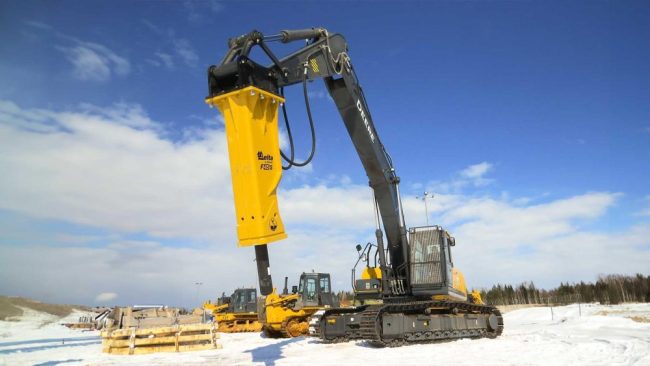
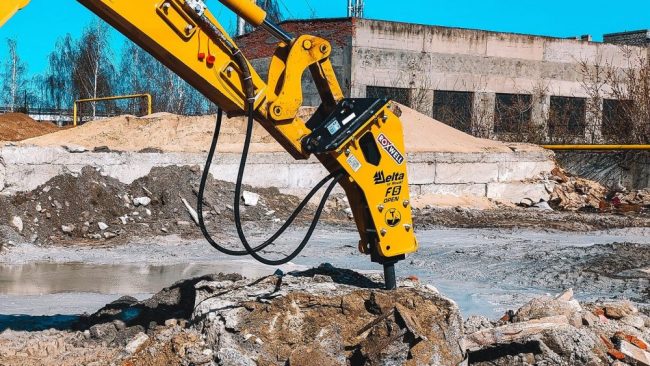
A hydraulic hammer is a hydraulic impact hammer attachment found on excavators, mini excavators, skid steers, and backhoe loaders. A piston inside the hammer body accelerates under oil pressure, transmitting high impact energy through a steel lance to the concrete. By concentrating the hammer's force in a small area, the hammer can split even the most durable construction and road materials.
A hydraulic hammer is most effective in applications requiring raw destructive energy:
- breaking up monolithic floor slabs, strip foundations, grillages, pile heads;
- dismantling the foundations of private houses, garages, industrial buildings and old outbuildings;
- removal of asphalt surfaces from courtyards, parking lots, access roads and road maps;
- creation of openings and “windows” in concrete and asphalt for new utility networks;
- crushing boulders and dense soil during excavation work.
Different materials require different approaches. For thick and heavily reinforced concrete, a high impact force and the weight of a hydraulic hammer are essential: a lightweight model will "crack" the concrete, but will take significantly longer to operate. A hydraulic hammer breaks up the concrete, and additionally cuts the rebar—sometimes hydraulic shears or cutting tools are used for this, if a more precise approach is needed. Foundations under older buildings are often uneven, containing rubble and debris, so it's important to ensure equipment has free access to the site to avoid wasting time on constant repositioning.
Asphalt is easier: even a mini-hydraulic hammer on a mini-excavator or compact loader can effectively remove 5–10 cm thick pavement without overloading the underlying soil. However, near utility lines, you need to be more careful and reduce the force of impact to avoid damaging the pipes underneath.
There are situations where a hydraulic hammer is not suitable or economically questionable:
- fragile structures that need to be partially preserved (for example, a neighbor’s retaining wall close to your foundation);
- extremely cramped conditions, where it is impossible to bring even mini-equipment - hand tools or cutting are the only options;
- Cases where diamond cutting and drilling are more profitable: precise large-diameter holes for utility lines, openings with even geometry.
If your task is rough demolition of concrete, foundations, or asphalt without the requirement for perfect edges, a hydraulic hammer will almost always be the fastest option.
How to choose a hydraulic hammer: weight, equipment class, and site conditions
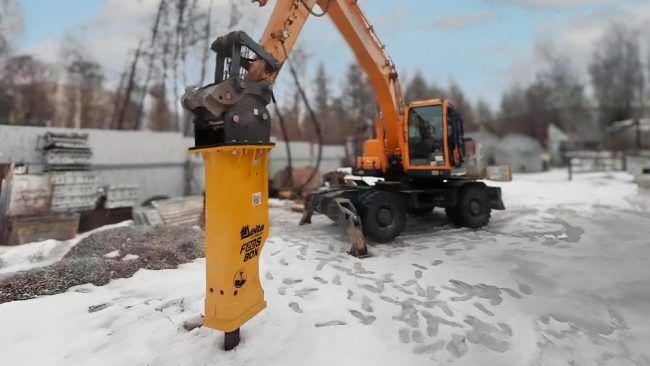
Choosing a hydraulic hammer starts not with a model catalog, but with the base machine. Hydraulic hammers are always matched to the weight of the excavator or loader, otherwise the equipment is pushed to its limits and quickly fails.
Conventionally, three classes can be distinguished:
- mini-equipment 1–3 tons – mini excavators and mini loaders, suitable for yards and confined spaces;
- Mid-size 8-20 tonne class – basic backhoe loaders and crawler excavators for most construction tasks;
- Heavy machines 20+ tons – large excavators for industrial facilities and massive structures.
If you equip a light excavator with a hammer that's too heavy, the boom and hydraulics suffer, increasing the risk of breakdowns and costly maintenance. A hammer that's too light on a powerful machine may work, but the impact force isn't sufficient: the operator has to hammer the concrete longer, and the rental cost of the special equipment runs up in extra shifts.
It is necessary to take into account the thickness and type of materials:
- 5-10 cm asphalt, garden paths, thin screeds – a small hydraulic hammer on a mini-excavator is sufficient; this is usually the most affordable format;
- a foundation for a garage or a private house 30–60 cm thick with reinforcement – it’s more reasonable to take a medium-class machine with an 8–14-ton capacity to effectively split the entire volume;
- Industrial foundations, overhead crane beams, massive foundations for heavy equipment – heavy hammers and access for large equipment are required.
Site conditions are often more important than the "ideal" model on the price list. In reality, the following must be taken into account:
- the width and height of driveways, yard turns, the presence of low canopies and branches;
- the bearing capacity of the soil - a heavy excavator simply won’t be able to reach the soggy clay base;
- proximity to walls and existing structures where excess impact energy cannot be allowed.
When ordering a rental, it is worth preparing the following information in advance:
- the thickness of concrete or asphalt, at least by eye, the presence of reinforcement, stones and other inclusions;
- approximate area of work and desired completion date;
- A photo of the property and a diagram of the entrance are often faster than any verbal request.
A convenient layout for yourself: if you have a small site, thin asphalt, and limited access, consider mini-equipment. If the strip foundation is about half a meter thick and there are adequate access roads, you need a medium-class one. Anything significantly thicker and heavier is best discussed with the specialized equipment rental company, describing the actual operating conditions.
Demolition Practice: How to Organize Work and Avoid Overpaying
Saving money on concrete demolition doesn't start with trying to find the lowest price per shift, but with proper work organization. The less equipment downtime, the cheaper the final cubic meter of demolished concrete.
A mini-preparation plan usually looks like this:
- Inspection of the site and measurement of actual volumes: a foundation 10 m long and 0.5 m thick is already several cubic meters of concrete, not “a couple of meters.”
- Thinking about where the base vehicle will be parked, how it will turn, and where to store the concrete and asphalt waste.
- Pre-arranged removal or recycling: dump trucks for disposal, or crusher bucket for rentto convert concrete waste into secondary crushed stone directly on site.
Typical mistakes made by customers:
- They buy a hydraulic hammer that is too light “to avoid overpaying for the weight of the machine” – as a result, the equipment works 1–2 shifts longer for the same task;
- the work area is not prepared: curbs, tiles, and light overhead structures that interfere with the movement of the working tool to the concrete have not been removed;
- There is no clear plan: the excavator has arrived, but the site is still dealing with issues of approvals and access.
To ensure rental efficiency, it's helpful to break the demolition work into blocks—by zone or volume. For example, completely demolish and remove a foundation under one wall in a single shift, rather than rushing the equipment around the site. Many companies offer an "excavator with a hydraulic hammer and operator" service, where the specialist already knows the operating modes, optimal hydraulic pressure, and operating characteristics of different models. The hourly rate is higher here, but due to the speed, the total cost for the task is often lower.
If you have no experience with attachments, it's best to order the equipment with an operator. This reduces the risk of damage to the equipment, extends the tool's lifespan, and frees you from the need to understand the technical nuances of the hydraulic system.
Hydraulic hammer rental in Belarus: formats, price, and choosing a contractor
In Belarus, three formats of mounted hydraulic hammer rental are most commonly used:
- rent a hammer as an attachment to your excavator if you already have the equipment and hydraulic lines;
- A turnkey excavator + hydraulic hammer + operator system is ideal for one-off tasks and private construction;
- Hourly or daily rental with a minimum booking time (usually from 4 hours to a full shift).
The price is affected by the base machine's weight, the hammer class, the site's distance from the city, accessibility, and the need for additional services: waste removal, loading onto trucks, and subsequent soil grading with a bucket. Delivery of the equipment to and from the site is also a separate cost—it's important to clarify this during the initial application process.
Before signing a contract, it is worth asking the contractor several specific questions:
- What exactly is included in the rate – fuel, operator work, delivery and maintenance of the tool;
- How is downtime due to the customer's fault calculated and is there a minimum per shift?
- What are the recommendations for preparing the site – what needs to be manually dismantled in advance so that the hydraulic hammer can operate without interruption?
- Is it possible to view a catalog of special equipment with basic specifications: impact energy, recommended machine weight in tons, tip diameter, available models?
Reliable companies typically maintain "news," "articles," and "vacancies" sections on their websites and openly publish information about their personal data processing policies. This is an indirect but useful indicator of how the company handles clients and documents. When placing an order, you fill out an application with your contact information—it's important to understand how your personal data will be processed.
The more detailed you describe the task—the type of structure, the thickness and area of the pavement, access conditions, and timeframe—the more accurately the contractor will select the equipment and calculate the estimate. In most cases, a properly selected hydraulic hammer and organized logistics are sufficient for demolishing concrete foundations and asphalt: then the work is completed quickly, technically competently, and without unnecessary overpayments.