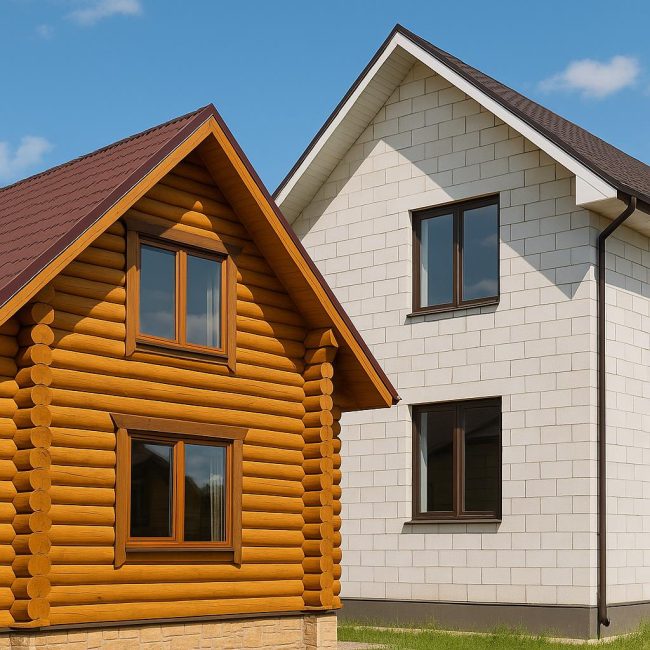
Choosing materials for a country house is a matter not only of finances, but also of comfort. House made of timber Wood and aerated concrete houses are considered the most popular options today among those building permanent homes. At first glance, both materials appear attractive: wood offers comfort and eco-friendliness, while aerated concrete offers technological advancement and practicality. But when it comes to warmth, microclimate, and comfort, doubts arise: which option is preferable?
In this article, we'll examine the physical properties of materials, the specifics of living and use, and also consider which home best retains heat and creates the most comfortable living conditions.
- Thermal insulation properties of materials
- Wooden beam
- Aerated concrete
- Impact on microclimate
- In a house made of timber
- In a house made of aerated concrete
- Resistance to cold and heat loss
- Houses made of timber
- Houses made of aerated concrete
- Comfort of use
- Tree
- Aerated concrete
- Where is it warmer and more comfortable?
- Results
Thermal insulation properties of materials
Wooden beam
Timber, especially profiled or glued laminated timber, has low thermal conductivity. Solid wood walls retain heat well while still allowing it to breathe. This creates a natural microclimate: the house is warm in winter and cool in summer.
The average thermal conductivity of dry wood is 0.12–0.18 W/(m °C)This is one of the best indicators among building materials.
However, wood also has a weak point: its properties deteriorate in high humidity. If the timber is poorly processed or the construction technology is improper, cold air can penetrate the cracks. Therefore, for a truly warm home, high-quality sealing of joints and protection from moisture are essential.
Aerated concrete
Aerated concrete, due to its porous structure, is also considered a "warm" material. Its thermal conductivity varies from 0.09 to 0.14 W/(m °C) Depending on the density of the blocks, this means that, based on formal indicators, aerated concrete even slightly outperforms wood.
But there's a caveat: aerated concrete blocks are rarely used without additional finishing. Exterior plaster or brick cladding reduces the walls' breathability, which means the natural regulation of humidity and temperature is disrupted. As a result, the house requires more precise heating and ventilation calculations.
Impact on microclimate
In a house made of timber
The main advantage of a wooden house is its ability to maintain a comfortable humidity level. Wood absorbs excess moisture from the air and releases it when it becomes too dry. This makes the house easy to breathe and the air doesn't feel stale.
Moreover, wood retains the scent of a natural material, which is psychologically perceived as cozy and "living warmth." This is especially noticeable in winter when a fireplace or stove is burning in the house.
In a house made of aerated concrete
Aerated concrete lacks the ability to regulate humidity. It doesn't absorb moisture as readily as wood, but it also doesn't release it. Comfort in such a home depends directly on proper ventilation and heating.
Moreover, aerated concrete walls don't emit odors, meaning the microclimate is created solely by the engineering systems. If the heating or ventilation isn't working properly, the air can become dry or, conversely, too humid.
Resistance to cold and heat loss
Houses made of timber
The thickness of a timber wall directly impacts thermal insulation. For year-round living, the optimal timber thickness is 200–240 mmIf the house is built from thinner material, additional insulation will be required.
Important: wood retains heat well, but is sensitive to drafts. If construction errors are made (poorly installed insulation between the logs, gaps in the joints), the house can lose significant heat.
Houses made of aerated concrete
To ensure a warm aerated concrete house, you need to choose the right block thickness. Typically, for central Russia, wall thicknesses of 375–400 mm Without additional insulation. In regions with harsh climates, insulation (mineral wool or expanded polystyrene) is often added.
Aerated concrete walls are less susceptible to drafts because they are laid with adhesive and minimal joints. However, when frozen, the blocks can accumulate moisture, which reduces their thermal insulation.
Comfort of use
Tree
- Warm walls immediately after construction.
- Natural scent and cozy atmosphere.
- The opportunity to live in a house without finishing, enjoying the natural texture of wood.
- Disadvantage: wood requires regular treatment with antiseptics and protection from moisture.
Aerated concrete
- Smoother walls, easier to finish.
- The house has virtually no shrinkage, which speeds up commissioning.
- No need for frequent processing of materials.
- Cons: The walls require a final finish to retain heat and protect against moisture.
Where is it warmer and more comfortable?
If we consider thermal conductivity alone, aerated concrete appears preferable. It allows for the construction of relatively warm walls with a smaller thickness. But living comfort isn't just about numbers.
- House made of timber It benefits from a vibrant microclimate, its ability to "breathe," and its ability to maintain optimal humidity. It offers a natural warmth that creates a cozy feeling even in moderate temperatures.
- House made of aerated concrete Provides stable warmth with proper insulation and finishing. However, comfort here depends primarily on the engineering systems: heating, ventilation, and air conditioning.
Results
- If it is more important to you natural comfort, ecology and coziness, the choice should be made in favor of timber housesThis type of home is especially pleasant for year-round family living, where naturalness is valued.
- If the priority is technological advancement, durability and minimal maintenance requirements, That house made of aerated concrete will be a practical solution.
Thus, the answer to the question "Where is warmer and more comfortable?" depends not only on the material's characteristics but also on your expectations. Any home can be made warm, but only timber can create a unique, cozy atmosphere that is difficult to replicate with artificial materials.