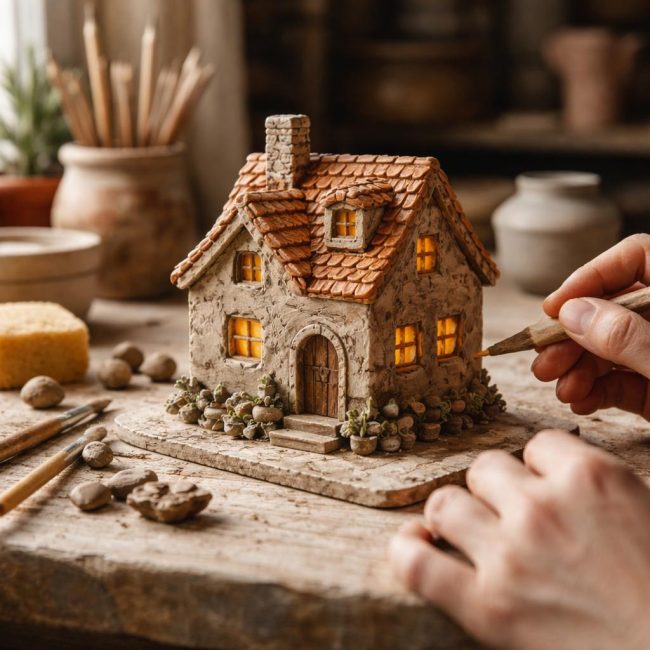
The idea of making a small ceramic house with your own hands usually arises from the intersection of several practical interests. Some people need a decorative object for their garden or interior, others are looking for a way to express themselves through handcrafted work, and still others see ceramics as a durable and "real" material, unlike plaster or polymers. Questions quickly arise: what exactly is a ceramic house, how does it differ from other hand-made objects, and why are such projects more complex in reality than they appear in photographs.
The topic seems simple, but it conceals a whole host of technological and material nuances. Ceramics is a material with character: it ages beautifully and holds its shape well, but it requires an understanding of its limitations. Therefore, a discussion of a ceramic house inevitably extends beyond the "craft" itself and touches on the principles of working with clay, firing, and handling the finished piece.
What is meant by "ceramic house"
This expression usually refers to a small architectural piece made of ceramic: a miniature house for decoration, a candlestick, a garden sculpture, or an interior object. It is not a building structure or a miniature replica of a real house in the technical sense, but rather a form that alludes to architecture.
It's important to understand that ceramics here serve not as a cladding, but as the primary material. Unlike wooden, plywood, or plaster houses, a ceramic object becomes monolithic after firing and is virtually indestructible. This influences both the approach to form and the expectations for the final result.
Conceptually, such houses are often perceived as warm and "handmade," almost toy-like. But the material dictates its own rules: each wall, roof, and opening exists not only as an image but also as a physical volume that must survive drying and firing.
Why ceramics?
Ceramics are not chosen at random. They possess properties that are difficult to replicate with other materials. They are moisture-resistant after firing, do not fade in the sun, and are perceived as an "honest" natural material. This is especially important for a garden: a ceramic house doesn't look temporary; it ages gracefully and can become part of the landscape.
In interior design, ceramics are prized for their tactility and surface depth. Even a simple form, after firing, acquires a complex texture that is difficult to imitate with paint. Therefore, ceramic houses often look convincing even without decoration—the mass itself and the traces of handcrafting become part of the image.
There's a downside, though. Ceramics doesn't forgive haste. It doesn't tolerate thin, random elements or sharp variations in thickness. What's easy to make out of cardboard or plastic can behave unpredictably in clay.
Principles of form and design
In practice, a ceramic house is always a compromise between its appearance and the material's capabilities. Right angles, thin roofs, and narrow windows look logical in architecture, but in ceramics they require special attention. The clay must dry evenly, otherwise the piece will warp or crack even before firing.
Therefore, the shapes of ceramic houses are often somewhat arbitrary. The roof may be thicker, the walls less vertical, and the openings wider than in a real house. This is not a simplification, but an adaptation of the architectural image to the properties of the material.
Another principle is integrity. The fewer individual parts, the more stable the object. In reality, it's precisely complex applied elements that become a source of problems: they react differently to drying and temperature. Therefore, expressiveness is often achieved not through detailing, but through proportions and overall flow.
How does this work in practice, from a broader perspective?
Looking at the process as a whole, a ceramic house goes through several key stages: from a soft form to a solid, irreversible object. This greatly influences the artist's thinking. Unlike wood or metal, there's no "adjustment" here. Every decision must be made in advance.
Firing becomes the point of no return. Before it, the house is flexible and vulnerable; after it, it's fragile but stable. This explains why many beginning artisans perceive ceramics as difficult: the material doesn't allow for the opportunity to go back and correct a mistake without consequences.
But there's also a special value to this. A finished ceramic house feels like a finished object, not a temporary item. It can stand in the garden or on a shelf for decades without losing its form or meaning.
Possible use cases
Most often, such houses appear in a garden setting. There, they act as an accent: they don't dominate, but rather add to the theme. Ceramics pair well with plants, stone, and wood, so the piece doesn't look out of place even after several seasons.
In an interior, a ceramic house is perceived differently. It becomes a focal point, almost a sculpture. Scale and context are important: a small form can become lost, while one that's too large can overwhelm the space. Therefore, in a room, ceramics often serve as a detail rather than a central element.
There are also intermediate options—terraces, verandas, and entryways. There, the ceramic house exists at the boundary between interior and exterior, and it's in such spaces that its properties are particularly evident.
Limitations that are often forgotten
The main limitation is fragility. Despite its strength after firing, ceramics do not withstand impacts and point loads well. This is not always obvious at the design stage, especially if the house is planned for outdoor use.
Temperature fluctuations also play a role. Although ceramics are moisture-resistant, sudden temperature changes can cause microcracks over time, especially if the piece has a complex shape or uneven thickness.
Another consideration is weight. Even a small ceramic house can be heavier than expected. This affects both the placement and the perception of the object: it immediately ceases to be a "toy" and requires a conscious place.
Common misconceptions surrounding the topic
One of the most common misconceptions is the idea of a ceramic house as a simple craft. In reality, it is a fully-fledged ceramic object, with all the attendant requirements for form and material. Expecting a lightweight construction often leads to disappointment.
Another misconception is scale. It seems that a small object is automatically simpler than a large one. But in ceramics, miniatures are often more complex: delicate elements and small sizes require greater precision and understanding of the material.
Ceramics are also often confused with other "hard" materials, expecting them to have the same strength as concrete or stone. In practice, ceramics are strong in compression but vulnerable to mechanical stress, and this is important to consider even at the conceptual level.
A view broader than a specific object
Building a ceramic house yourself isn't so much about the shape of the house as it is about learning about the material and its logic. Such a project quickly demonstrates how clay reacts to volume, thickness, and stress. Therefore, even if the result isn't perfect, the experience remains valuable.
Over time, many come to understand that a ceramic house is just one of many possible designs. The principles that become clear during the process are applicable to other forms as well: sculpture, tableware, and architectural elements for the garden. In this sense, the house becomes a starting point, not an end goal.
This is precisely why the topic remains vibrant and engaging. It lies at the intersection of craft, design, and space, where the material dictates the rules and the result is unique every time—even if the original idea seems simple.