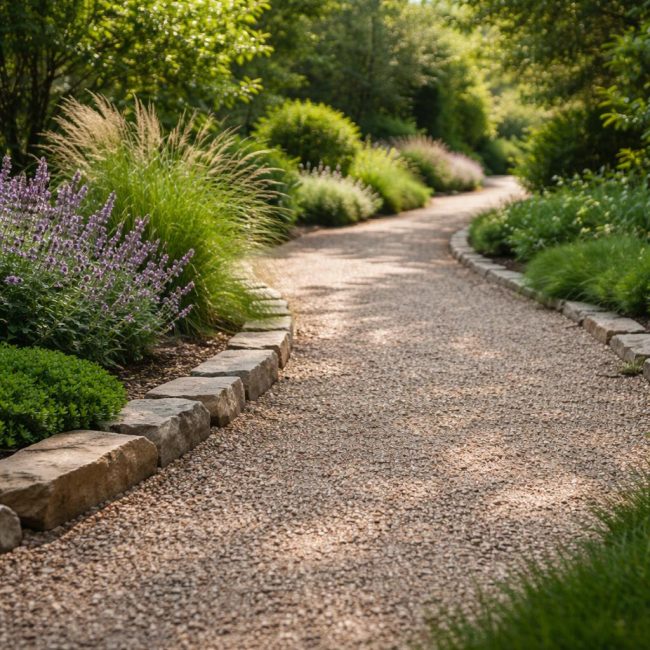
Granite chips are often used as a paving material for garden and property paths when a neat, non-rigid appearance and a sense of solidity are desired. This option is often considered for areas where drainage, natural topography, and a visual connection to the landscape are important, rather than the appearance of a permanent paving. This is where questions arise: how does granite chips behave over time, how are they fundamentally different from sand or gravel, and why do some paths made with them look neat for years, while in others they quickly lose their shape.
Granite chips aren't a compromise between tiles and crushed stone. They're a distinct material with their own application logic, and it's helpful to understand this at the paving selection stage, before making any decisions about the shape and design of the paths.
- What is granite chips and why is it chosen?
- How does a crumb track work at a fundamental level?
- Behavior in real conditions: not only in theory
- Where such paths are appropriate, and where they are controversial
- Limitations that are often forgotten
- Common misconceptions about granite chips
- A broader view: not just about paths
What is granite chips and why is it chosen?
Granite chips are typically understood as the product of crushing natural granite into small- and medium-sized fractions. Unlike rounded gravel, their grains have sharp, jagged edges. This characteristic determines the behavior of the coating: the particles adhere to each other, forming a more stable layer.
In practical terms, granite chips occupy a middle ground between loose materials and rigid pavements. They don't form a monolith, but they also don't behave like loose sand. Due to the angular shape of the grains, the compacted surface feels more "coordinated," and walking on it is predictable.
The choice of crushed stone is often dictated by aesthetics. The color and texture of natural granite are perceived as neutral and calm, not overpowering, and blend well with both modern homes and natural-style properties.
How does a crumb track work at a fundamental level?
The main principle of this type of path is to distribute the load through the dense placement of small sections, rather than through a rigid slab. When garden equipment walks or drives over the surface, the pressure is transferred downward and sideways, rather than concentrated in one spot.
In practice, this means that granite chips perform best in areas where movement is regular but not extreme. The surface "adapts" to the load, shifting slightly and then stabilizing. This reduces the risk of cracks or sudden changes in surface stability that are typical of hard surfaces due to subfloor movement.
Water drainage is also important. The aggregate doesn't retain moisture on the surface: water passes through the layer without forming puddles. In regions with frequent precipitation, this is perceived as a significant advantage, especially compared to dense, flat pavements.
Behavior in real conditions: not only in theory
On paper, granite chips appear to be a nearly universal solution, but in reality, their performance is highly dependent on site conditions. On flat or moderately sloping surfaces, they retain their shape significantly better than many expect. Moreover, visual changes occur gradually and are perceived as natural "aging" rather than deterioration.
Under intense lateral pressure—for example, on narrow, heavily trafficked paths—the material begins to slowly "creep." This isn't a defect of the granite itself, but a consequence of its friable nature. The narrower the path and the sharper the turns, the more pronounced this effect becomes.
In winter, crushed stone behaves more calmly than dense coverings. It doesn't crack due to moisture expansion and doesn't form a slippery, icy crust in the traditional sense. However, in the spring, after thawing, the surface may appear less even—this is a result of natural freeze-thaw cycles, not a sign of a problem.
Where such paths are appropriate, and where they are controversial
Granite chips are especially suitable for gardens where paths are not the main architectural element but merely support the structure of the space. They work well between seating areas, in ornamental gardens, and around outbuildings where strict geometry is not required.
Crumbs are a less suitable choice in areas where high point loads or constant wheel traffic are expected. In such areas, the surface loses its visual appeal more quickly than desired and begins to feel temporary, even if it was originally intended to be durable.
Another controversial scenario involves areas with a pronounced slope. Theoretically, the aggregate can be retained there, but in practice, its behavior becomes less predictable. The material begins to flow, albeit slowly, especially after rain.
Limitations that are often forgotten
One of the main limitations of granite chips is their dependence on the surrounding boundaries. Without clearly defined edges, the material tends to spread outward. This doesn't mean the path will necessarily lose its shape, but its contours will become less defined over time.
Another consideration is footwear and the surrounding environment. Small particles can be carried beyond the path, especially in wet weather. This isn't a maintenance issue, but it does affect the overall appearance of the area.
Finally, crumbly paving requires accepting that the surface won't look exactly the same every day. Small variations in texture, footstep marks, or tire tracks are part of its "living" nature. For some, this is a drawback; for others, it's a significant advantage.
Common misconceptions about granite chips
It's a common misconception that granite chips are simply "small crushed stone" and will behave the same way. In practice, the difference is noticeable precisely because of the grain shape: crushed stone is often larger and less stable underfoot, while granite chips create a denser surface.
Another misconception is the expectation of absolute immobility of the surface. Granite chips are not designed to remain unchanging like concrete or stone tiles. They operate according to different laws and compensate for subsurface movement not by destruction, but by displacement.
Sometimes, crumbled paving is perceived as a temporary or "cheap" solution. This is more a question of context than material. In a well-designed landscape, such paths look deliberate and appropriate, not a forced replacement for something more permanent.
A broader view: not just about paths
Interest in granite chips often begins with paths, but its potential doesn't end there. The same principle is used in decorative areas, around plantings, and in spaces between functional elements of a property. Wherever drainage, natural texture, and visual lightness are important, granite chips perform predictably and smoothly.
Understanding how this material holds up over time helps avoid inflated expectations and disappointment. Granite chipped paths aren't an attempt to imitate stone or tile, but a distinct type of paving with its own logic, character, and rhythm. This is precisely their value for those who view their property as a living system, not a collection of rigid surfaces.