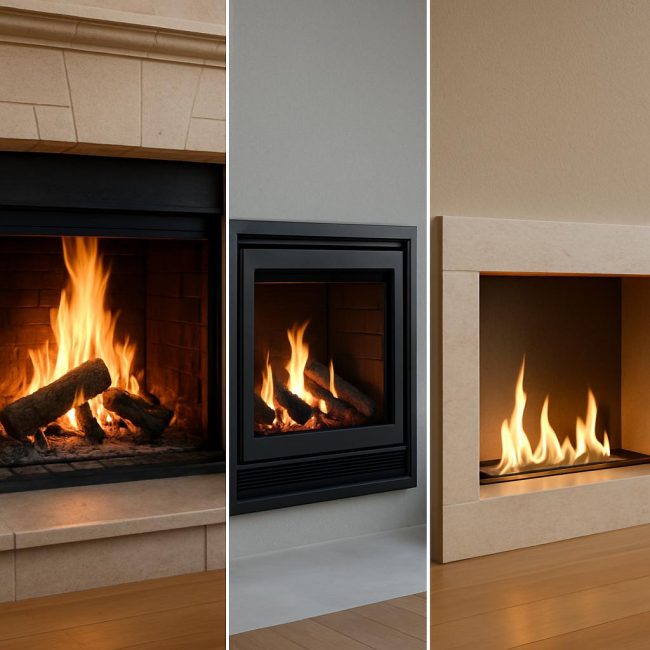
When it's a gray, chilly autumn or a blustery winter, nothing creates an atmosphere of coziness and tranquility quite like a crackling fire in a fireplace. Many homeowners dream of this source of warmth, but face a difficult choice: which fireplace is best—wood, gas, or bio-fireplace? Each option has its own pros, cons, and installation considerations. In this article, we'll explore all three types in detail to help you make an informed choice that suits your home, lifestyle, and budget.
- Wood-burning fireplace: a classic with character
- The atmosphere of real fire
- ✅ Advantages:
- ❌ Disadvantages:
- Where appropriate:
- Gas fireplace: heat with minimal hassle
- Modern convenience
- ✅ Advantages:
- ❌ Disadvantages:
- Where appropriate:
- Bio-fireplace: maximum aesthetics, minimum hassle
- Decor with heat function
- ✅ Advantages:
- ❌ Disadvantages:
- Where appropriate:
- Comparison table
- Which fireplace to choose: recommendations for the scenario
- Conclusion
Wood-burning fireplace: a classic with character
The atmosphere of real fire
A wood-burning fireplace is a symbol of traditional home comfort. Only it offers a live fire, the distinctive crackling sound of logs, and the scent of burning wood—all of which cannot be replicated in other types of fireplaces.
✅ Advantages:
- Real flames and the sound of burning wood create a unique atmosphere.
- High heat transfer, especially in models with heat accumulation (fireplace stoves).
- Autonomy — works without electricity and gas.
❌ Disadvantages:
- A chimney is requiredThis is the main design challenge—if it's not there, major installation will be required.
- Need for firewood - storage space is needed, regular purchasing and maintenance of stock.
- Labor-intensive care - ash, soot, chimney cleaning.
- Less efficiency compared to modern heating systems.
Where appropriate:
- In private houses with well-designed ventilation and chimney.
- In homes for permanent residence, where the fireplace is used not only as an element of coziness, but also as an additional source of heat.
Gas fireplace: heat with minimal hassle
Modern convenience
Gas fireplaces run on natural or liquefied gas. They're the ideal option for those seeking comfort with minimal effort.
✅ Advantages:
- Purity - no ash, smoke or odor.
- Ease of use - switching on by pressing a button or via the remote control.
- Precise regulation of temperature and flame intensity.
-
Visually very realistic, especially models with ceramic firewood.
❌ Disadvantages:
- Connection to the gas main is required or installation of a gas cylinder.
- Permits and supervision from the gas service are required.
- Less romance, than a wood-burning fireplace - the flame is not “live”, although similar in appearance.
Where appropriate:
- In houses with a gas supply or the possibility of safely installing a gas cylinder.
- Where convenience, automation and cleanliness are valued.
Bio-fireplace: maximum aesthetics, minimum hassle
Decor with heat function
Bio-fireplaces run on liquid bioethanol. This is the easiest option to install and maintain—it doesn't require a chimney, ventilation, or connection to utility lines.
✅ Advantages:
- Ease of installation — can be installed in almost any room.
- No permission required, approvals, gas or electrical connections.
- Eco-friendliness - no smoke or soot is released during combustion, only water vapor and a little carbon dioxide.
- A wide range of design solutions — from wall-mounted to built-in models.
❌ Disadvantages:
- Low heat output — more of a decorative element than a full-fledged source of heat.
- Fuel cost higher than that of wood and gas.
- Limited burning time without refueling (usually 2-5 hours).
Where appropriate:
- In houses with good heating, where the fireplace serves a decorative function.
- In rooms where it is impossible to install a chimney or supply gas.
Comparison table
| Characteristic | Firewood | Gas | Bio-fireplace |
|---|---|---|---|
| Type of fire | Real flame | Pseudo-realistic | Real, but smaller |
| A chimney is needed | Yes | Yes | No |
| Connecting to networks | No | Gas | No |
| Level of care | High | Short | Short |
| Heat transfer | High | Medium/high | Low |
| Operating costs | Average | Low | High |
| Possibility of automation | No | Yes | Partially |
Which fireplace to choose: recommendations for the scenario
If you want a fireplace for the soul, love chopping wood and aren't afraid to get a little dirty, then choose wood-burningIt will create a truly cozy atmosphere, especially if the house is used in winter.
If needed a warm and easy-to-use fireplace, which does not require much care, will do gas — especially in a house with a centralized gas supply.
For aesthetics without repairs and dust, as a stylish interior accent, your option is - bio-fireplaceIt is suitable even for small houses and is used more often as a design element than for heating.
Conclusion
A fireplace in a country house is not only a source of warmth but also a focal point, a mood enhancer, and a part of your lifestyle. A wood-burning fireplace is for lovers of classic style and real fire, a gas fireplace is for those who value comfort, and a bio-fireplace is for aesthetes and minimalists. Whatever type you choose, the most important thing is that it brings joy and comfort to your home.
If you're still unsure which option is right for you, you can start with a decorative bio-fireplace and eventually move on to more substantial designs. And if you're just building a house, consider installing a chimney in advance: this will expand your options in the future.