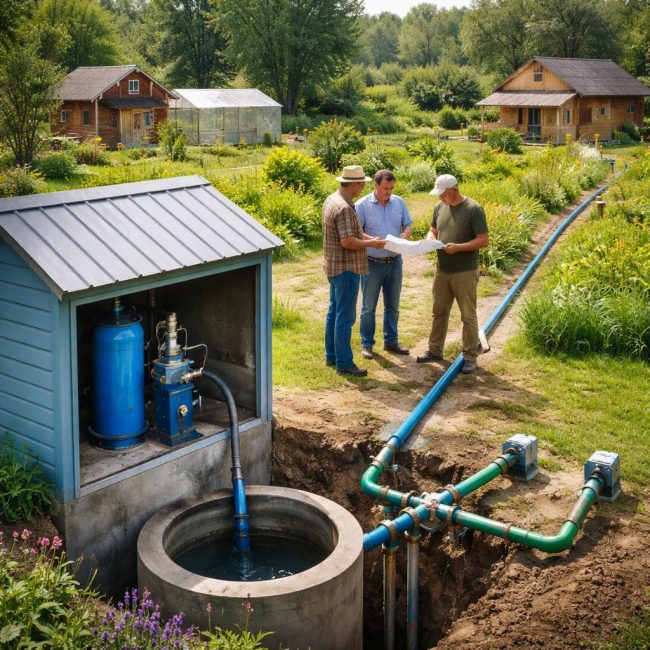
When several gardening non-profit partnerships (SNTs) decide to join forces to share a well, it can be a beneficial solution for all participants. However, this approach requires careful consideration of numerous details, ranging from technical aspects to legal issues. In this article, we'll explore the key considerations when organizing a shared water supply and the potential challenges that may arise.
The crux of the matter: well sharing
Consolidating several SNTs to share a single well is a practice that can save money on drilling new water sources and providing water. Instead of each SNT maintaining a separate well, the costs can be shared by a single installation that will supply water to all plots. However, this approach requires consideration of many nuances.
How does this work in practice?
For several gardening cooperatives to share a well, a number of technical and organizational requirements must be met. First and foremost, it's crucial that the existing well's capacity be sufficient to supply all participants with water. It's also crucial to conduct hydrogeological studies to determine whether the water source can meet the needs of several gardening cooperatives.
Technical aspects
- Well capacityThe most important factor is checking the well's capacity. This requires calculating the amount of water required for each SNT. It's important to consider not only daily consumption but also peak consumption (for example, during the summer season, when the number of summer residents increases).
- Water distribution equipment: Since water must be supplied to several SNT, it will be necessary to install distribution systems, which may include pumping stations, main pipes and individual water distribution devices for each SNT.
- Water qualityWater from a shared well must meet sanitary standards for household and garden use. Regular water quality testing will be required, which can be costly. It's important to agree on shared responsibility for water quality in advance.
Legal aspects
For several gardening associations to legally use a single well, an agreement between all parties is required. It's important for all project participants to understand who is responsible for the well's operation, maintenance, and payment of utility bills.
- Agreement between SNTSuch an agreement must clearly outline how the costs of operating and maintaining the well will be distributed. It is also important to specify who will be responsible for equipment repairs and who will pay fines for water code violations, should they arise.
- Registration of water resource useIn some cases, it is necessary to register rights to use the water resource and obtain permission from government agencies, which is especially important if the water from the well is used not only for the needs of summer residents, but also for agriculture.
Limitations and nuances
While the idea of combining several SNTs to use one well may seem appealing, there are a number of limitations and risks that you must be prepared to face.
- Water shortage during dry seasonsIn the event of a prolonged drought or other natural factors that could affect groundwater levels, all SNTs may not have enough water. It is important to provide additional water sources for emergencies.
- Excessive water consumption: In the event of uneven distribution of water between SNT or unjustified overconsumption by one of the members, the overall system may be disrupted, which will lead to dissatisfaction among other participants.
- Uncertainties in service and responsibilityWhen several SNTs join forces to share a well, the most important task is determining who will be responsible for maintaining the system. This division of responsibility must be clear, otherwise, problems related to dissatisfaction and conflict may arise.
Common misconceptions
- "One well is beneficial for everyone"This isn't always the case. Even if a well is technically sufficient to service several SNTs, it's important to consider additional maintenance costs and potential water shortages during peak demand periods.
- "Water from a common well will always be of the same quality."Water quality can vary depending on the season, weather conditions, and other factors. Regular testing and use of filters are necessary to ensure adequate water supply conditions.
Expanding completion
Consolidating several gardening cooperatives to share a well can be a profitable and effective solution if properly organized and all possible factors are taken into account. It's important to address all technical and legal aspects in advance to avoid future problems. Coordinating terms with neighboring gardening cooperatives, ensuring equitable resource distribution, and organizing regular water quality monitoring are key to the successful implementation of such a project.