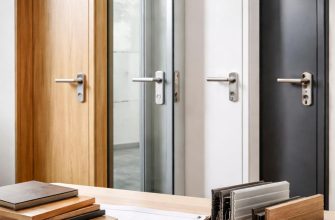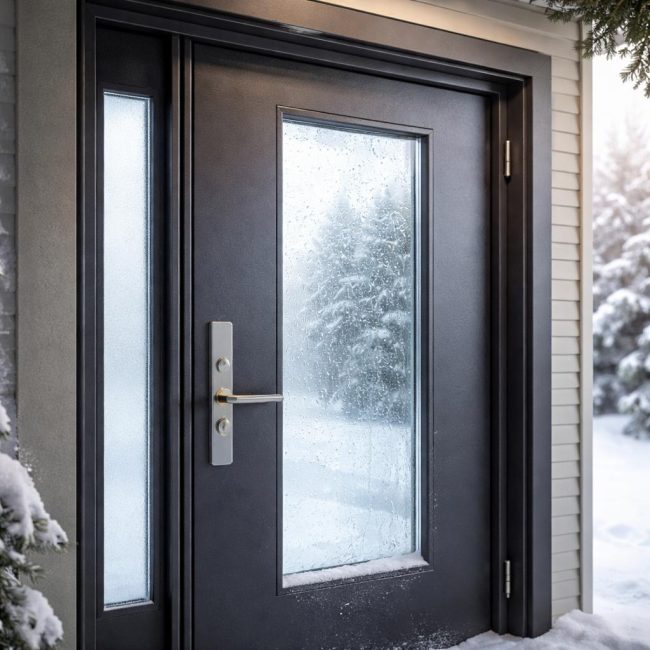
The entrance door to a private home or heated space operates at the intersection of two environments—hot and cold. It undergoes heat flow and experiences changes in temperature, humidity, and air pressure. In this context, combining a thermal break and a window in a single structure seems logical, but not always a straightforward solution. To understand where such a door is justified and where it creates unnecessary compromises, it's important to consider not just the name, but the design and physics of its operation.
- What does a thermal break mean in a door design?
- How a window changes the thermal performance of a door
- Types of glazing used in entrance doors
- The influence of windows on condensation formation
- Where is such a door justified from a functional point of view?
- Design limitations and installation nuances
- Common misconceptions surrounding these doors
- How to correctly perceive this construction
What does a thermal break mean in a door design?
A thermal break is not an additional layer of insulation or a "warm filling," but rather a fundamental separation between the inner and outer parts of the door leaf and frame. Between them, a low-thermal-conductivity material is placed, which interrupts the direct path of cold transmission through metal or a dense structural element.
In metal doors without a thermal break, the outer sheet, inner sheet, and frame form a single heat-conducting circuit. At subzero temperatures outside, cold air passes unimpeded into the structure, resulting in the inner surface of the door cooling, and condensation forming in the area of contact with warm air. A thermal break eliminates this effect—it doesn't so much "insulate" as eliminate the thermal bridge.
In practice, a thermal break is implemented as an insert made of polyamide, PVC composite, or another stable material, integrated into the profile of the door leaf and frame. It is important that the break be continuous: a partial or imperfect element will not solve the problem.
How a window changes the thermal performance of a door
A window in a door always weakens the enclosing power, even if double-glazed units are used. Glass conducts heat worse than metal, but worse than insulated multilayered fillings. Furthermore, it's more difficult to ensure complete airtightness and uniform temperature distribution in the glazed area.
When a window is added to a door with a thermal break, a contradiction arises: one part of the structure is designed to break the heat transfer, while the other is inherently colder. As a result, the overall thermal performance of the door is determined not by the best part, but by the weakest part.
This doesn't mean a door with a window "doesn't work." However, its properties will differ from those of a solid door with the same thermal break, and these differences need to be taken into account in advance.
Types of glazing used in entrance doors
Thermally broken doors typically use compact double-glazed units rather than single glass. These are most commonly:
- double-chamber or single-chamber glass units with energy-saving coating;
- tempered glass or triplex to increase mechanical stability;
- small inserts located outside the lock and hinge area.
Even with this design, the glazing remains an area of increased heat flow. Therefore, the window size and its location are crucial. A narrow vertical insert or transom behaves differently than a large central pane.
The influence of windows on condensation formation
One of the reasons people choose thermally broken doors is to combat condensation and ice buildup on the interior surface. This task becomes more difficult when there's a window. Glass cools faster than insulated glass, and in high humidity, it's the glass that first becomes wet.
If the double-glazed unit is properly selected and the room's ventilation is stable, condensation may not occur. However, in a cold climate, high humidity, and large glazing, the risk remains. In this regard, a door with a thermal break and a window requires more careful consideration of operating conditions than a solid structure.
Where is such a door justified from a functional point of view?
In practice, doors with a thermal break and a window are most often used in three scenarios:
- Entrance to a private house with a vestibuleThe vestibule reduces temperature fluctuations, and the door window is no longer a critical point. At the same time, natural light in the hallway remains beneficial.
- Doors to heated outbuildings, verandas, workshopsVisual connection and lighting are important here, while heat loss is not as sensitive.
- Architectural solutions with limited glazing areaWhen the window plays a supporting role and does not dominate the design.
In conditions where there is direct access from a warm room to the street, especially in regions with persistent frosts, such a door becomes a compromise between light and thermal insulation.
Design limitations and installation nuances
The presence of a thermal break and a window increases the demands on manufacturing and installation precision. Errors that would be barely noticeable in a standard door become critical here. These include:
- skew of the box, disrupting the pressure in the glazing area;
- breaks in the sealing contour around the glass unit;
- use of fittings that are not designed for temperature deformations.
Furthermore, the installation area around the frame must be insulated and protected from drafts. A thermal break within the frame does not compensate for the cold installation joint.
Common misconceptions surrounding these doors
One of the most common misconceptions is the expectation that a door with a thermal break and a window will be equivalent in thermal insulation to a solid door without glazing. This is physically impossible: the presence of glass always changes the balance.
Another misconception concerns universality. Such a door is not the "best option for all situations." It solves specific problems—a combination of thermal break and light transmission—but at the cost of increased design complexity and environmental requirements.
How to correctly perceive this construction
A door with a thermal break and a window isn't a compromise in the negative sense, but a deliberate balance of characteristics. It provides light, visual lightness, and reduces the effect of freezing of the metal part, but it requires an understanding of the limitations.
With proper entryway design, climate considerations, and proper installation, such a door can operate reliably and without problems. If these factors are ignored, the window itself becomes a source of disappointment—not because the design is flawed, but because it was expected to perform properties it inherently lacks.
In this sense, choosing a door with a thermal break and a window is not a matter of fashion or an "improved version," but a matter of compliance with the specific conditions of the home and the real tasks that the entrance area must solve.