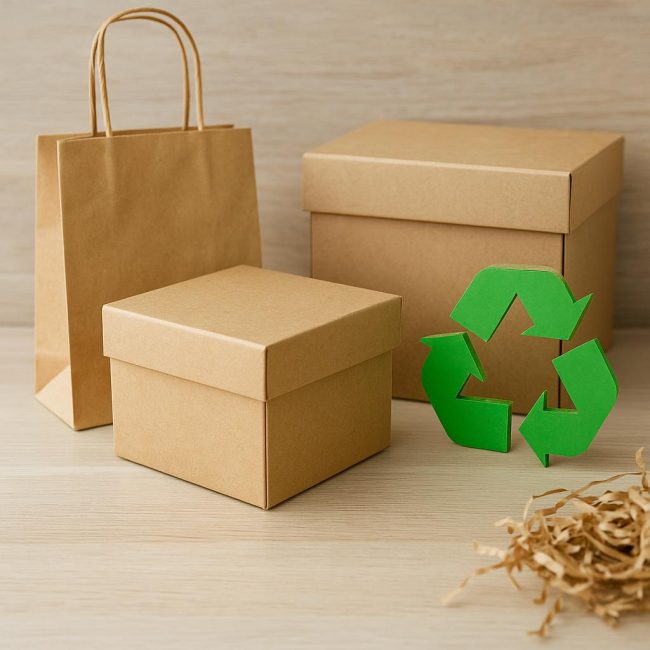
In today's competitive environment, packaging has ceased to be simply a protective shell for a product. It has become an independent marketing tool, influencing brand perception, consumer emotions, and even repeat purchase decisions.
Even before customers see the product itself, they evaluate the packaging. Therefore, even the choice of where to purchase packaging boxes becomes part of the marketing strategy, as the package's appearance builds trust and expectations. The way a brand presents its products influences not only the first impression but also whether consumers associate the company with quality, care, and responsibility.
Today, this choice is increasingly driven not by design or price, but by environmental considerations. People want to receive their orders in boxes that can be recycled or reused. Businesses, in turn, see this not just as a passing fad, but as an opportunity to demonstrate awareness and a modern approach. Thus, eco-friendly packaging is becoming an important part of corporate philosophy and a competitive advantage.
- Why the eco-trend has become part of business culture
- Materials of the Future: What's Replacing Plastic?
- Eco-friendly packaging as a marketing tool
- The Economics of Ecotrends: Is It More Expensive to Be Responsible?
- Consumer Behavior: Why People Choose Eco-Friendly Packaging
- How businesses can implement eco-friendly solutions
- The Future of Sustainable Packaging
- Conclusion: Sustainability as a strategy, not a fashion
Why the eco-trend has become part of business culture
The growing interest in eco-friendly packaging is linked to several global trends. First, consumers have become much more aware. They know that plastic takes hundreds of years to decompose, while paper and cardboard products can be recycled several times without significant loss of quality. Second, governments and international organizations have increased pressure on companies to reduce waste and switch to recycled materials.
Moreover, eco-friendly packaging has become a reputational tool. When customers see that a company uses recycled cardboard and minimizes the use of paint or glue, they perceive the brand as progressive, responsible, and modern. This is especially important for younger consumers—Generation Z—who make informed choices based not only on price but also on ethical principles.
Materials of the Future: What's Replacing Plastic?
The modern packaging market is actively seeking alternatives to synthetic materials. Biodegradable and recycled solutions are the main areas of development.
- Cardboard and paper. These are the most common and readily available materials. They are easily recycled, inexpensive, and yet allow for the creation of durable boxes for a wide variety of products, from cosmetics to electronics.
- Biodegradable polymers. PLA and PHA are next-generation plastics made from corn starch, sugar, or vegetable oils. They biodegrade naturally, without polluting soil or water.
- Combined solutions. Manufacturers often use cardboard with a thin layer of biopolymer to ensure moisture resistance without harming the environment.
- Secondary raw materials. Increasingly, packaging is being made from recycled materials—waste paper, recycled cardboard, and even fabric.
The trend is clear: the less plastic and the more natural, renewable resources, the higher the value of the packaging in terms of ecology and brand image.
Eco-friendly packaging as a marketing tool
For modern businesses, sustainability is not only a concern for the planet but also a marketing advantage. Companies that use eco-friendly boxes often indicate this on their website or directly on the packaging. The phrase "100% recyclable" or "eco-friendly packaging" has become a kind of seal of quality.
It is important not to slip into the so-called greenwashing — when a business pretends to be environmentally friendly while in fact continuing to use harmful materials. For example, if a brand claims "eco-friendly packaging" but uses laminated cardboard with a plastic coating, this creates distrust in consumers.
True sustainability is in the details: minimal adhesive, recyclability, reasonable material thickness, and the elimination of unnecessary printing and plastic foil.
The Economics of Ecotrends: Is It More Expensive to Be Responsible?
One common misconception is that eco-friendly packaging is significantly more expensive. In fact, with the right approach, costs can actually be reduced.
For example:
- Cardboard boxes are easy to stack and take up less space in the warehouse;
- Reducing the weight of packaging reduces transportation costs;
- standardized box sizes allow for optimization of logistics;
- and the elimination of bright multi-layer materials reduces printing costs.
Yes, a company may initially spend a little more on the transition—finding a supplier, testing materials, and changing packaging processes. But in the long run, eco-friendly solutions prove more beneficial not only financially but also reputationally.
Consumer Behavior: Why People Choose Eco-Friendly Packaging
Today's shoppers don't want to feel guilty about their purchases. When they receive their order in a recyclable box without excess plastic, they feel a sense of participation in a common cause. It's an unconscious, yet powerful, sense of belonging to the global movement "for a cleaner planet."
Moreover, beautiful, simple, and eco-friendly packaging has become part of the minimalist aesthetic. People appreciate neat and natural-looking packaging: craft cardboard, soft colors, and minimalist graphics—all of this is associated with brand honesty and transparency.
How businesses can implement eco-friendly solutions
- Analysis of current packaging. Where to start is to understand what materials are currently used and whether they can be replaced.
- Selection of suppliers. Find manufacturers that offer recyclable materials. It's important not just to buy boxes for packaging your product, but to ensure they truly meet environmental standards.
- Waste minimization. Use of standard sizes, reduction of decorative elements, rejection of unnecessary inserts.
- Informing clients. Place an explanation on the packaging or website about how it can be recycled.
- Implementation of feedback. Reward customers who return or reuse packaging.
Small steps gradually shape a larger strategy. Even if a company starts small—switching to kraft cardboard—it will already be an investment in sustainable development.
The Future of Sustainable Packaging
Every year, technology improves: stronger biopolymers are emerging, paper is becoming moisture-resistant without chemical additives, and cardboard is being produced from fast-growing plants such as bamboo or reed.
In the future, packaging will likely be more than just a means of protection, but part of a closed cycle—where each box can become raw material for a new one.
The direction is also actively developing smart packaging (smart packaging), which combines eco-friendliness with functionality. For example, biodegradable labels indicating expiration dates or product condition. This is not only convenient but also reduces food waste—another important component of sustainability.
Conclusion: Sustainability as a strategy, not a fashion
Eco-friendly packaging is no longer a niche trend. It's the standard for a new generation of businesses. Companies that implement sustainable solutions today will be leaders tomorrow. After all, customers are becoming increasingly demanding, and brand trust is directly dependent on how honest they are in their environmental claims.